
Part 4 of our series on AI visibility for hotels
Why this topic matters now
The first three parts of this series (links below the article) looked at how your hotel becomes visible to AI systems such as ChatGPT, Gemini or Google AI Overviews. But AI is not only changing how guests find a hotel — it is also changing how a hotel works internally. A recent industry survey of more than 500 businesses shows that AI has long since arrived in day-to-day operations, from reception to housekeeping. The real challenge today is no longer whether to use AI, but where it genuinely helps — and where it causes more trouble than benefit.
The problem in everyday hotel operations
Many hotel businesses know this pattern: one team member tries ChatGPT for an email reply, another uses a translation tool for guest messages, a third person tests a chatbot provider — and after a few weeks it all fizzles out. The reason is rarely the technology itself, but the lack of a clear answer to three questions: What exactly do we use AI for? Who is responsible for it? And how do we make sure guests never feel left alone with a machine? Without this clarity, AI in a hotel remains a collection of isolated attempts rather than a genuine tool.
Current findings from studies and practice
Several recent analyses show where AI actually makes a difference in a hotel's daily business:
- Up to 50 percent of all guest communication consists of the same questions asked over and over — about check-in times, parking or breakfast hours, for example. This is exactly where AI-supported communication is most effective.
- Hotels using AI in guest communication report 25 to 35 percent fewer repetitive requests at reception — freeing up time for personal guest contact and more complex matters.
- 82 percent of hotels expect their use of AI to increase further over the coming year, and 71 percent already report a noticeable impact — guest communication is most often cited as the area with the greatest effect.
- Digital guest communication is increasingly seen as a fixed part of the entire guest journey — no longer an isolated add-on tool, but part of the process from booking through to departure.
- Study authors explicitly recommend making the benefit of AI use measurable — for example through time saved at reception, additional sales per guest or a higher review rate, rather than introducing AI based on a "feeling".
What does this mean for your hotel?
1. Start with the questions that keep repeating
Not every area of hotel operations is equally suited to AI. The greatest and fastest benefit arises where questions constantly repeat themselves: arrival, parking, WiFi, breakfast times, room amenities. These topics can be answered well through automation without losing the personal touch — because no individual touch is needed here anyway.
2. Define where the line to a human lies
A complaint, a special request, an emotional concern: such situations should always land with a person. Agree within your team which requests the AI may answer directly, and at what point it is automatically handed over to a person. This boundary matters more than the choice of tool.
3. Measure the benefit, don't just assume it
Before introducing an AI tool, define a simple metric — for example the number of reception enquiries per week or the average response time to guest messages. Only this way can you say after a few months whether the effort was worthwhile, instead of relying on a vague sense that "it's helping somehow".
Practical example: a family hotel in the Bernese Oberland
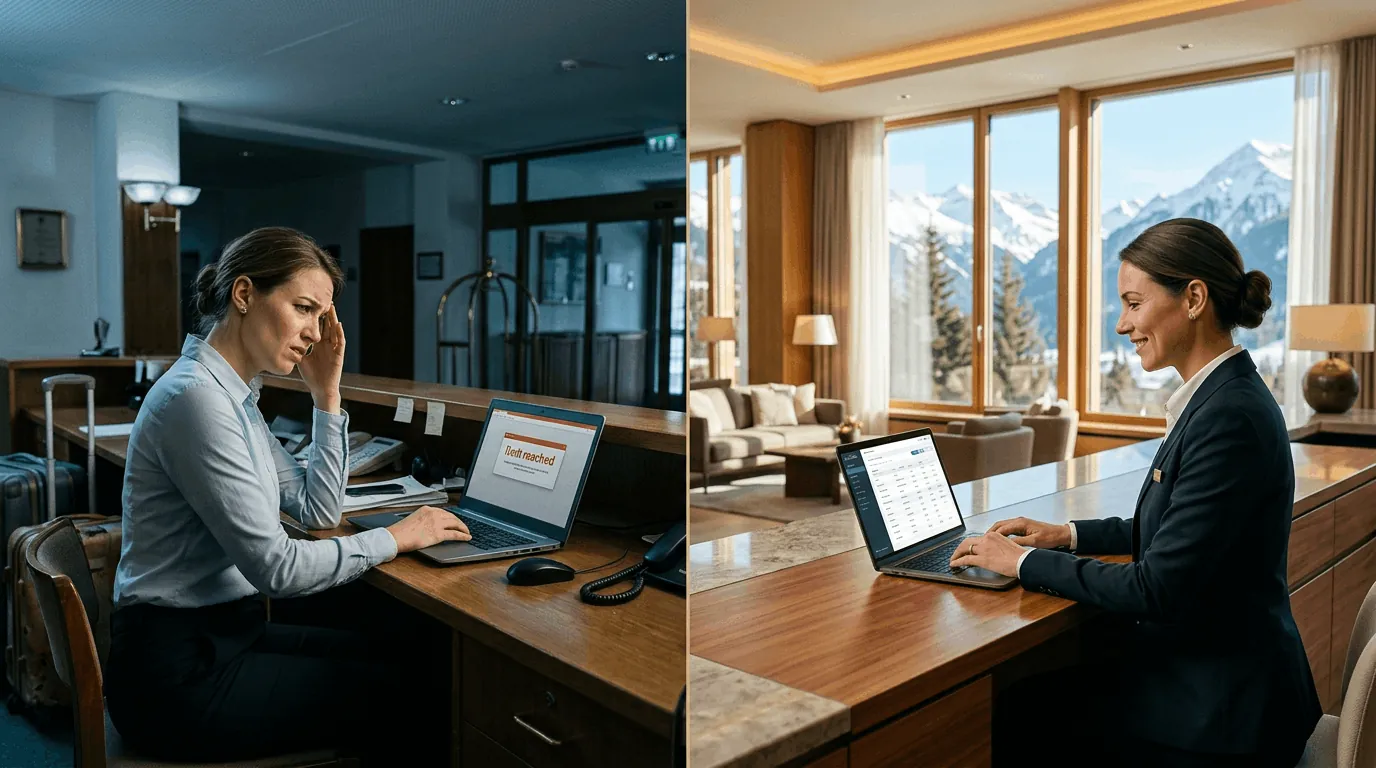
Starting point: A family hotel with 45 rooms received around 30 emails and WhatsApp messages with guest questions every day — most of them about arrival, parking and half board. This regularly blocked the reception, especially during the busy afternoon hours.
Measure taken: The hotel introduced a simple AI-supported chat on the website and in WhatsApp that automatically answers the ten most common questions. The reception team continues to handle all other matters. The rollout was communicated to the team, including a short list of which questions the AI is allowed to answer.
Result (fictional example, realistically derived from study figures): After two months, the number of manually answered standard enquiries dropped by around a third. In the afternoon hours, reception could focus more on check-ins and personal matters. Response time to more complex enquiries improved measurably, because less time was lost on repeated questions.
Common mistakes
- Introducing AI without clear responsibility. If no one on the team is accountable, a tool goes unmaintained and quickly becomes outdated.
- Automating too much at once. Handing all guest enquiries over to AI immediately risks unsuitable answers on sensitive topics and frustrated guests.
- Not measuring success. Without a simple metric, it is impossible to judge later whether the introduction was worthwhile — and decisions remain gut feeling instead of fact.
Conclusion
AI in everyday hotel operations is not an end in itself, nor is it a thing of the future anymore — for many businesses it is already lived practice, especially in guest communication. The difference between a business that truly benefits and one that abandons AI again rarely comes down to the tool itself. It comes down to whether there is a clear idea of what AI is used for, where the boundary to personal contact remains, and how the benefit is reviewed. Take the time to clarify these three points for your business before choosing a tool — that is worth more than the search for the "perfect" software.
Sources
- Study: AI is now part of everyday life for hotels — Tophotel.de
- Study on digitalisation in hotels — HOGAPAGE
- AI customer service for the hotel industry: what really works (2026) — eesel AI
- How can hotels better manage the growing flood of guest information? — Hospitality Pioneers
More related articles:
- How visible is your hotel really — on Google and in ChatGPT & Co.? (Part 1 of the series)
- Why a "beautiful website" is not enough (Part 2 of the series)
- How to write texts that an AI actually uses as an answer (Part 3 of the series)
- Why don't hotels have their own AI budget — and what does it really cost? (measuring benefit and justifying investments)
- The illusion of free AI (tool selection and cost/benefit)
- AI in the hotel: start now or wait for the next generation? (getting started with AI use)
- Does AI also threaten jobs in the hotel industry? (the boundary between AI and personal contact)
- What happens if your AI tool is blocked overnight? (risks and dependency on individual tools)
- Radisson now bookable via ChatGPT (contrasting example: AI for guests versus AI in operations)
- Agentic AI: why hotels now need to rethink their booking systems (optional deep dive on automated processes)