The unemployment rate in Switzerland has risen to 5.2 percent — a level not seen since the pandemic. At the same time, American tech companies are laying off tens of thousands of employees and blaming artificial intelligence. The obvious question: will this trend soon reach hotels too? A look at a recent NZZ am Sonntag investigation shows that the answer is more complicated than the headlines suggest.
The problem in everyday hotel operations
Many hoteliers know the feeling of being torn between two poles with every new AI tool. On one side, the hope of finally saving time on administrative work and giving guests more attention. On the other, the concern that employees will perceive automation as a threat — and resist rather than get on board. This uncertainty is not unique to Switzerland. It is currently affecting entire industries, as the NZZ am Sonntag investigation from 12 July 2026 shows.
What the study shows
Journalist Christin Severin spoke with labour market economists and industry representatives for NZZ am Sonntag. The key findings:
- Unemployment has indeed risen, but AI is not the main reason. According to Michael Siegenthaler, professor of labour market economics at ETH Zurich, AI accounts for at most one fifth of the rise in unemployment between 2023 and 2025. The rest is due to the war in Ukraine, the energy shock, US tariff policy and the weak economy.
- Mainly clearly defined, text-heavy occupations are affected. IT professionals, marketing and communications specialists, journalists, translators and proofreaders show above-average unemployment figures. The hotel industry does not appear on this list.
- Perceived insecurity is greater than the actual danger. Marius Osterfeld, chief economist at Swissstaffing, speaks of "Fobo" — the "fear of becoming obsolete". This fear affects mainly well-educated, younger employees in industries that have so far had low unemployment.
- Experience is regaining value. Because AI systems still make mistakes, companies are bringing experienced professionals back into decision-making positions. Carmaker Ford, for example, rehired 350 engineers after automated systems had overlooked quality problems.
- AI can also create jobs rather than destroy them. In a call centre described in the article, employees' sales conversion rate rose from 2 to 25 percent thanks to AI support. More revenue per employee means that, in such cases, additional hires become worthwhile again.
- Even Sam Altman is backpedalling. The OpenAI chief publicly admitted at the end of May 2026 that he had overestimated AI's impact on the labour market.
What does this mean for your hotel?
1. Pro: AI can create capacity without putting jobs at risk
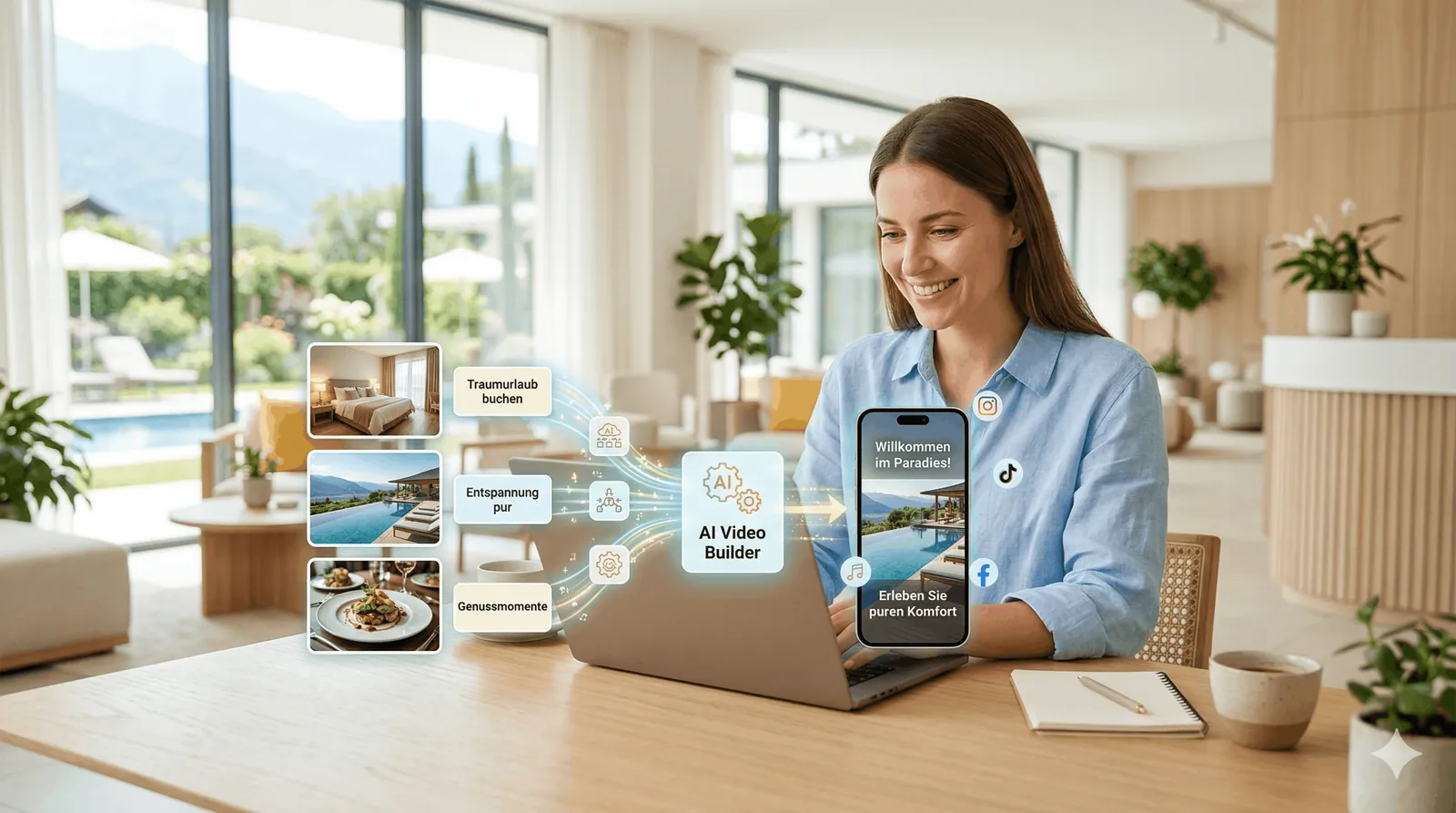
The hotel industry is in the fortunate position that its core task — personal contact with guests — can hardly be replaced by software. AI sensibly takes over routine work: drafting responses to standard enquiries, pre-sorting booking requests, monitoring prices. This relieves employees rather than replacing them. As in the call centre example from the article, AI can even mean that additional staff become worthwhile again, because each employee generates more revenue.
2. Con: uncertainty within the team costs motivation
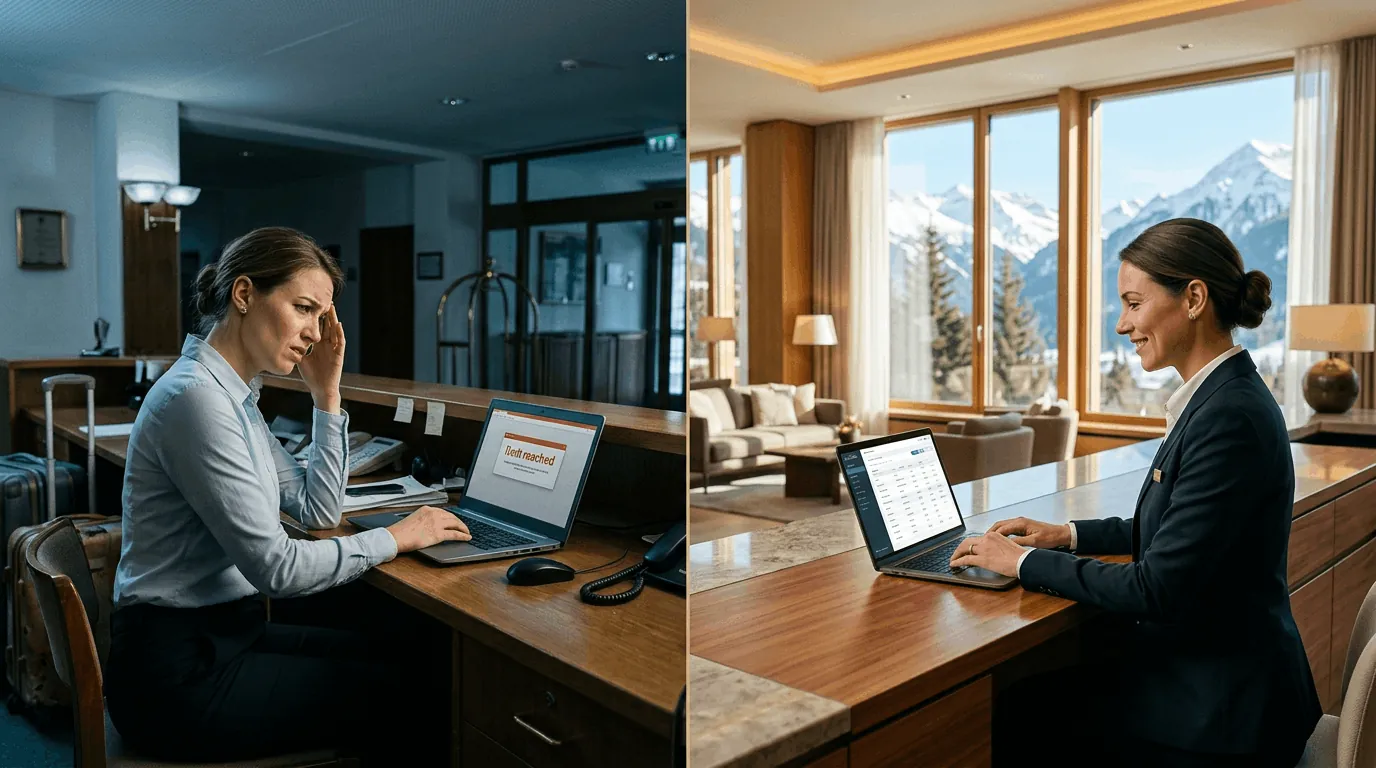
Anyone who introduces AI tools to their team without explanation risks exactly the opposite of the intended effect. The "Fobo" described in the article also affects reception, reservations and sales. Employees who fear being made redundant are unlikely to commit fully to new tools. This is especially true for smaller businesses without their own HR department, where every unsettled person stands out immediately.
3. The reality: experience remains the trump card
The article clearly shows that experienced professionals are gaining in value because AI systems continue to make mistakes. For the hotel industry, this means: long-standing employees who know the guests, the processes and the exceptional situations are not obsolete. They are the benchmark against which every AI tool in the business must be measured.
Practical example: a mountain hotel faces uncertainty openly
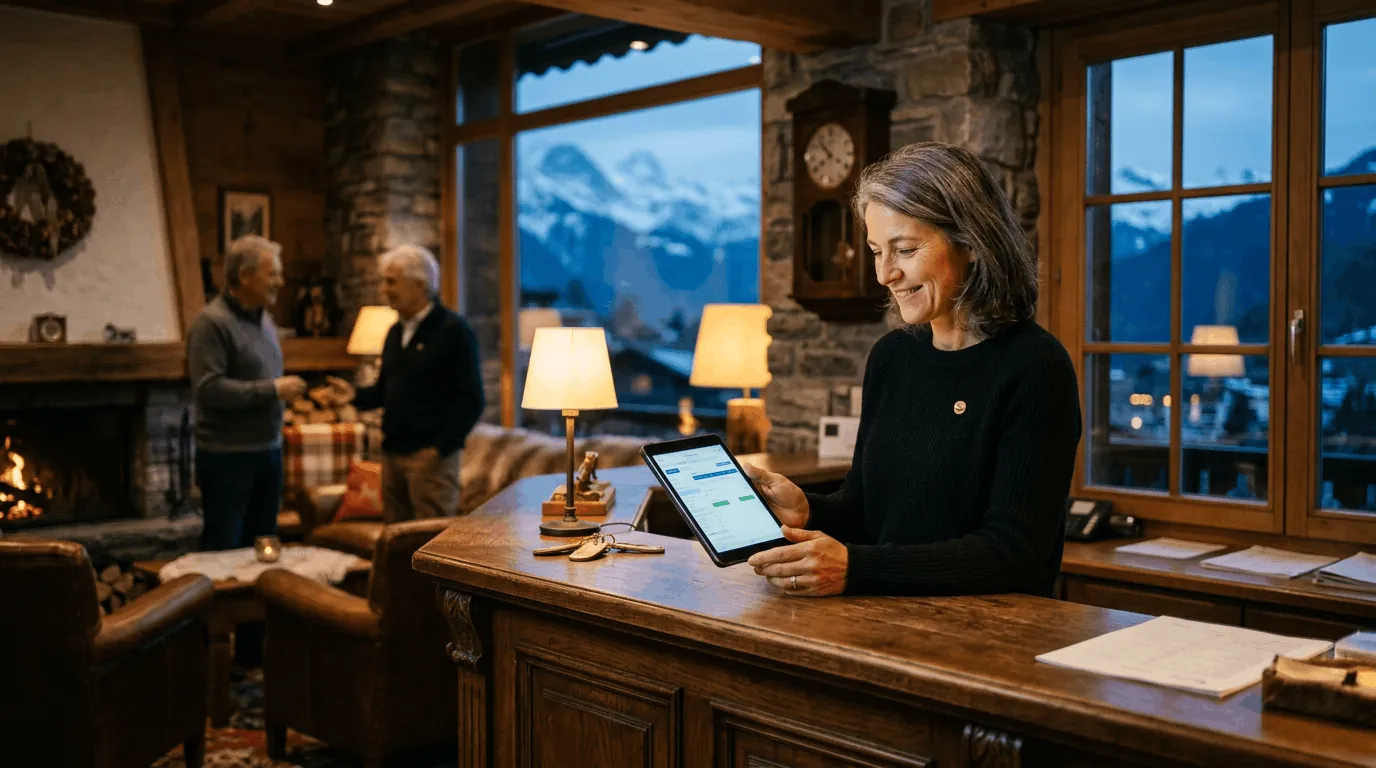
A fictional 45-room mountain hotel in the Bernese Oberland noticed that reception staff were reacting with increasing concern to a newly introduced AI tool for answering email enquiries. Instead of simply rolling out the tool, management organised a short, mandatory workshop: What exactly does the AI do? Which tasks remain with people? Where does reception still make the decisions? The team jointly drew up a list of enquiries the AI is allowed to prepare, and others that are always answered personally. Result: processing time per enquiry dropped noticeably, the complaint rate remained stable, and team morale improved measurably — because no one felt they were being secretly replaced.
Common mistakes
- Introducing AI tools without involving the team. Imposing software from above creates resistance instead of curiosity.
- Blaming every poor figure on AI. As described in the article regarding the banking sector, AI easily becomes a scapegoat for management decisions that actually lie elsewhere.
- Underestimating experiential knowledge. Businesses that rely purely on automation and reduce long-standing staff risk facing exactly the quality problems that forced Ford to rehire 350 engineers.
Conclusion
The headline "job apocalypse" sounds dramatic, but it only partly holds up under analysis. For the Swiss hotel industry, this means: AI is not currently replacing jobs on a large scale, but it is changing which skills are in demand. Those who involve their team early, value experiential knowledge and use AI where it genuinely provides relief have little to fear. Those who stay silent and ignore concerns, on the other hand, risk exactly the kind of uncertainty that harms their own business the most. So the real question is not "Will AI replace our employees?" but "How well are we preparing our team to work alongside AI?"
Sources
- Christin Severin: "Kommt die Job-Apokalypse?", NZZ am Sonntag, 12.07.2026
- Michael Siegenthaler, ETH Zurich, professor of labour market economics (quoted in NZZ am Sonntag, 12.07.2026)
- Marius Osterfeld, chief economist, Swissstaffing (quoted in NZZ am Sonntag, 12.07.2026)
- Georg Därendinger, Interpharma (quoted in NZZ am Sonntag, 12.07.2026)
- Quartz: report on the rehiring of engineers at Ford (quoted in NZZ am Sonntag, 12.07.2026)
More related articles
- AI in hotels: start now or wait for the next generation? (related fundamental question)
- Why don't hotels have their own AI budget (complementary perspective: investment instead of fear)
- The illusion of free AI (practical use of AI in daily operations)