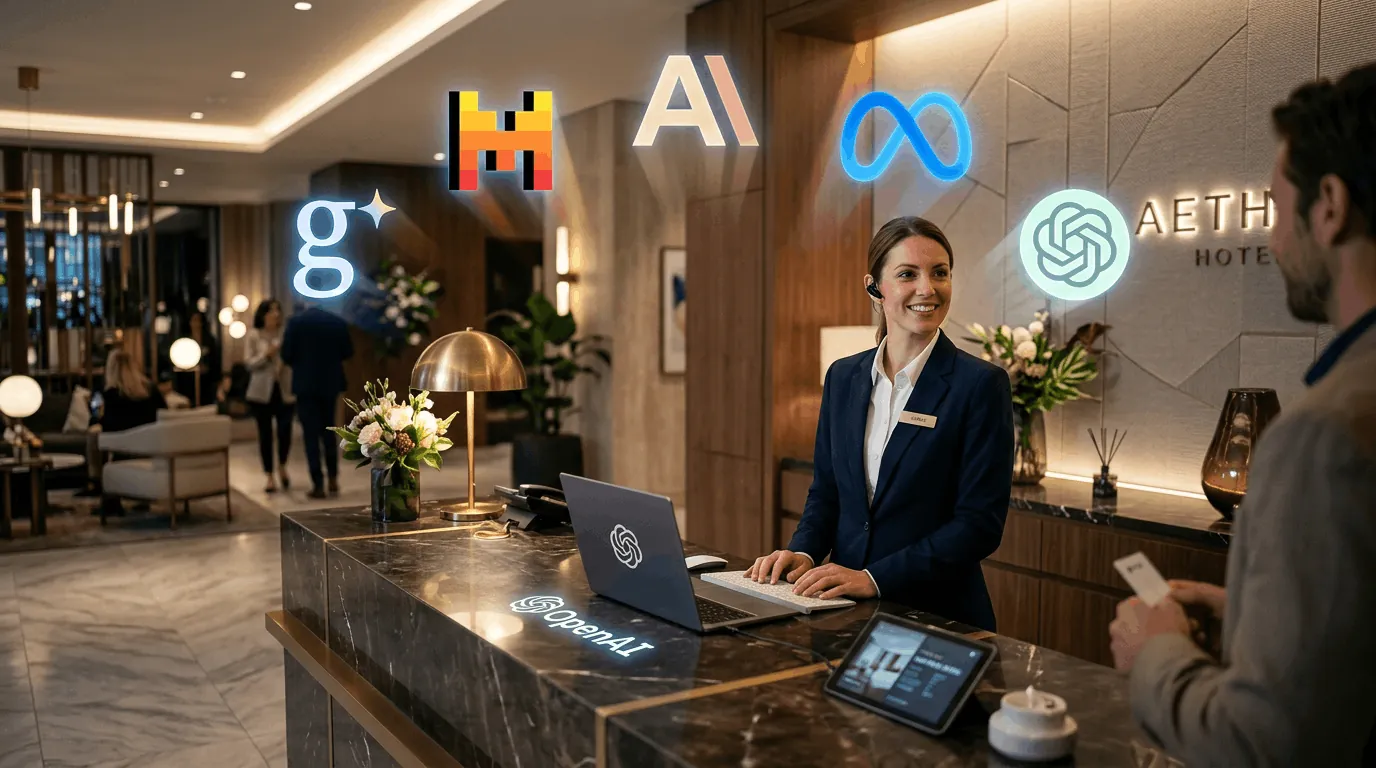

Every hotel has a laundry budget. But no AI budget.
Anyone running a hotel today plans budgets for cleaning, breakfast, staff, advertising. Sometimes even for new coffee machines. But a dedicated budget for Artificial Intelligence? That's simply missing in most businesses – not out of disinterest, but because AI is still seen as a "tech topic" that's supposed to disappear somewhere into the IT pot. That's a mistake. And it gets more expensive the longer it persists.
The problem: AI runs on a shoestring – or not at all
Most hotels using AI do so half-heartedly. Someone signed up for a free ChatGPT account, writes the occasional text with it, and that's it. No plan, no budget, no accountability. The result: the possibilities remain unused, competitors pull ahead – and the team has no idea what AI could actually deliver.
This isn't a criticism. It's a structural problem. If you have no budget, you can't make a decision. And if you don't make a decision, you stay with the status quo.
What the numbers say
Three recent studies show how wide the gap is between intention and reality:
82% of hotels plan to expand their AI use in 2026 – according to the report "Navigating AI: Hospitality Shifts From Exploration to Execution" by Canary Technologies. At the same time, 85% of these businesses already see AI tools as a fundamental operational requirement, not an experiment.
Fewer than 10% of hotel companies worldwide have advanced AI capabilities – this is shown by a cross-industry analysis from Boston Consulting Group (BCG, March 2026). The rest are still in the testing phase or haven't started at all.
Integration and know-how are missing – the global study "AI & Automation in Hospitality 2025" by h2c GmbH, supported by 15 leading hospitality IT providers, concludes: hotel chains are investing in AI, but competence and central governance remain patchy. Over 40% of respondents expect reservations, guest data management, and digital marketing to be fully automated within five years – but the foundations for this are still missing today.
2026 is the decision year – according to the Hospitality Industry Outlook by Mews. Those who don't act now will have to catch up in 2027. And catching up costs more than thinking ahead.
What this means for your hotel
1. Without a budget, there is no strategy
AI doesn't run itself. Anyone who wants to work seriously with it – for texts, guest communication, review responses, market analysis, price optimisation – needs tools that work. Paid versions of common AI platforms cost between 20 and 100 francs per month and user. This isn't an IT project. It's a marketing budget line item that pays for itself.
Those who define no budget de facto opt for the free version – with all its limitations: less performance, no enterprise-level data security, no support.
2. AI needs someone to lead it
An AI tool without clear accountability is like a new employee without onboarding. It sits there, does something, and nobody quite knows what. The same applies to AI: someone in the business must know what it's used for, how the results are checked, and where the limits are. That takes time – and time costs money. That belongs in the budget too.
3. ROI is measurable – if you measure it
Hotels that use AI in a structured way report concrete time savings: review responses in a third of the time, texts for the website and newsletter in minutes instead of hours, faster analysis of booking data. This isn't a marketing promise. These are hours that can be used elsewhere. If you don't measure it, you don't see the benefit – and it's the first thing cut in the next round of savings.
Practical example: Berghotel Alpenruh (fictional, but realistic)
The Berghotel Alpenruh in Graubünden, 28 rooms, family-run, defined a small AI budget for the first time in January 2026: 80 francs per month for two staff members, plus four hours of introductory training.
Starting point: The front desk manager wrote review responses manually, often in the evening after her shift. Newsletters were sent irregularly because there was "no time". The website texts dated from 2021.
Measures: With the AI access, review responses were reduced to a tenth of the time. The front desk manager gives the AI the key points, checks and adjusts – done. The newsletter now appears monthly, because the first draft is ready in 15 minutes. Three new room descriptions were revised in one afternoon.
Result after four months: The review rate on Google rose because responses come faster. The newsletter has an open rate of 38%. And the front desk manager no longer works on texts in the evening.
Total cost: 320 francs. Time saved: an estimated 6–8 hours per month.
Three mistakes that typically go wrong
Mistake 1: AI is tried out, but not implemented.
Someone tests ChatGPT, finds it "quite nice", and puts it aside again. Without clear use cases and a brief introduction, AI remains a toy.
Mistake 2: the budget is hidden in the IT pot.
AI for marketing, communication, and guest experience is not an IT topic. It belongs in the marketing budget – with clear goals and measurable results.
Mistake 3: waiting for the "perfect solution".
There isn't one. The tools develop further week by week. Those who wait until everything is perfect never start. Better: start small, learn, adjust.
Conclusion
AI is no longer a trend. It's infrastructure – like the Wi-Fi in the room or the booking system at the front desk. Anyone who doesn't budget for it leaves the field to those who do. It doesn't have to be a large budget. But it has to be a deliberate one: with a clear purpose, a responsible person, and a standard against which the benefit is measured. The first step isn't the perfect AI strategy. The first step is the decision that AI has a place in the budget.
Sources
- Canary Technologies: "Navigating AI: Hospitality Shifts From Exploration to Execution", 2026 – money-tourism.gr
- Boston Consulting Group: "AI Disruption in Hospitality. Building an AI-First Hotel Company", March 2026 – hotelinside.ch
- h2c GmbH: "AI & Automation in Hospitality 2025" – tageskarte.io
- Mews: "Hospitality Industry Outlook 2026" – tageskarte.io
- ahgz / h2c: "Study: AI is everywhere, but know-how and budget are missing" – ahgz.de
More related articles
- The illusion of free AI (directly related topic: cost/benefit)
- AI in the hotel: start now or wait for the next generation? (call to action)
- What happens if your AI tool is blocked overnight (risk management for AI investment)