Millions of people use the free versions of ChatGPT, Claude or Gemini every day – and draw completely wrong conclusions about the actual performance of Artificial Intelligence. Judging AI today based on the free version is essentially like comparing an old feature phone to a modern smartphone. For hotels that really want to integrate AI into their operations, this is a costly misunderstanding – because it costs not money, but time and potential.
The problem in everyday hotel operations
Many hoteliers have already tried ChatGPT or a similar tool. And many have set it aside again afterwards – because it "didn't really help". What lies behind this: they used the free version. For occasional, simple tasks, it does deliver usable results. But anyone who works with it daily – drafting guest inquiries, commenting on reviews, writing offers – quickly notices: the quality of the output often isn't sufficient for professional use. Texts need more editing. Answers don't match the tone of the house. More complex tasks overwhelm the model.
This is the "illusion of free AI": the free version doesn't show what AI can really do. It shows what AI can do when you hand it the weakest tools.
What the numbers show
The differences between the free and paid version are bigger than many assume – and they lie less in usage limits than in model quality:
- Free versions run on weaker models – without access to reasoning functions, agents or internet access. These are not minor details, but the actual strengths of modern AI.
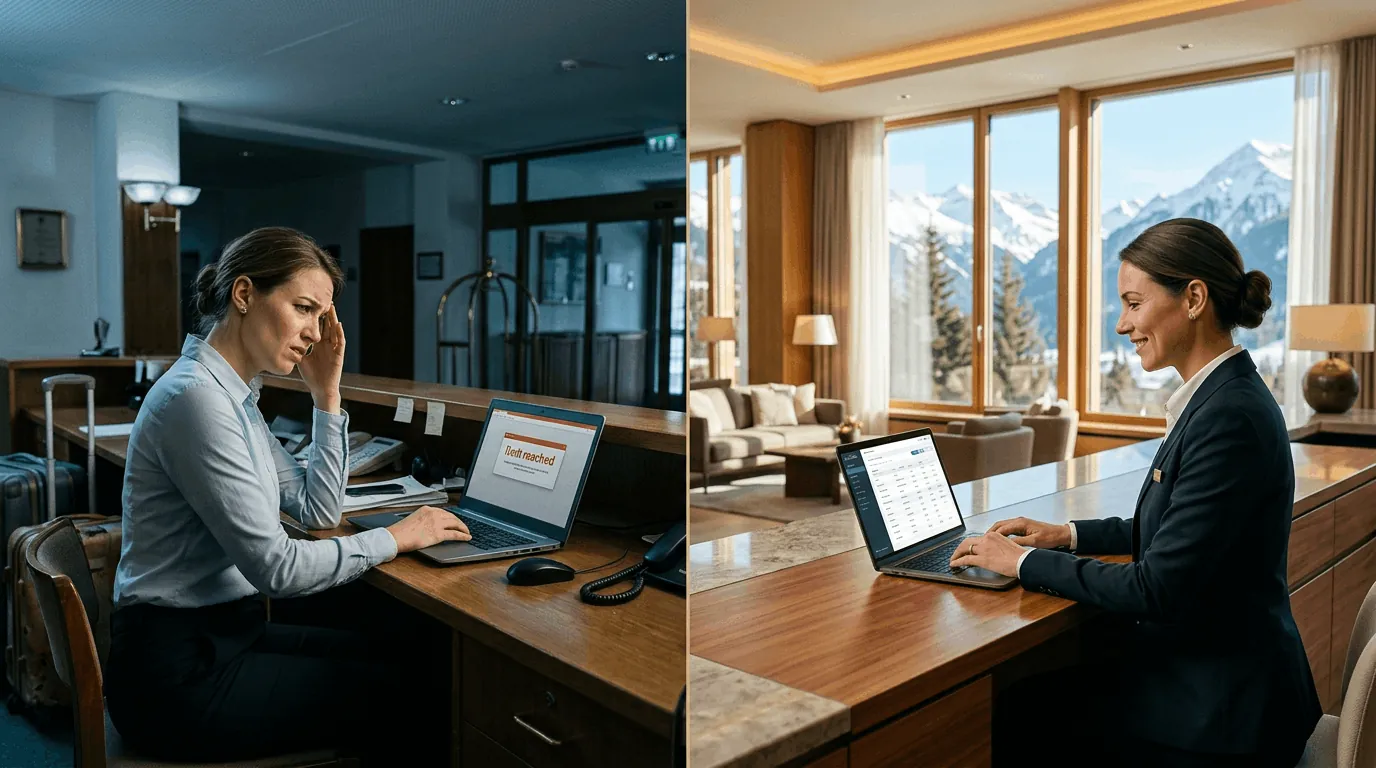
- If the limit is reached anyway, quality drops: ChatGPT then automatically switches to a weaker mini model – exactly at the moment when you need the tool most.
- A Harvard Business School study showed 25% time savings among knowledge workers who used AI tools intensively – provided they had access to powerful models.
- ChatGPT has around 35 million paying users worldwide (2026) – a clear signal that the added value of the paid version is evident to many.
- AI tools can increase productivity in customer service by 30–45% when used regularly and with the more powerful models.
- The paid version of ChatGPT (Plus) has cost around 20 US dollars per month unchanged since launch – with significantly expanded functionality.
What does this mean for your hotel?
1. No limit – no interruption in the workflow
For most users, the free version doesn't hit its limit in everyday use as quickly as often feared. The real problem is a different one: if the limit is reached anyway, the tool automatically switches to a weaker mini model – without warning. The quality of the output drops at exactly the moment you need the tool most. The paid version guarantees continuous access to the most powerful model – reliably, without drops in quality.
2. Better models – noticeably better results
The free version uses older or weaker models. The paid version gives access to the latest versions – with better language understanding, more precise answers and the ability to handle more complex tasks. Added to this are so-called reasoning models: AI that doesn't simply answer, but first "thinks" – step by step, like an experienced employee. For hotels, this means: texts that need less editing. Answers that better match the tone of your house.
3. Internet access, agents and real automation
Many paid versions can access current information on the internet and – even more importantly – work as agents: this means the tool carries out several steps independently, without you having to trigger each step individually. Relevant for hotels: research on competitors, automated compilation of offers, or processing guest feedback from various sources. The free version doesn't have these functions.
Brief digression: aren't free models constantly improving?
A legitimate question – and the honest answer is: yes, partly. In May 2026, Google launched Gemini 3.5 Flash, a model that is available for free and works at nearly Pro level in many areas. For occasional, simple tasks, this is indeed a strong option.
Nevertheless, structural limits remain that quickly become noticeable in everyday hotel operations:
- Usage limits also apply to Gemini 3.5 Flash – anyone using the tool intensively and daily will hit them.
- Data protection: in the free version, inputs may under certain circumstances be used for model training. For sensitive guest communication or internal operational data, this is problematic.
- No team functions: shared templates, uniform settings or shared access for multiple employees are not provided for in the free version.
- Gemini 3.5 Pro – the even more powerful variant – is paid and designed for professional use.
So the models are getting better – but the structural differences between free and paid remain. For a hotel that wants to use AI as a real working tool, "free" continues to not be enough.
Brief digression: is open-source AI an alternative?
Some hoteliers ask whether free open-source AI (e.g. Llama or DeepSeek) can be used to bypass the paid version. The honest answer: running it yourself requires powerful hardware – often worth several thousand francs. This is not a realistic option for most hotel operations. Open-source models make sense where large companies build their own systems. For everyday hotel use, the rule is: the paid version of an established provider is the simpler, cheaper and more reliable route.
Practical example: Boutique Hotel Alpenstern, Graubünden (fictional example)
Starting position: The Boutique Hotel Alpenstern (18 rooms) used ChatGPT for free for occasional text drafts. The receptionist regularly hit the message limit when processing several guest inquiries one after another. The team concluded: "AI doesn't work for us."
Action: The hotel switched to ChatGPT Plus (approx. 20 CHF/month). At the same time, the owner created three simple templates ("prompts") that the team uses daily: one for guest inquiries, one for review responses, one for newsletter texts.
Result: After four weeks, the team reported that processing guest inquiries goes noticeably faster. The quality of the answers is more consistent – even when different employees are writing. The monthly cost of 20 CHF is more than covered by the time saved. And the team has fundamentally revised its opinion of AI.
Common mistakes
1. Taking the free version as the benchmark.
Anyone who judges AI based on the free version is evaluating a heavily limited demo – not the actual product. This leads to wrong conclusions and missed opportunities.
2. No system, no templates.
An AI tool without clear prompts (instructions) delivers mediocre results – whether free or paid. Added value only arises once the team knows how to address the tool correctly.
3. Trying too many tools at once – or the wrong one for teams.
ChatGPT, Claude, Gemini, Copilot – anyone testing everything at once loses track. For individuals, the rule is: choose one tool, activate the paid version, use it consistently for 30 days. For teams, there is a sensible alternative: so-called AI platforms, which bundle several models (ChatGPT, Claude, Gemini) under one roof. The team works with a single login, shared templates and uniform settings – without every employee having to manage their own subscription. Such solutions are specifically built for enterprise use: with data protection to European standards, access management and the ability to store company-specific content. For hotels with several employees who want to use AI together, this is often the more pragmatic route than five separate individual subscriptions.
Conclusion
The free version of AI tools is not a fair test – it is a business card, not a working basis. Anyone who really wants to use AI in hotel operations needs the paid version. Around 20 to 30 francs per month separate a tool that helps occasionally from one that actually changes day-to-day work. The question is not whether it's worth it. The question is which tasks in the business are still being done manually today, even though an AI tool could take them over in minutes. Anyone who answers that honestly finds the answer to the cost question on their own.
Sources
- Digitale Profis (YouTube), "Die Illusion der Gratis-KI", 2026: youtu.be/8APgQtYXsFw
- OpenAI / ChatGPT plan overview, as of June 2026: openai.com/pricing
- Brynjolfsson et al., "Generative AI at Work", Harvard Business School / NBER, 2023
- Incremys, ChatGPT Statistics 2026: incremys.com
- Master of Code, ChatGPT Statistics in Companies, January 2026: masterofcode.com
- freeacademy.ai, ChatGPT Free vs Plus vs Pro 2026: freeacademy.ai
Related articles
- Why don't hotels have their own AI budget (preceding article on the topic of costs)
- AI in the hotel: start now or wait for the next generation? (getting-started motivation)
- What happens if your AI tool is blocked overnight (risk of tool choice)