Why this topic matters now
Since 2 August 2026, certain transparency obligations under Article 50 of the AI Act apply in the EU. Among other things, they cover AI-generated or AI-manipulated image, video and audio content, as well as transparency requirements for certain AI systems. However, no blanket labelling obligation for every hotel text created with AI can be derived from this. What matters is the content, the form of use and the applicable rules in each case.
The problem in everyday hotel operations
AI has long since arrived in the daily routines of many hotel businesses – often without much discussion. Room photos are brightened or "prettified" with AI tools. Texts for the website, for Booking.com or for Instagram are created or revised with ChatGPT or similar tools. Virtual tours are supplemented with AI-generated elements. This is practical and saves time – but until now, hardly anyone has thought about whether and how this needs to be labelled. The AI Act changes this fundamentally.
What the EU AI Act specifically requires
Here are the key points in simple terms:
1. The obligation applies from 2 August 2026 – immediately
According to the European Commission's FAQ, there is generally no retroactive labelling obligation for content created before 2 August 2026. Voluntary labelling can nevertheless make sense.
2. Images, videos and audio are mainly affected – there is an important exception for text
Anyone who creates a room image with Midjourney or generates an advertising video with AI tools clearly falls under the labelling obligation. Heavily AI-edited photos may also be affected – depending on the extent of the change. For text, the rule is: if an AI-generated text has been read, revised and editorially approved by a human, the labelling obligation no longer applies. So if you adapt and approve a ChatGPT text, you don't need to label it. If you adopt it unchanged, you do.
3. The label must be visible and understandable
A hidden note in the small print is not enough. The label must be placed so that users can perceive it on first contact with the content. Wording such as "This image was created with AI" or "AI-generated content" is correct.
4. Chatbots must identify themselves as AI
Anyone using an AI chatbot on the hotel website that communicates with guests must ensure the chatbot clearly identifies itself as AI – and does not pretend to be human.
5. Deepfakes and deceptive content are prohibited
Content intended to deceive people – for example fake guest reviews with AI-generated photos, or manipulated videos – is not merely subject to labelling but simply prohibited.
6. Violations can become expensive
The AI Act provides for substantial fines. Even though the exact enforcement is still developing: those who act now are on the safe side.
What does this specifically mean for your hotel?
Point 1: take an honest stock of the situation.
Which content on your website, your social media channels or on booking platforms was created or edited with AI? You need to know this before you can act. Many businesses underestimate how much AI is already in use – often without a conscious decision.
Point 2: label consistently – and make it routine.
Set an internal rule: whoever creates AI content labels it immediately. This applies especially to images. A simple note such as "Image: AI-generated" is sufficient in many cases – as long as it is clearly visible. For texts, the rule is: whoever edits and approves is on the safe side.
Point 3: use the obligation as an opportunity.
Transparency builds trust. Guests who know that a hotel communicates openly react more positively than those who feel they are being deceived. Anyone who implements labelling professionally shows: we use modern technology – and we stand by it.
Case study: the boutique hotel "Zur alten Post"
Starting point: The boutique hotel "Zur alten Post"* with 22 rooms in a medium-sized Swiss city has been using AI tools for its digital presence for about a year. Room photos are brightened and "decluttered" with an AI tool, texts for the website and for Booking.com are created with ChatGPT and then manually adapted. AI-generated mood images are occasionally posted on Instagram. The business had no bad intentions – it was simply more efficient.
Measures: After a short internal audit, the hotel finds: around 40 percent of the current website images have been AI-edited, three of them are fully AI-generated. The texts on the booking page were largely written with AI support, but always checked and adapted by the team. The hotel decides on the following approach:
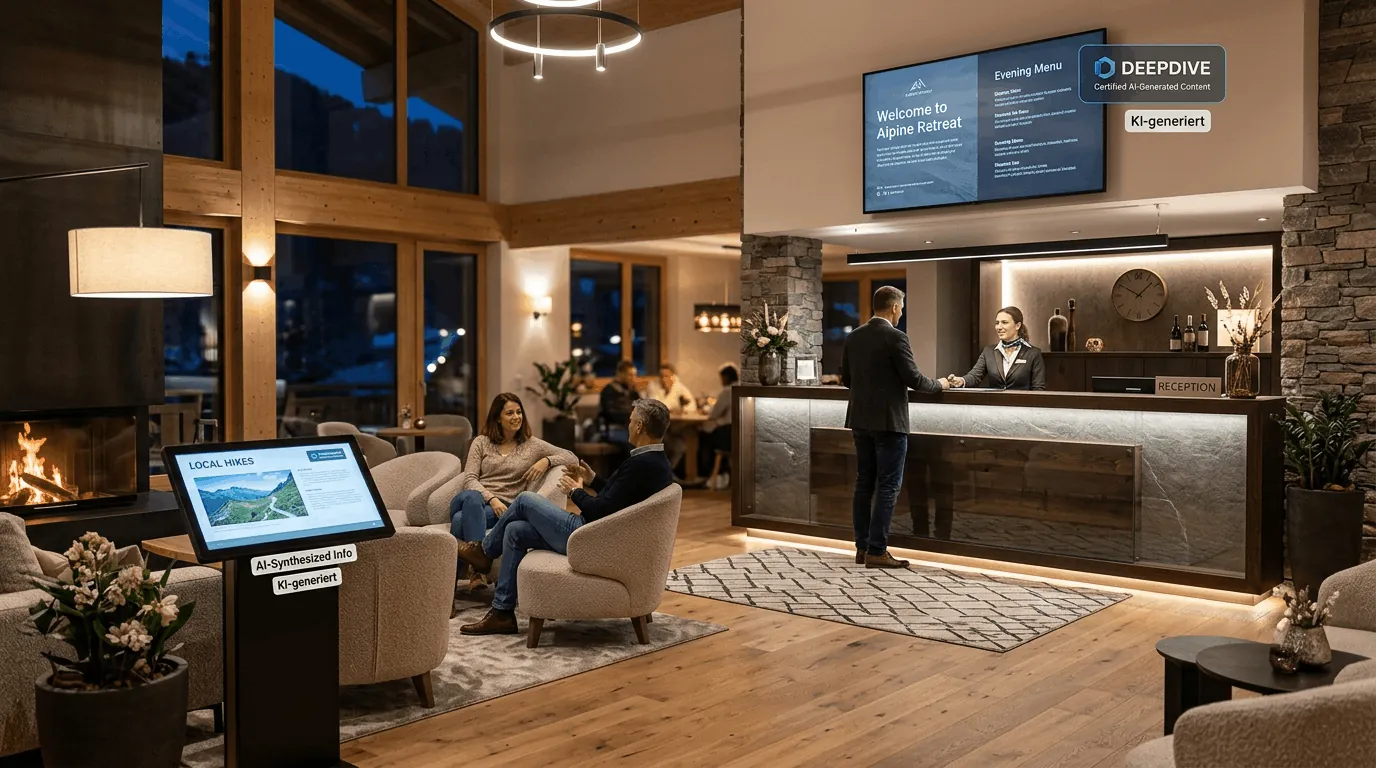
- Fully AI-generated images are given a discreet note "Image: AI-generated" or replaced with real photos.
- AI-edited photos (e.g. brightened, background cleaned up) are labelled "Photo: AI-edited".
- Texts adopted 1:1 from AI (without editorial review) receive the note "Text created with AI support". Texts that have been revised and approved by the team do not need to be labelled.
- The new AI chatbot on the website is introduced under the name "Lena – your digital concierge (AI)".
Result/expectation: The hotel is legally on the safe side. The labels are implemented professionally and discreetly – they do not disrupt the user experience but appear transparent and modern. Initial guest feedback shows: the openness is well received. And internally, the audit has led the team to use AI tools more consciously.
*fictional example
Does this also apply to Swiss hotels?
A question that concerns many Swiss hoteliers – and one that deserves an honest answer.
Formally: No. Switzerland is not an EU member, and the EU AI Act is not Swiss law. There is currently no AI legislation of its own in Switzerland that prescribes a labelling obligation.
In practice: it applies to most Swiss hotels anyway.
The EU AI Act follows the so-called market location principle: anyone who directs content or services at people in the EU falls under the law – regardless of where the company is based. This is already known from the GDPR, which has long affected Swiss companies with EU customers. The same principle applies here.
Specifically, this means: a hotel in Zurich, Basel or Graubünden that actively addresses guests from Germany, France or other EU countries – via its own website, via Booking.com or via Instagram – is directing its content at EU persons. This means the AI Act applies. Anyone listed on international booking platforms is, by definition, addressing an EU audience. The distinction "we only serve Swiss guests" is, in practice, barely tenable for the vast majority of businesses – anyone online is reachable by EU users.
And even if the AI Act does not formally apply:
Switzerland is watching EU regulation very closely and will – as with the GDPR – sooner or later follow suit or create its own rules. Those who act now are on the safe side: legally, but also with regard to guests, who are paying increasing attention to transparency.
Conclusion for Swiss hoteliers: Anyone addressing international guests – and that applies to the vast majority of businesses – should take the labelling obligation just as seriously as a hotel in Germany or Austria. The effort involved is minimal. The risk of not doing so is unnecessarily large.
How do you implement labelling technically? The most important practical questions
Many hoteliers ask themselves the same questions at this point. Here are the answers – without technical jargon.
"Is the invisible watermark that my AI tool automatically inserts enough?"
No – at least not on its own. Tools such as Gemini (Google) or Adobe Firefly automatically embed so-called digital watermarks or metadata into the file. This fulfils the technical obligation of the AI providers. As a hotel publishing the content, you are additionally obliged to provide a note visible to humans. The invisible marking alone is not enough.
"What is SynthID – and do I need to worry about it?"
SynthID is Google's technology that embeds an invisible watermark directly into the pixels of an image or into audio files – robust, even after cropping or compression. It is a valid technical method within the meaning of the AI Act. But: SynthID is Google's affair, not yours. You do not need to activate or manage SynthID. Your task remains the visible note for the guest.
"How do I label content specifically – depending on the channel?"
On your own website / in the CMS (e.g. WordPress, Typo3):
The simplest way is a short caption directly below the image: "Image: AI-generated" or "Photo: AI-edited". Alternatively, a small note as an image caption or tooltip. For fully AI-generated page content, a discreet note at the beginning or end of the page is sufficient.
On Booking.com, HRS or Expedia:
Here you have little technical scope as a hotel – the platforms themselves are working on their own solutions. The most pragmatic solution: either replace AI-generated images with real photos, or – if the platform allows it – label them in the image caption.
On Instagram and Facebook:
Meta has already introduced its own AI label system that automatically applies a label to recognised AI content. In addition, you can manually mark "Created with AI" when uploading – and briefly note this in the post text. Both together is the safest option.
In blogs or newsletter texts:
For texts, the legal situation is more nuanced than for synthetic image, video or audio content. Human editorial review can be relevant, but does not automatically lead to a general exception for every AI text. Hotels should examine the specific use and the applicable guidelines rather than making a blanket distinction between "edited" and "unchanged".
"Do I need to set this up specially in my CMS somehow?"
No. There is no technical obligation to install a special plugin or system. A visible, understandable note in text form – where the content appears – meets the requirements. Those who wish can additionally work with metadata standards such as C2PA or IPTC DigitalSourceType, but this is not a must for hotels.
Common mistakes – these should be avoided
Mistake 1: "no one will notice anyway."
Many businesses assume that AI content is not recognisable and that labelling is therefore unnecessary. This is a misconception – and a legal risk. The obligation applies regardless of whether the content appears "obviously" AI-generated or not.
Mistake 2: hiding the label in the small print.
A note at the very bottom of the page, in small type, does not meet the requirements. The label must be where the content is – clearly visible and understandable.
Mistake 3: checking only new content, forgetting old content.
Anyone who starts labelling now but does not review existing content on the website or on booking platforms has only half solved the problem. Older AI content that remains online is also subject to the obligation.
Conclusion
The EU AI Act is not a bureaucratic obstacle – it is a signal that transparency in the digital space is taken seriously. For hotels, this means: those who use AI must stand by it. This may initially sound like extra effort, but in practice it is well manageable. A short internal audit, clear internal rules and visible labels are sufficient in most cases. Those who act now are not only legally protected but also position themselves as a modern, trustworthy business. Because guests who notice that a hotel communicates honestly prefer to book – and come back. Use the obligation as an opportunity to fundamentally question your digital presence: what are we really showing? And how honest are we being about it?
Sources
- EU AI Act, Article 50 – transparency obligations for AI systems: eur-lex.europa.eu
- Ecovis Unternehmensberatung: "EU AI Act: Kennzeichnungspflicht für KI-generierte Inhalte" (2026): https://de.ecovis.com/unternehmensberatung/eu-ai-act-kennzeichnungspflicht-unternehmen/
- Haufe: "Kennzeichnungspflicht für KI-Inhalte gilt ab August 2026" (2026): https://www.haufe.de/recht/kanzleimanagement/kennzeichnungspflicht-fuer-ki-inhalte-gilt-ab-august-2026_222_681220.html
- Das KI-Magazin: "KI-Inhalte kennzeichnen: Was ab 2. August 2026 gilt" (2026): https://www.das-ki-magazin.de/artikel/ki-inhalte-kennzeichnen-was-ab-2-august-2026-gilt.html
- Gesellschaft für Datenschutz: "KI Kennzeichnungspflicht nach Art. 50 KI-VO" (2026): https://gesellschaft-datenschutz.de/ki-kennzeichnungspflicht/
- European Commission: Code of Practice on labelling AI-generated content: https://digital-strategy.ec.europa.eu/de/policies/code-practice-ai-generated-content
- Datenschutz.law: "Welche Auswirkung hat die KI-Verordnung für die Schweiz?": https://datenschutz.law/ratgeber/welche-auswirkung-hat-die-ki-verordnung-fuer-die-schweiz
- Knowlee Blog: "EU AI Act in der Schweiz: für wen gilt er, für wen nicht": https://www.knowlee.ai/ch/blog/eu-ai-act-schweiz-anwendbarkeit
Related articles
- Hotel videos with AI (affected use case)
- The illusion of free AI (general use of AI tools in the business)
- AI in social advertising (AI-generated creatives – also relevant for labelling)