On 12 June 2026, the US government blocked access to two of the most powerful AI models in the world — from one day to the next, without warning. All users outside the USA were affected. Anyone who had integrated these models into their work processes suddenly had no tool at all. For hotels that already use AI in their daily operations, this is a wake-up call.
The problem: many hotels depend on a single AI tool
AI tools have arrived in many hotel operations — for texts, guest communication, translations, social media posts or preparing offers. That is a good thing. But most businesses use exactly one tool, from exactly one provider, with no plan B.
This is comparable to having only a single supplier for the hotel kitchen. As long as everything runs smoothly, it goes unnoticed. When the supplier fails, the kitchen comes to a standstill.
What happened on 12 June 2026?
The US company Anthropic blocked its new AI models "Fable 5" and "Mythos 5" on instructions from the US Department of Commerce. Reason given: national security. The ban applies to all foreign nationals — worldwide, including foreigners residing in the USA.
What this means in concrete terms:
- A political decision made an AI service inaccessible overnight
- Anthropic itself, by its own account, did not know exactly what the authority's concern was
- Affected users had no advance warning and no transition period
- Similar scenarios are also conceivable with other US providers — whether due to regulation, technical failures or corporate changes
This is not an isolated case. It is a pattern that can repeat itself.
What does this mean for your hotel?
1. Check how dependent you are on a single tool
Take a simple inventory: which tasks do you currently handle with AI? And what would happen if that tool were no longer available tomorrow?
If the answer is "chaos", there is a need for action. If the answer is "we would do it manually", that is at least a plan — but not a good one.
2. Know at least two alternatives
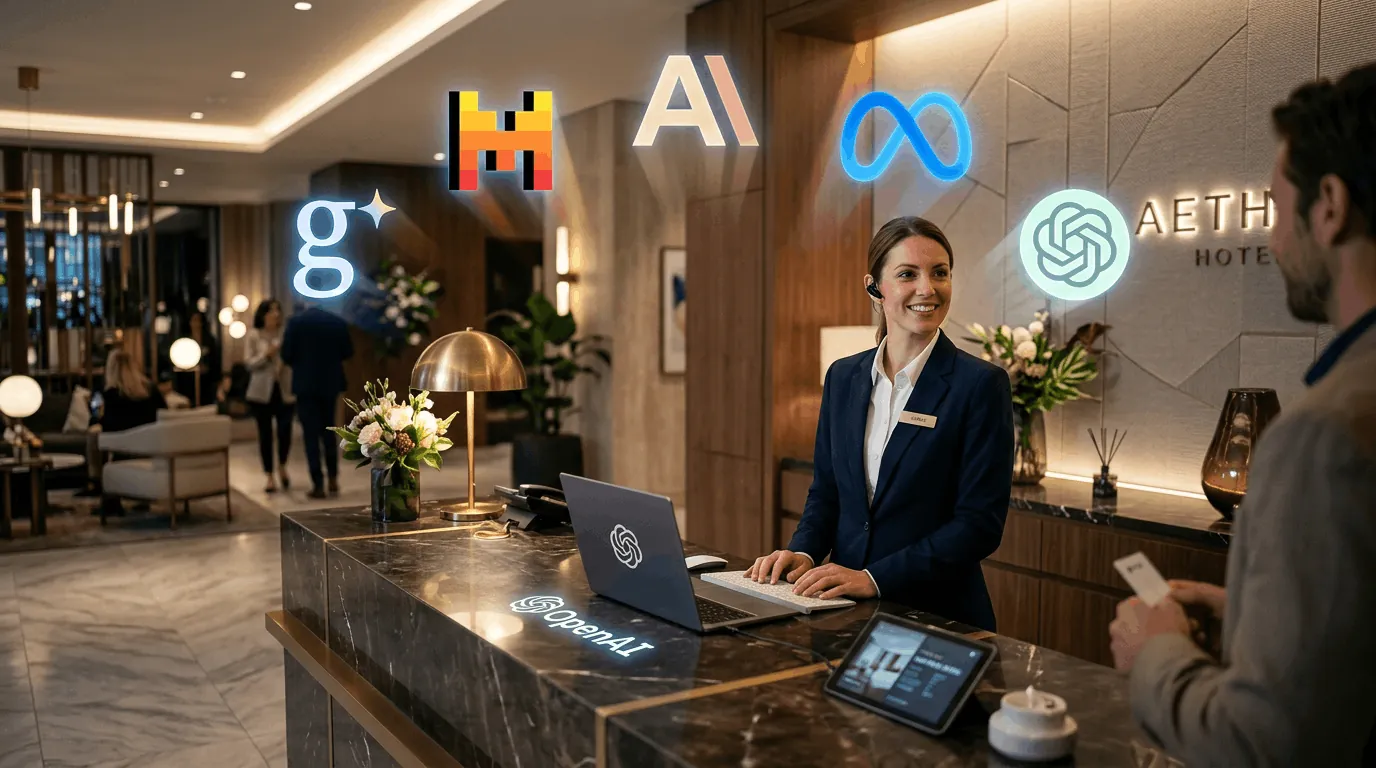
There are many powerful AI tools available today — from American providers such as OpenAI or Google, but also from European ones such as Mistral (France) or Aleph Alpha (Germany). No tool is perfect, but knowing several and testing them occasionally costs little and protects a lot.
Concretely: anyone who currently uses one tool to respond to guest reviews should know which tool they would use tomorrow if the first one fails.
3. Use platforms that bundle several models
There is a category of tools that could be called an "AI control centre": platforms through which you can use different AI models — without signing a separate contract for each one or getting deeply into the technical details. You choose the model that best fits the task at hand, and can switch if needed.
This is the crucial difference: the model is not the tool — the platform is. The model behind it is interchangeable.
Practical example: boutique hotel in Central Switzerland
(Fictional example, realistically constructed)
The Seeblick Boutique-Hotel in Lucerne has been using AI for a year for three tasks: responding to guest reviews, writing newsletter texts and drafting offers for groups. Everything runs through a single American tool.
When the news about the model block appears in June 2026, the person responsible for marketing asks herself for the first time: what would we do if our tool stopped working tomorrow?
She then tests two alternatives — a European model and a platform that bundles several models. The result: both deliver comparable quality for her tasks. She sets up access to both, documents which tool is used for which task, and thereby creates a simple contingency plan in half a day.
Effort: four hours. Benefit: full ability to act, no matter what happens.
The three most common mistakes
1. "That won't happen to us"
Political decisions, technical failures and corporate changes are unpredictable. Anyone without a plan B is not just being careless — they have simply been lucky so far.
2. Tailoring all processes to a single model
Some users adapt their texts and workflows so closely to a particular tool that switching becomes cumbersome. Those who keep their prompts and processes general can switch at any time.
3. Not knowing European alternatives
Many hoteliers only know the large American providers. Yet there are powerful European models that often also fit better with Swiss businesses in terms of data protection law.
Conclusion
AI is no longer a nice-to-have — for many hotels, it has become a genuine working tool. And as with any tool: whoever has only one is vulnerable. The case of 12 June 2026 shows that dependence on a single provider is a real risk — not a theoretical one.
The good news: broadening your base costs little — and, especially with AI platforms, offers additional opportunities to optimise internal processes. Knowing two alternatives, testing them occasionally, having a simple contingency plan — that is enough. You don't need to be an IT specialist to implement this.
Sources
- Heise Online: US-Regierung erzwingt Abschaltung von Anthropics KI Fable 5 und Mythos 5 (13 June 2026)
- ZDF heute: Auf US-Anweisung: Anthropic sperrt neue KI-Modelle (13 June 2026)
- Euronews: Anthropic stoppt Zugang zu den KI-Modellen Fable 5 und Mythos 5 (13 June 2026)
- BR24: Auf Anordnung der US-Regierung: Anthropic sperrt Top-KI-Modell (13 June 2026)
Related articles
- Die Illusion der Gratis-KI (related topic: tool selection/dependency)
- ChatGPT verliert Marktanteile (market shift as context)
- Warum haben Hotels kein eigenes KI-Budget (risk diversification as a budget question)