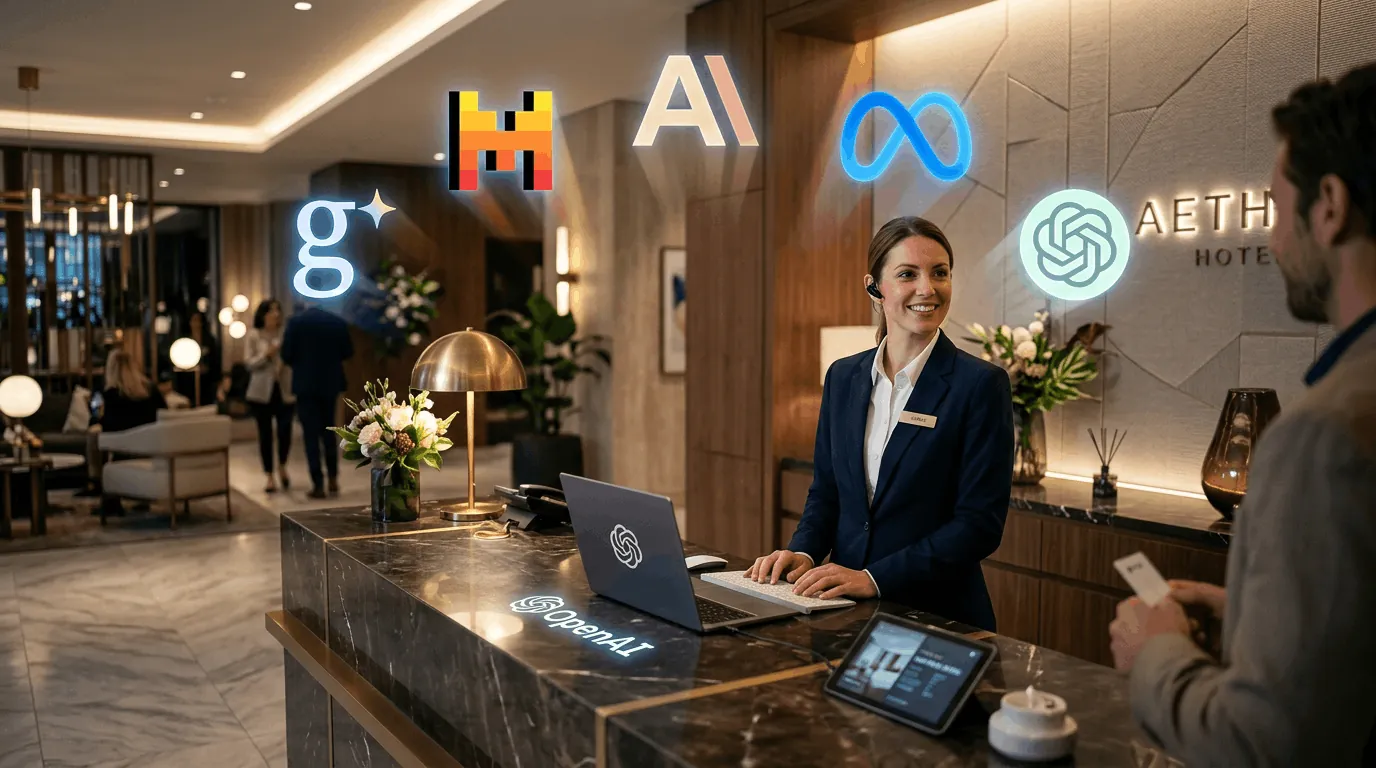

A new AI model every week, a new feature every month that makes the previous one look outdated. No wonder many hoteliers ask themselves: is it even worth investing time in AI now — or would it be better to wait until the tools are more mature? The question is legitimate. But the answer is clearer than it feels.
The problem in everyday hotel operations
Many businesses are stuck in a kind of holding pattern. They tried ChatGPT once, maybe generated an image or had it write a text — and then set it aside again, because «everything keeps changing anyway». The concern: you invest time in a tool or a way of working that will be outdated in six months. This concern is understandable, but in practice it usually leads to standstill rather than a conscious decision.
Current findings from studies and practice
A look at current figures on AI use in companies shows a clear pattern:
In Switzerland too, AI has long since arrived in everyday business. The AXA Switzerland SME labour market study shows that more than half (55 percent) of the Swiss SMEs surveyed already use artificial intelligence in their operations. Another third is in the trial stage. The share of active users rose from 22 to 34 percent between 2024 and 2025 — and the trend is still upward.
Usage is becoming the standard, not the exception. The same picture emerges in Germany: the Bitkom AI Study 2026 shows that 41 percent of German companies now actively use AI, with a further 48 percent planning to. The share of active users has more than doubled compared with the previous year. Those who wait are no longer waiting to enter a niche — they are waiting to catch up with the mainstream.
Acting early reinforces your own advantage. Gartner analyses of so-called «trailblazers» — companies that adopt AI early and decisively — show a self-reinforcing cycle: faster adoption leads to more experience, more experience leads to more confidence, and that in turn leads to better results.
Not every pilot project has to succeed. At the same time, Gartner expects that around 30 percent of generative AI projects will be discontinued after the pilot phase — usually due to unclear benefit or a lack of structure. This puts the fear of choosing the «wrong» tool into perspective: failure is part of the process, not a reason to opt out.
The tools are not getting worse, they are becoming more accessible. Every new model generation makes existing applications easier to use, not more complicated. Those who start today with a simple tool do not lose that experience — they build on it when the next version arrives.
Regulatory deadlines are not waiting. From August 2026, new labelling requirements for AI-generated content will apply in the EU. Businesses that address their processes early can integrate these requirements into existing workflows — rather than scrambling to catch up under time pressure.
What does this mean for your hotel?
1. Waiting is also a decision — just an unfavourable one
Those who wait for «the perfect tools» do not simply lose time standing still — they miss out on the learning effect. Businesses that work today with simple applications (draft texts, image editing, replies to reviews) will be further along in a year — regardless of which model happens to be leading at that point.
2. Starting small beats planning big
You do not need to develop an AI strategy for the entire business. A single, clearly defined use case — for example, preparing replies to Google reviews or drafting social media texts — is enough to get started. From this experience, you can expand step by step later on.
3. Team competence matters more than the individual tool
The tool of today will likely be replaced in two years. What remains is the team's ability to use AI applications sensibly: formulating good inputs («prompts»), checking results, recognising limitations. This competence survives every change of model.
Practical example: family hotel in the Bernese Oberland
Starting point: A family hotel with 40 rooms had hesitated for over a year to use AI tools. The owner wanted to «wait until the dust settles first». In the meantime, review replies piled up, and social media posts were created irregularly because there simply wasn't time for them.
Action taken: The hotel introduced a paid AI subscription for the reception and defined a single use case: replies to Google reviews. Staff received a brief introduction on how to give the tool the necessary context (type of hotel, tone, specific situation).
Result: Within six weeks, the average response time to reviews fell from two weeks to two days. The team gained confidence in using the tool and independently expanded its use to newsletter texts. No new model could have anticipated this progress — the experience could not be postponed, only gathered.
(The example has been simplified slightly for illustration purposes.)
Common mistakes
- Waiting for «the one perfect tool». There is no tool that solves all requirements at once — and there never will be. Waiting for it means waiting for something that will never exist.
- Starting too many use cases at once. Trying to overhaul the entire marketing, guest contact and accounting at the same time overwhelms the team and the processes. One use case after another brings real progress.
- Working with the free version and concluding that AI is of no use. Free tools are often significantly limited. Drawing a general judgement about AI from this confuses a weak tool with a weak idea.
Conclusion
Development in the AI field is not slowing down — that is a constant, and nothing will change it. The only variable you can influence is the point in time at which you start growing along with this development. Those who wait until everything is fully mature are waiting for a state that will never arrive. Those who start today with a small, clearly defined use case gather experience that remains useful even with the next model and the one after that. So the question is less «is the technology mature enough yet?» and more «is my business ready to take the first small step now?»
Sources
- AXA Switzerland, SME Labour Market Study 2025: AI on the rise among Swiss SMEs
- Bitkom AI Study 2026 (cited via mybusinessfuture.com): Bitkom AI Study 2026: 41 percent of companies use AI, mid-sized businesses catching up
- Gartner forecasts on AI adoption and pilot projects (cited via superkind.ai): AI adoption among mid-sized businesses
- Gartner analysis on «trailblazers» in AI strategy (cited via omr.com): AI strategy for companies 2026
- EU AI Act, labelling requirement from August 2026 (cited via contentmanager.de): AI Regulation 2026: why an AI audit makes sense now
Further related articles
- Why don't hotels have their own AI budget (a direct follow-up question: what does getting started cost)
- The illusion of free AI (a practical first step)
- Does AI also threaten jobs in the hospitality industry? (related fundamental debate)
- What happens if your AI tool is blocked overnight (the risk aspect of getting started)