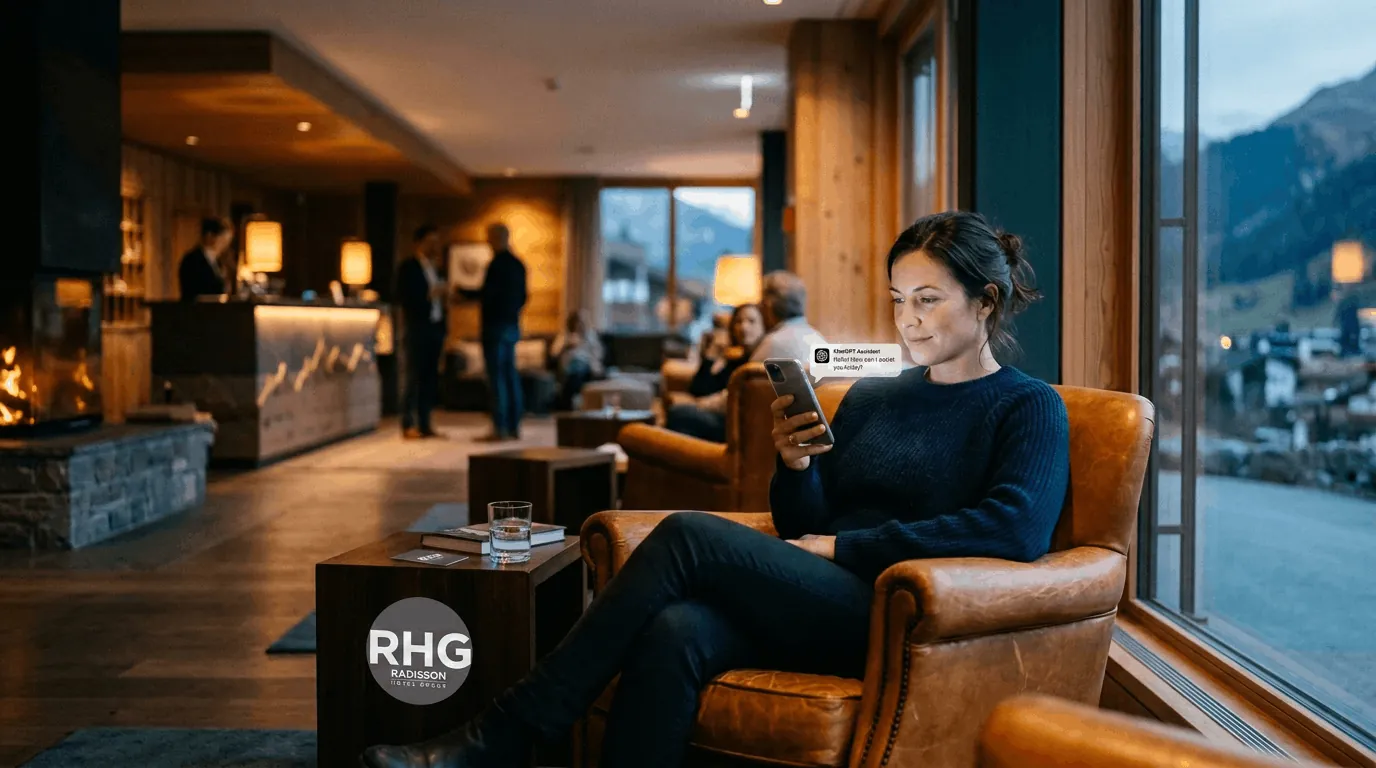
Since 28 July 2026, travellers have been able to chat directly with Radisson in ChatGPT, compare hotels and be forwarded to booking. The Radisson Hotel Group, together with Accenture, has launched its own app in the ChatGPT Store — for over 1'000 hotels in more than 100 countries. For smaller and medium-sized hotels, this raises a pressing question: does this change the rules of the game for businesses without a global chain behind them?
The problem in everyday hotel operations
Many hoteliers have put a lot of energy in recent years into their own website, Google Ads and social media. That was right — and remains important. But part of the guest journey is now shifting to a place where most businesses don't yet have a say: chats with AI assistants. If you're not there, you don't lose bookings immediately. But you slowly lose visibility at exactly the point where many journeys begin today — with the first, non-binding question, "Where should I stay?"
What Radisson and Accenture have actually built
- A dedicated app in the ChatGPT Store. Anyone starting a chat with "@RadissonHotels" receives hotel suggestions directly in the conversation — including room rates, availability, amenities and a map view.
- The booking itself still runs through the hotel's own website. ChatGPT handles advice and pre-selection, while the transaction takes place on radissonhotels.com — deliberately as a direct booking, not via a booking platform.
- The motivation is communicated openly. Radisson itself says that organic search traffic and direct website traffic — the classic channels for online bookings — are increasingly giving way to new touchpoints such as ChatGPT.
- The figures behind this are clear. According to an Accenture study, 87 percent of travellers are open to being advised by an AI-powered travel assistant. 71 percent expect AI to influence at least half of their spending on hotels or flights within the next twelve months.
- Loyalty is more fragile than one might think. A separate Accenture survey on "Agentic Commerce" shows that 90 percent of heavy AI users in North America would switch away from a previously preferred brand if their assistant suggested a better option.
- Radisson is not alone. At virtually the same time, the budget chain Motel 6 also launched its own ChatGPT presence — an indication that this channel is developing across all price segments.
What does this mean for your hotel?
1. AI visibility becomes a discipline of its own
Until now, it was enough to rank well on Google and maintain a well-kept Google Business Profile. Now a third layer is added: is your hotel actually understandable to an AI system? ChatGPT, Gemini and Perplexity read different signals than a search engine — structured facts, clear descriptions, current reviews. If you rely only on beautiful pictures, you remain invisible to an AI, even if guests love your website.
2. Large chains create expectations that reach you too
If guests are used to asking Radisson about rates and availability by chat, they unconsciously carry this expectation over to every other hotel they consider — including an independent property in the mountains or in the city. You don't have to build the same technology. But your website and your Google profile should be able to answer the same questions just as clearly when an AI checks them.
3. Direct booking remains the goal — even in the age of AI
What is remarkable about Radisson's move is that the booking deliberately does not take place within ChatGPT itself, but ends on the hotel's own website. The underlying idea applies to every hotel: AI channels should increase visibility, not pass commissions on to third parties. If you appear in AI answers today but end up on a booking platform, you give away exactly the advantage this development actually offers.
Practical example: a city hotel positions itself for AI search
A fictional four-star city hotel with 60 rooms in Lucerne notices in spring 2026 that inquiries via its own website are declining slightly, while at the same time more and more guests mention at reception that they "searched with ChatGPT for a hotel near the station with a sauna."
Starting point: The website is visually well maintained but technically unstructured. Important facts such as room amenities, arrival times or cancellation conditions are hidden only in flowing text, not in clear sections or FAQ form.
Measure: The hotel builds a structured FAQ page with the twenty most common guest questions, consistently updates its Google Business Profile, and makes sure current, positive reviews are visibly included. In addition, pricing communication is made clear so that the website always offers the best available rate.
Expected result: Within a few months, the hotel appears in the answers of ChatGPT and Perplexity for typical AI queries such as "hotel Lucerne near station with sauna." The direct booking rate rises noticeably, because guests who became aware of the hotel through AI land directly on its own site and immediately find the information they were looking for.
Common mistakes
- Waiting until "the big chains have tried it out." AI visibility cannot be built overnight. Those who only react once the effect is already measurable have lost valuable time.
- Confusing AI visibility with classic SEO (search engine optimisation). Good Google rankings alone are not enough. AI systems need clearly structured, fact-based content — often in a different form than a classic website text.
- Neglecting your own pricing sovereignty. If you allow booking platforms to appear more prominently than your own website in AI queries, you give away margin you will not get back.
Conclusion
Radisson's move is a clear example of where the guest journey is heading: away from the pure search engine, towards conversations with AI assistants that make suggestions before a website is even visited. This is no longer a marginal phenomenon, but a signal that affects hotels of every size. You don't need to build your own ChatGPT app to benefit from this. But you should ask yourself whether an AI could actually understand and correctly recommend your hotel today. Those who answer this question honestly now secure an advantage that becomes more valuable with every new AI feature.
Sources
- Radisson Hotel Group & Accenture: "Radisson Hotel Group and Accenture Redefine Travel Discovery on ChatGPT", Accenture Newsroom, 28 July 2026
- "Radisson Hotel Group Brings Hotel Booking Straight Into ChatGPT", Entrepreneur Middle East, 28 July 2026
- "Hotels are moving into ChatGPT, but not the payment", The Next Web, 28 July 2026
- "Radisson Hotel Group Launches AI Hotel Discovery App in ChatGPT", Hotel News Resource, 28 July 2026
Further articles on this topic
- Agentic AI: Why hotels need to rethink their booking systems now (technical background)
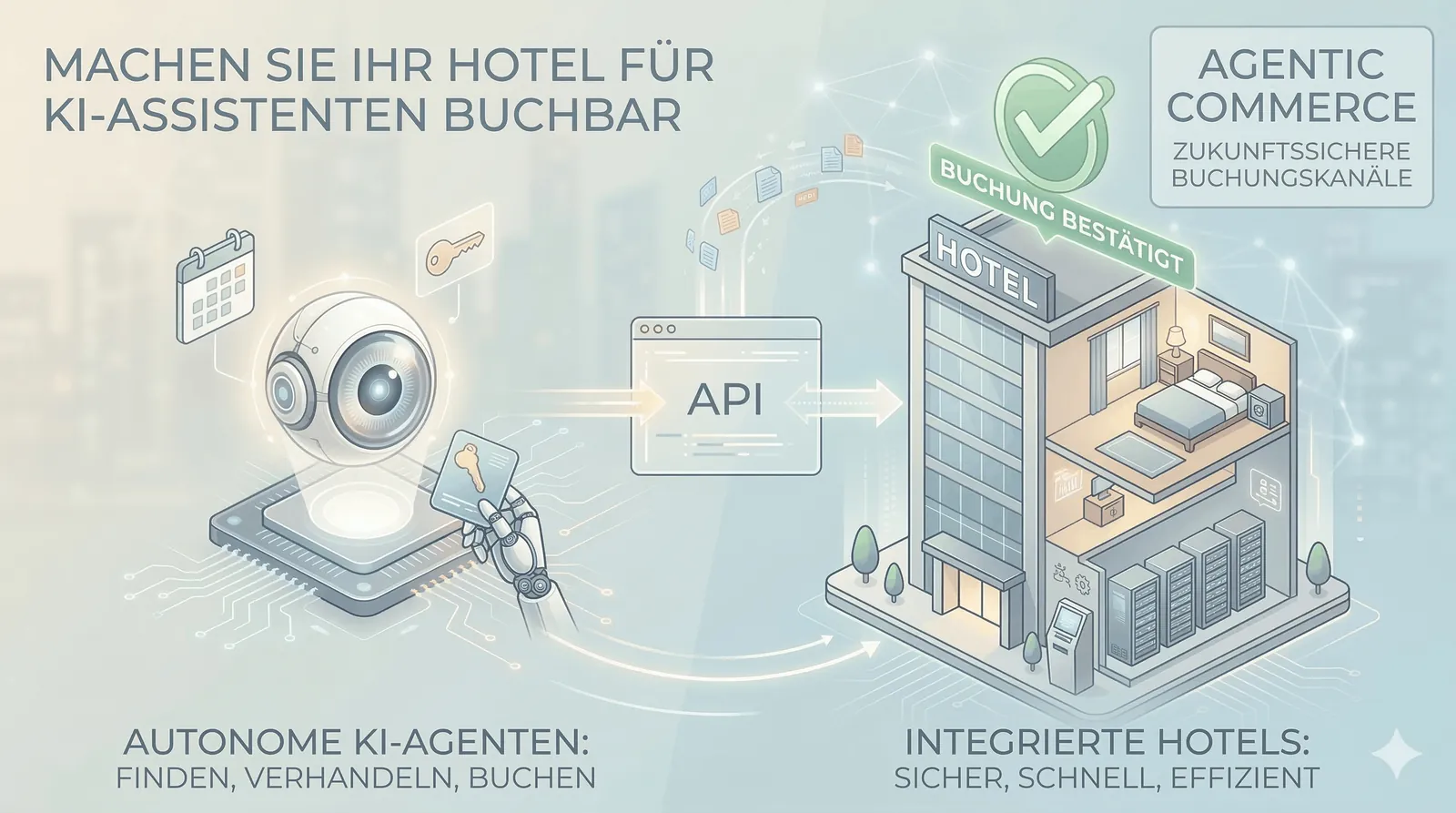
- Agentic Commerce: Make your hotel bookable for AI assistants (action guide)
- How visible is your hotel really (introduction to the topic)
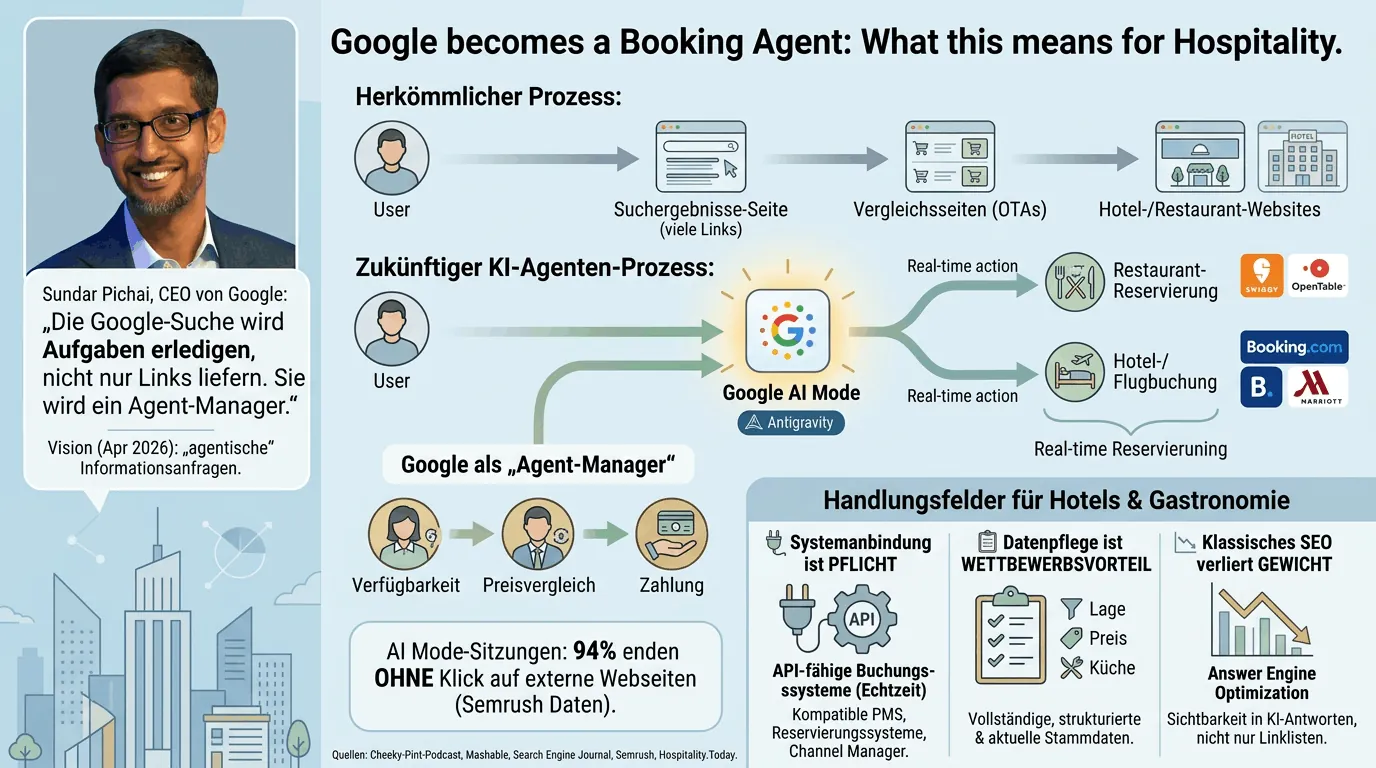
- Google is becoming a booking agent (related development)