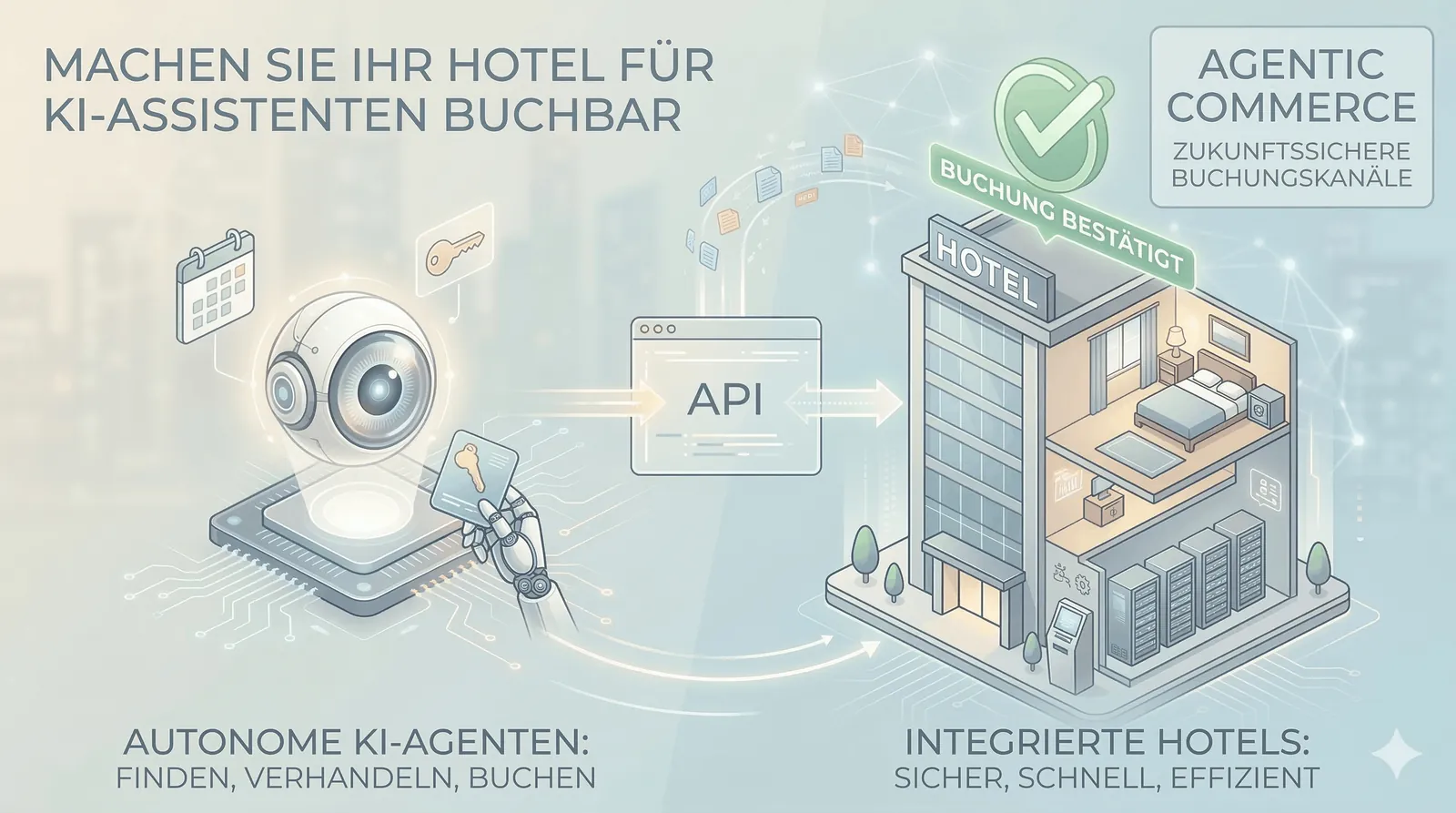
Google CEO Sundar Pichai has made an announcement that should make the entire hospitality industry take notice: Google Search will no longer just deliver links — it will complete tasks. Directly, independently, without detours.
The vision: Google as an "agent manager"
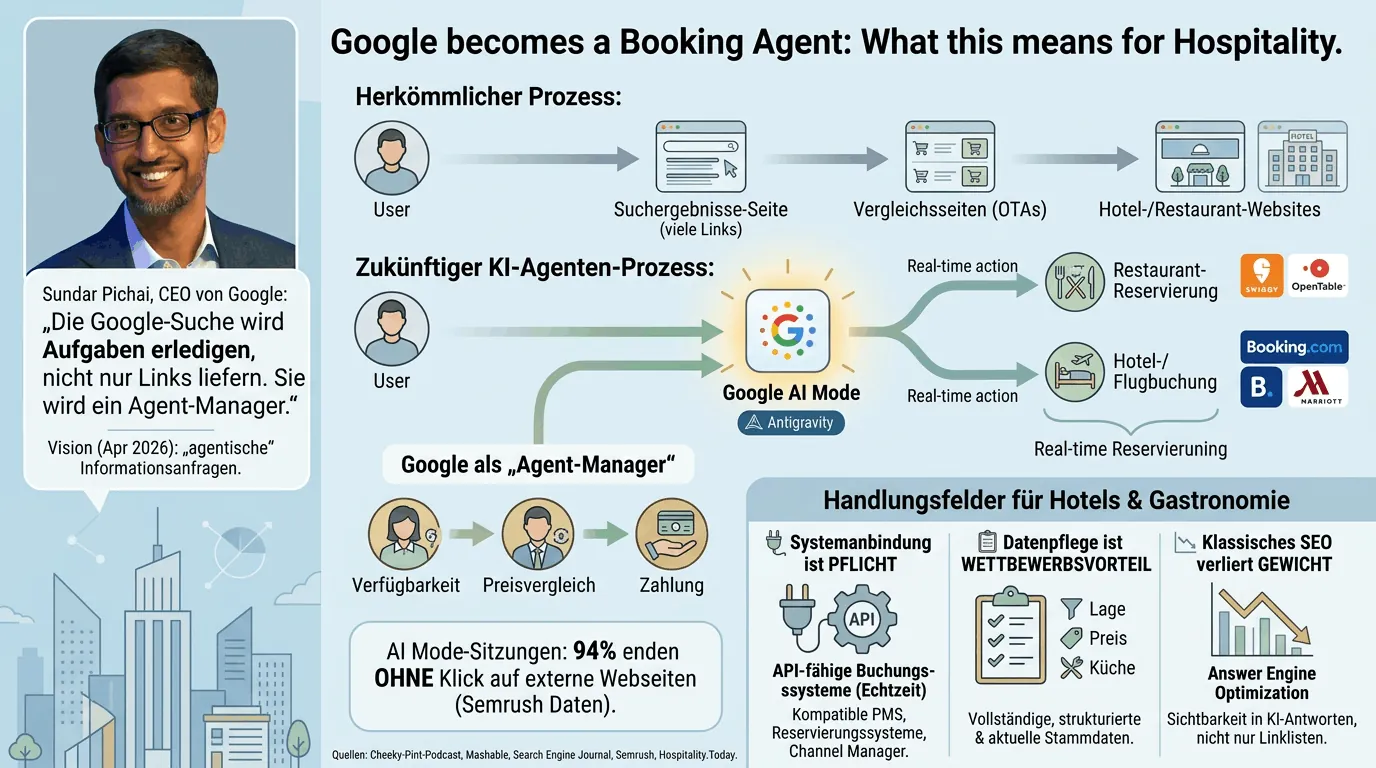
In the podcast hosted by Stripe co-founder John Collison and investor Elad Gil, Pichai outlined the future of search in clear terms:
"When I look ahead, many pure information requests in search will be agentic. You will get tasks done. You will have many threads running at the same time."
And further: search will be an "agent manager." As a concrete example, he mentioned an internal Google tool called Antigravity, in which AI agents already handle parallel-running tasks for him today. By 2027, this is expected to be fully realised for non-technical workflows.
From vision to practice — in restaurants
Only a few days after the podcast appearance, the first real-world implementation followed: Google introduced agent-based restaurant reservations in AI Mode in the UK and India.
Guests can now search in natural language — cuisine, party size, dietary needs, time — and receive directly bookable results. No switching tabs, no portal, no detour. The reservation runs seamlessly through integrated partners:
- 🇬🇧 UK: OpenTable, TheFork, SevenRooms, ResDiary and others (8 platforms)
- 🇮🇳 India: EazyDiner, Swiggy, Zomato
The feature builds on the US rollout from August 2025 — and is therefore no longer an experiment, but a reality that is rolling out internationally.
Hotels and flights: the next stage has already been announced
Google makes no secret of where this is heading: hotel and flight bookings directly in search are already in development. Partners already named include: Booking.com, Expedia and Marriott International.
What begins with restaurant reservations — a comparatively low-risk transaction — is the targeted test run for the bigger goal: the complete takeover of the booking chain in hospitality.
What this means for the industry
The figures are clear: according to Semrush data, 94% of AI Mode sessions already end today without an external website being visited. So anyone who doesn't appear directly in Google's AI results simply isn't seen.
For hotels and restaurants, this results in three immediate areas for action:
- System integration is not optional: Only those with API-capable booking systems available in real time will appear in AI results. PMS, reservation system and channel manager must be compatible.
- Data maintenance becomes a competitive advantage: The AI filters by precise criteria — location, amenities, price category, cuisine, dietary options. Complete, structured and up-to-date master data determines whether a business is recommended or not.
- Classic SEO loses weight: The "rank for clicks" model is breaking down. Anyone still dependent on traffic from Google must shift to Answer Engine Optimization — that is, being visible in AI-generated answers, not just in the list of links.
Conclusion: the shift is not a distant prospect
Sundar Pichai's vision sounds big — but the implementation is already underway. For restaurants and hotels, this means: the question is no longer whether Google will become the central booking channel, but how quickly. Businesses that invest now in system integration, structured data and AI visibility secure their relevance. All others risk becoming invisible in agentic search — before they have even understood what happened.
Sources: Cheeky Pint podcast (Stripe/Elad Gil), Mashable India, Search Engine Journal, Semrush, Hospitality.today
More related articles
- Agentic AI: Why hotels need to rethink their booking systems now (broader topic)
- Marriott and Google usher in a new era (almost identical topic)
- Booking.com overtakes Google (related power shift in the booking market)