Why this topic matters now
Swiss hospitality is currently experiencing a remarkable phase: 2025 saw record figures once again, with 43.9 million overnight stays. Demand is there. And yet many businesses struggle to remain visible, increase direct bookings and hold their own against the market power of the large booking platforms. Anyone who wants to succeed in this environment must understand where guests' decisions are actually made — and today that is almost exclusively online.
The problem: many businesses still think in old categories
In Swiss hospitality, you still hear sentences like: "We don't do much online marketing — we're more classically positioned." Or: "We don't have a budget for digital marketing, but we're featured in a few travel guides and advertise in the regional magazine."
That's understandable. Many businesses achieved good occupancy for decades using exactly these means. But guest booking behaviour has changed fundamentally — and anyone who ignores this quietly loses bookings without directly noticing.
What the figures say
The data is clear and directly affects Switzerland:
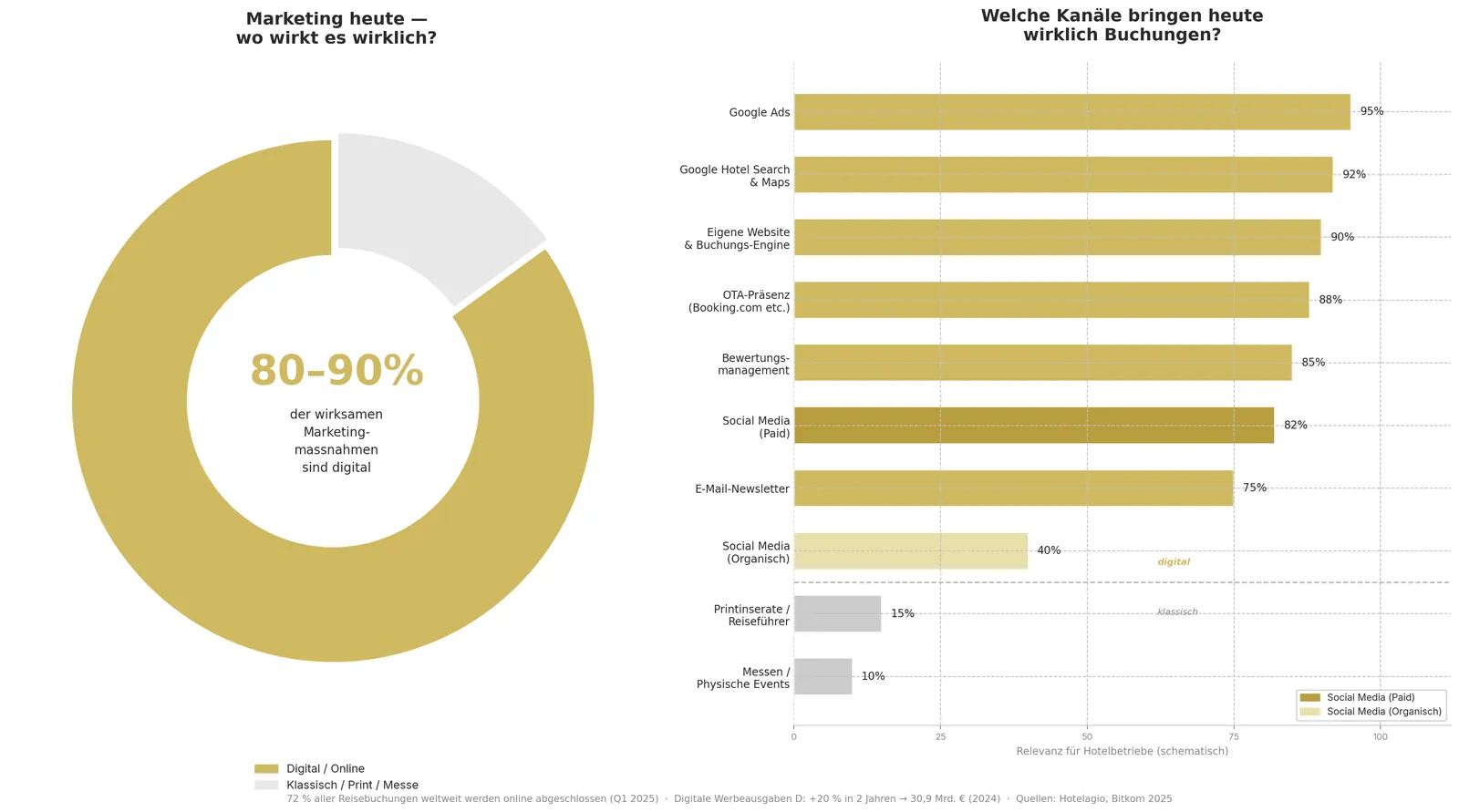
- Around 72% of all travel bookings worldwide are now completed online (Q1 2025). Swiss guests and international visitors travelling to Switzerland follow this pattern too.
- OTAs such as Booking.com dominate the digital booking market — despite the "Lex Booking," the Swiss law that has restricted certain platform parity clauses since 2022. A study by HES-SO Valais-Wallis, commissioned by HotellerieSuisse, shows: the market power of the large booking platforms remains considerable despite legal regulation. Anyone without a digital presence automatically ends up dependent on them.
- Guests research their accommodation online — before booking. Google, review platforms, social media and the hotel website are the touchpoints where booking decisions are made. Not at the travel agency, not in a print ad.
- Switzerland Tourism and HotellerieSuisse are jointly investing in digital marketing — with roadshows, tools and campaigns specifically aimed at more direct bookings and a stronger online presence. This is no coincidence: both organisations know where guests can be reached today.
- Digital advertising spend in the DACH region is growing rapidly. In Germany alone, spending on digital marketing rose from around 25.7 billion euros (2022) to 30.9 billion euros in 2024 — an increase of 20% in just two years (Bitkom, 2025). The market continues to shift towards digital, not away from it. Swiss businesses feel this pull directly: anyone not present in the relevant digital channels loses visibility to competitors who are investing.
If you honestly list which marketing measures actually have an impact for a Swiss hotel — Google Hotel Search, your own website with a booking engine, review management, social media, email newsletters, OTA presence, metasearch, Google Ads — you arrive at 80 to 90% digital channels. This is not a theory. This is the reality of booking behaviour.
What does this mean specifically for your hotel?
1. Separating "marketing" from "online marketing" harms you.
Anyone who treats digital measures as an add-on invests too little in the channels that actually generate bookings. Understand digital marketing not as a supplement, but as the core of your visibility.
2. Direct bookings happen digitally — or not at all.
The debate around "Lex Booking" shows that Swiss hoteliers want to become less dependent on OTAs. But this only succeeds if your own digital presence is strong enough to address guests directly. A well-maintained website, an active Google profile and a clear booking path are the foundation for this.
3. "Digital" doesn't have to mean a large budget.
Small and medium-sized businesses in particular — and Swiss hospitality consists largely of exactly these — can achieve a great deal with targeted, simple digital measures. Current photos, well-managed reviews, a functioning booking process: this is not rocket science, but it is marketing.
4. Paid visibility is not a luxury — it is a lever.
Free measures such as a well-maintained Google profile or active reviews are the basis. But they are often not enough to reach new guests beyond your regular customer base. Google Ads close this gap: the ad appears exactly when someone is actively searching for a hotel — ready to book, with a specific destination in mind. Anyone who directs this person straight to their own booking process saves commission and gains a guest they would otherwise have lost to Booking.com.
A practical example: the mountain hotel that "really has no time for online"
A family hotel in Graubünden, 28 rooms, well occupied in winter season, weaker summer months. The owner works in the business daily, has no dedicated marketing person and says: "I don't have time for online marketing."
The current situation: the website is running but hasn't been updated in two years. The Google listing still shows old prices and no summer photos. Reviews are rarely answered. Booking.com performs well — but commission eats up a significant part of the margin.
What changes when the owner takes targeted action: she updates the Google profile, uploads summer photos and responds to reviews. At the same time, she runs a simple Google Ads campaign that specifically targets guests searching for "family hotel Graubünden summer" — and directs them straight to her own booking process. No large project, no complicated setup.
The result: better visibility in Google search for summer bookings, more trust among new guests — and a real chance to increase direct bookings without paying commission. What was previously dismissed as "online marketing" is simply the marketing that works today.
Common mistakes
1. "Booking.com is working — that's enough.
"OTAs are an important channel, but no substitute for your own digital presence. Anyone bookable only via platforms pays commission, loses direct contact with the guest — and has no way to build up direct bookings in a targeted way.
2. "We set that up once — it's running fine."
Digital channels need maintenance. An outdated Google listing, old photos or missing responses to reviews send the wrong signal — and cost bookings without you directly noticing.
3. "We'll do that when things get quieter."
In tourism, quiet phases are rare, and digital visibility cannot be built up in reserve. Anyone who waits until the season is over misses the booking phase for the next one — and leaves the field to competitors who are already investing.
Conclusion
Swiss hospitality is in a good position — the overnight-stay figures prove it. But behind these record figures lies a structural shift that many businesses have not yet fully grasped: today's guest makes their booking decision digitally. Not sometimes. Almost always.
The distinction between "marketing" and "online marketing" is no longer helpful — it is a misconception that leads to investing in the wrong channels or postponing digital measures. This is not about changing everything at once. It is about maintaining your digital presence with the same care with which you run your house — and investing specifically where guests are ready to book.
Because for your guests, the stay at your hotel begins long before arrival — the moment they find you online. Or don't.
Sources
- Federal Statistical Office FSO (2026): Accommodation Statistics 2025 — Swiss hospitality records overnight-stay record. bfs.admin.ch
- HotellerieSuisse / HES-SO Valais-Wallis (2024): Study on OTA market power following the introduction of Lex Booking. tageskarte.io
- Switzerland Tourism / HotellerieSuisse (2024): Hotel Marketing Days on Tour — digitalisation and direct bookings. hotelleriesuisse.ch
- Bitkom e. V. (2025): Digital Marketing in Germany — study on the value contribution of digital marketing 2025. bitkom.org
- Hotelagio (2025): Online Travel Booking Statistics and Trends 2025. hotelagio.com
- RoomPriceGenie (2025): 7 trends shaping Swiss hospitality in 2026. roompricegenie.com
Further related articles:
- Online marketing for hotels: which channels are really worthwhile in 2026 (practical continuation)
- The winners in hotel marketing build systems, not individual measures (related mindset)
- Hotel marketing 2026: why 94% of hotels are invisible in AI search (evidence for the thesis)