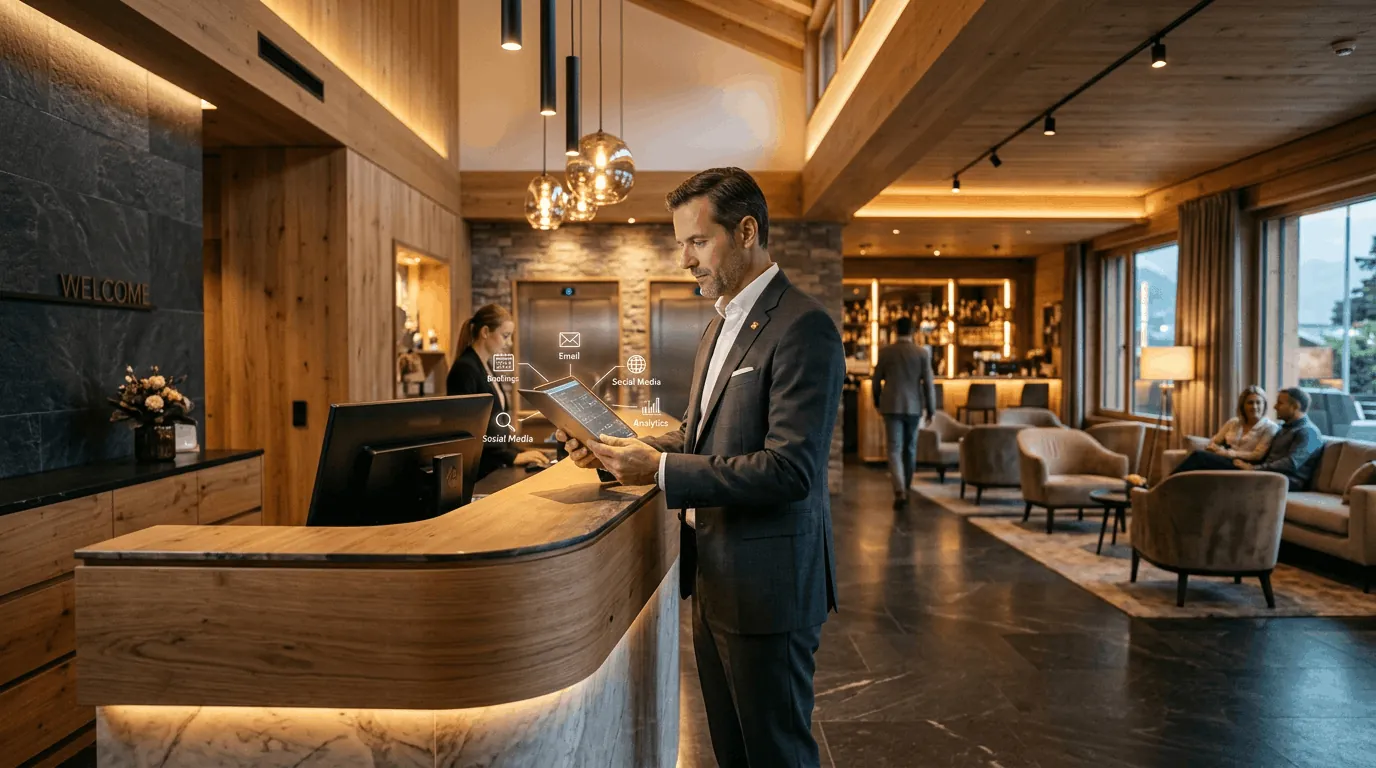
Why thinking in channels costs you bookings
Many hotels today are active on almost every channel: Google Ads here, an Instagram post there, occasionally an email campaign. It feels like marketing. But often it isn't. What's missing is the connecting element — a system that turns individual measures into a real growth strategy. This is exactly what separates hotels that grow from hotels that stagnate today.
The problem in everyday hotel operations
Most properties run marketing like a buffet: you take a bit of everything, but nothing interlocks. The CRM doesn't know the guests who came through Google Ads. The social media campaign doesn't know which rooms currently have poor occupancy. And conversion tracking shows numbers that nobody really reads.
The result: budgets are distributed, but not steered. Measures are launched, but not evaluated. And in the end you wonder why direct bookings aren't increasing — even though you're supposedly "present everywhere".
What current industry data shows
The figures from several current studies — including the Changing Traveller Report 2026 by SiteMinder (12'000 travellers, 14 countries) as well as analyses by Cloudbeds, GCommerce Solutions and Gourmet Marketing — paint a clear picture:
- Independent hotels gave up an average of 63.4% of their bookings to OTAs in 2025 — at commissions of 15 to 30% per booking. The cancellation rate for OTA bookings stood at 21.8%, more than double that of direct bookings (10.6%).
- "The most important hotel marketing trend for 2026 is integration", writes Gourmet Marketing in its annual analysis. AI personalisation is useless without clean data. Metasearch collapses without rate parity. Video visibility fizzles out without a functioning booking engine.
- Hotels with integrated marketing platforms distribute their budget in real time — no longer quarterly. This allows faster reactions to demand fluctuations and measurably better performance.
- When data, tools and channels work together, every guest interaction becomes the foundation for the next one. A guest who comes via a Meta ad is captured in the CRM, receives a personalised email before arrival, and is specifically brought back to book directly after the stay.
- Hotels that systematically use first-party data achieve measurably higher direct booking rates and a lower cost per acquisition, according to Cloudbeds.
What this means for your hotel
1. Data must flow — not sit in silos
The biggest problem is not a lack of budget, but a lack of connection. If your booking engine, your CRM, your tracking and your advertising channels don't communicate with each other, you're working with blind spots. Check this: Does your email system know where a guest came from? Can your tracking attribute a booking to a specific campaign? If not, that's the first lever to pull.
2. Channels are means — not goals
Google Ads, Meta, SEO, GEO, metasearch: each channel has a role. But only if it's aligned with a shared goal — for example: a direct booking share of 40% by year end. Anyone running channels without an overarching goal is optimising into a void.
3. Performance needs a common standard
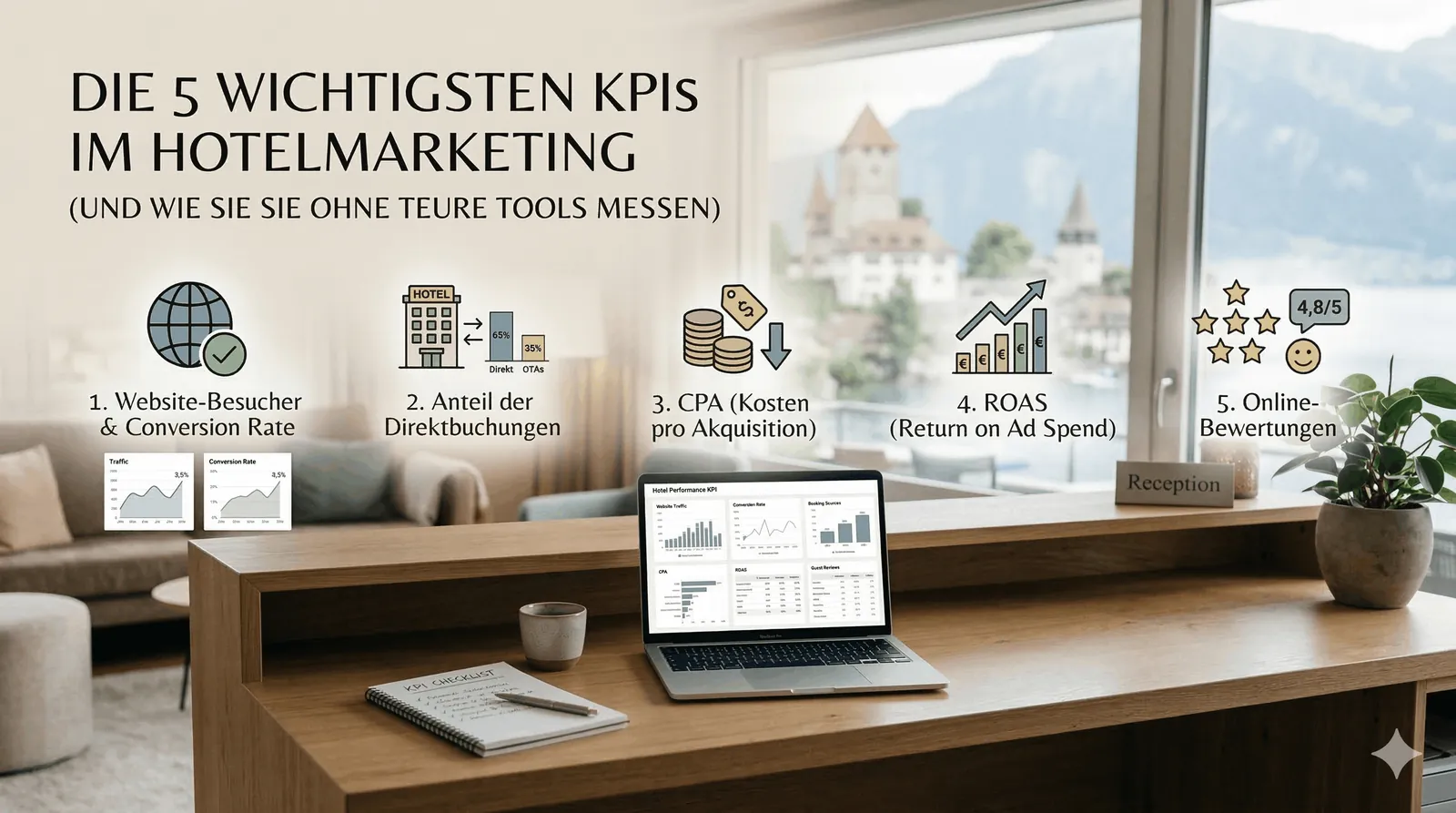
Integrated marketing also means shared metrics. Not "likes" here and "clicks" there, but metrics that show the overall picture: Cost per Acquisition (CPA), Revenue per Available Room (RevPAR), direct booking share. Anyone who knows these numbers and reads them regularly can steer — instead of just reacting.
Case example: Stadthotel Zürich (fictional, realistic)
Starting position: A 45-room city hotel in Zurich runs Google Ads, is active on Booking.com and posts twice a week on Instagram. The direct booking rate stands at 22%. The team doesn't know which channel actually drives bookings — tracking is incomplete.
Measures: The hotel opts for a structured approach. First, conversion tracking is set up properly — every booking is attributed to a source. Then the CRM is connected to the booking engine, so guest data is captured automatically. On this basis, targeted email campaigns for repeat bookings are set up. The Meta ads are switched to retargeting — only people who have already visited the website see the ad.
Result after 6 months: The direct booking share rises to 31%. The cost per acquisition falls by around 18%. For the first time, the team has a clear picture of which measures are working — and can deploy the budget specifically.
Common mistakes
1. Channels are evaluated individually, not in interaction.
Anyone who judges Google Ads only by click cost, and not by how many of those clicks actually lead to bookings, makes the wrong decisions. Every channel must be evaluated in the context of the entire funnel.
2. The CRM is misunderstood as a newsletter tool.
A CRM is not a mailing tool — it is your hotel's memory. Anyone who only uses it for occasional mailings is giving away the largest direct booking potential they already have: their own guest list.
3. Building the system is postponed to "later".
Many hoteliers wait for the "right moment" — a quieter season, new budget, a new team. But a system isn't built in a week. Whoever starts today will have a head start in six months. Whoever waits will be catching up.
Conclusion
Successful hotel marketing in 2026 is no longer a channel puzzle. It is a system in which data, content, campaigns and booking processes interlock. Hotels that understand this and act accordingly won't just become more visible — they will become more profitable. The difference between a hotel that is "present everywhere" and one that grows doesn't lie in the budget. It lies in the connection.
Is your marketing already set up as a system today — or still as a sum of individual measures?
Sources
- SiteMinder: Changing Traveller Report 2026 — siteminder.com
- Cloudbeds: 6 Hotel Marketing Trends for 2026 — cloudbeds.com
- Gourmet Marketing: 7 Digital Marketing Trends Every Hotel Should Watch in 2026 — gourmetmarketing.net
- GCommerce Solutions: 2026 Digital Marketing Trends & Predictions for Hotels and Resorts — gcommercesolutions.com
- Punch Hospitality: The Lucky 13 Hotel Marketing Trends That Will Define 2026 — punch-hospitality.com
- Hotelinking: Hotel Marketing Trends for 2026 — hotelinking.com
Further related articles:
- Online marketing for hotels without a marketing department: a 90-day roadmap (concrete implementation plan)
- "Online marketing" no longer exists — there is only marketing (related fundamental stance)
- The 5 most important KPIs in hotel marketing (making systems measurable)
- Requirements for a booking engine for the hotel website (example of a connected system)