Let us imagine for a moment that the hotel director enters the kitchen at 5 a.m. Flour, yeast, water. He rolls up his sleeves and starts kneading dough. Why not? He knows what bread rolls should taste like. He has an opinion on it. And in theory, he could learn how.
Sounds absurd? Correct. That is exactly why most hotels buy their baked goods from the baker.
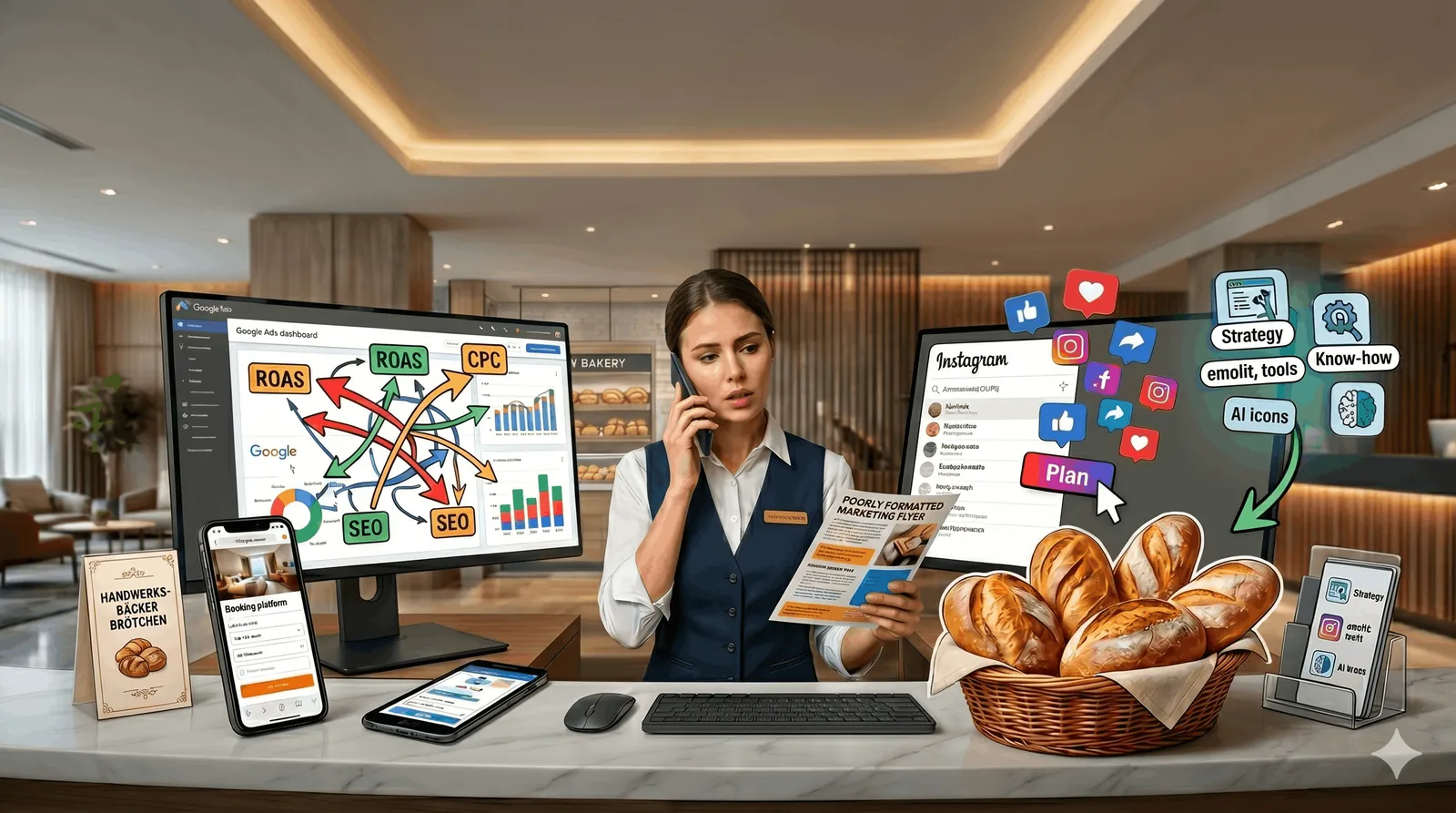
Now the same question for marketing: why does someone from reception in many hotels spend three hours a week on Instagram posts, juggle a booking platform that has not been touched since 2019, and try to understand Google Ads on the side — while competitors outside run professionally timed campaigns?
The bread-roll paradox
The logic behind outsourcing the bakery is compellingly simple:
- The baker does it better.
- He does it faster.
- And usually he does it more cheaply — once you honestly factor in the hidden costs of doing it yourself.
The exact same applies to marketing — with the difference that the stakes are higher. A dry bread roll costs the hotel one guest at breakfast. A weak marketing strategy costs it visibility, bookings and positioning. Over months. Over years.
What an external marketing agency really delivers
A good agency does not simply deliver "nice posts." It delivers:
Strategy instead of ad hoc action. Anyone working in day-to-day operations thinks tactically. An agency thinks in campaigns, target groups, seasonality and customer journeys — with distance and overview.
Specialised know-how that keeps renewing itself. Algorithms change. SEO rules shift. Meta Ads become more complex. An agency invests in this knowledge every day — a hotel structurally cannot do that.
Tools and infrastructure. Professional analysis, planning and automation tools cost money and require training. An agency spreads these costs across many clients — and the hotel benefits from the full scope of services.
Measurability and accountability. What does a campaign achieve? Which channel converts? What does a booking really cost? An agency provides answers — and has to stand behind them.
The counterarguments — and what is really behind them
"We know our property best."
Absolutely. And that is valuable. But "knowing the property" is briefing — not marketing. The baker does not know the technical details of his oven either. He still bakes the better bread roll.
"An agency does not understand the hotel industry."
That is a legitimate objection — and at the same time a question of agency choice. Anyone who chooses an agency with hospitality expertise avoids this problem. Anyone who chooses just any agency does indeed have a problem. But that is not an argument against outsourcing — it is an argument for choosing the right partner.
"We lose control over our brand."
A classic reflex — and usually unfounded. On the contrary: a good agency forces the hotel to define its own brand more clearly than would ever be possible in day-to-day operations. Brand management comes from clarity, not from internal control.
"It is too expensive."
Here an honest calculation is worthwhile. What does a half-time position for a "somehow-responsible-for-marketing person" cost? What does the lack of visibility cost when Google no longer lists the hotel on page 1 or it is not recommended by ChatGPT? What does it cost when bookings come in via expensive OTA channels because there is no own direct-booking strategy? Outsourcing is rarely more expensive than doing nothing — but it is almost always cheaper than trial and error.
Where the hotelier should actually take the lead
There is one area where the hotelier must not delegate, but lead: positioning.
What is the hotel's promise? For whom? Why here and not elsewhere? No agency in the world can answer these questions — that is homework for the owner or the management. An agency can work with it, sharpen it, communicate it. But it cannot invent it.
This means: the brief, the briefing belongs to the hotel. The execution is handled by the agency.
How outsourcing works — when approached correctly
Marketing outsourcing often fails not because of the agency, but because of the process. For it to work, it needs:
- Clear onboarding. What is the hotel, for whom, with what claim? Images, texts, tone of voice, competitors — all on the table.
- An internal point of contact. Not full-time, but reliable. Someone who gives approvals, answers questions, provides feedback.
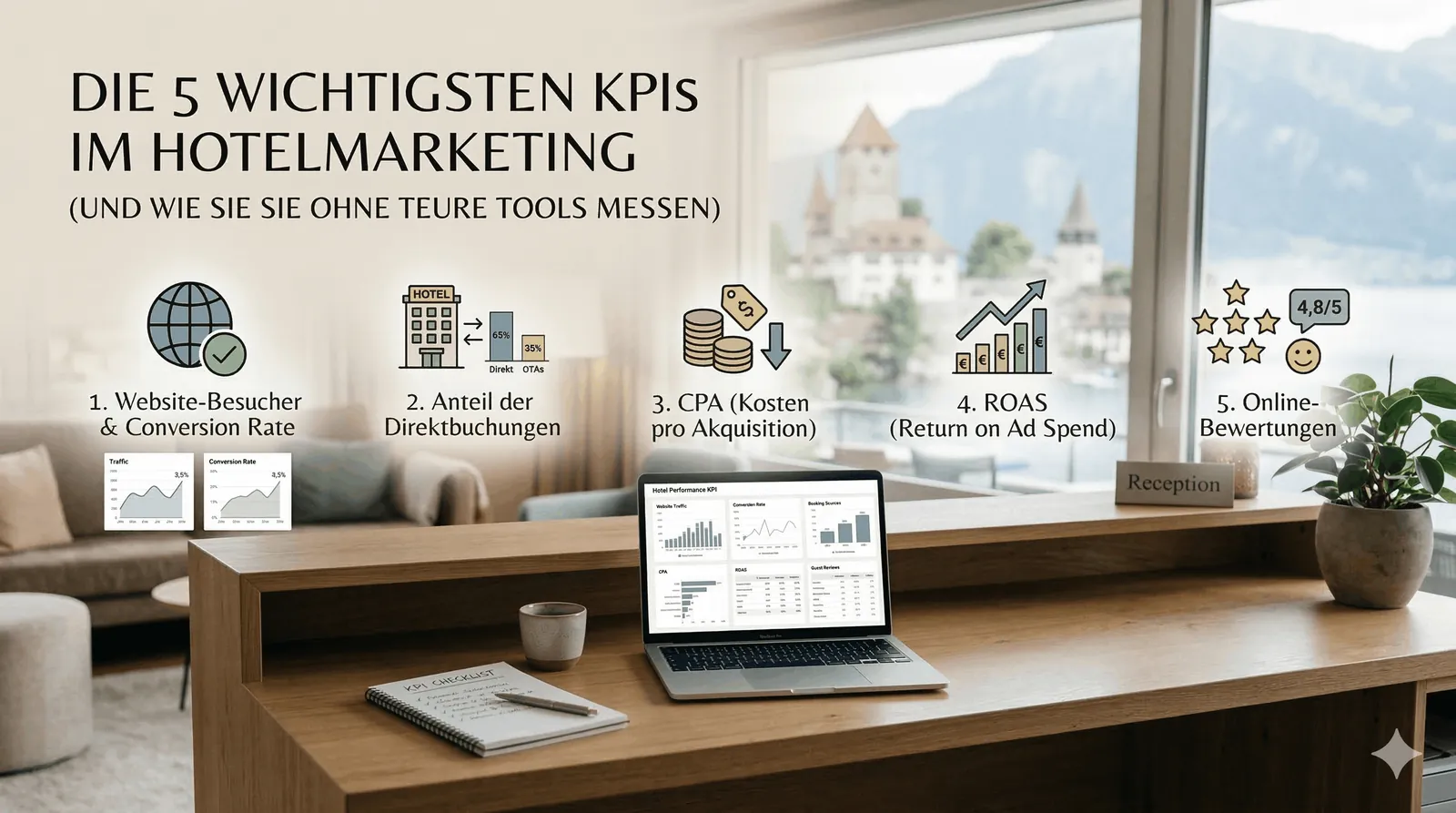
- Clear goals and KPIs. More direct bookings? Higher occupancy in the low season? Stronger perception in the MICE segment? The more concrete, the better.
- Regular review cycles. Monthly, quarterly — depending on intensity. Marketing without a feedback loop is marketing into the void.
- Mutual trust and time. Good marketing needs a run-up period. Stable and sustainable results can only be properly assessed after a sufficiently long measurement period.
The decisive question when choosing an agency: who is already thinking digitally — and who is already thinking in AI?
The marketing landscape is changing faster than ever. Anyone evaluating an agency today should not just ask, "How many followers have you built up for us?" — but rather, "How do you use current digital tools and AI-supported methods in your work?"
From automated content production to AI-supported target group analysis to data-based campaign optimisation — the agencies that invest here will give their clients a measurable edge in the coming years. Those who still think in analogue terms will also deliver in analogue terms.
Digital competence is no longer a nice-to-have. It is a selection criterion.
Conclusion: the bread roll does not lie
Hotels are masters of efficiency. They know exactly what they need to be able to do themselves and what they are better off buying in. At breakfast, with the laundry, with the concierge service.
It is time to consistently apply this logic to marketing.
Because at the end of the day, an empty hotel with a perfect Instagram feed is just as bad as a full hotel with lukewarm coffee.
The difference: the guest notices the lukewarm coffee immediately. The missing guests — you only notice those once it is too late.
Do you have questions about what structured marketing outsourcing could look like for your hotel? We would be happy to look at it together with you.
More related articles:
- Looking for a tourism marketing agency? (direct continuation of the argument)
- The most common online marketing mistakes of small Swiss hotels (practical consequence of doing marketing in-house)
- Online marketing for hotels without a marketing department: a 90-day roadmap (an alternative for businesses without an agency)