«We know what we should be doing – we simply lack the time.» We hear this sentence again and again in conversations with hoteliers. And the figures confirm it: a recent digitalisation study shows that half of the businesses surveyed name lack of time as the biggest obstacle to digital investment – not lack of knowledge or lack of interest. Anyone working without their own marketing department therefore doesn't need a master plan, but a realistic roadmap that can be implemented alongside day-to-day business.
The problem in everyday hotel life
In most small and medium-sized hotels, there is no one whose sole job is marketing. Management, sometimes supported by the front desk, handles the website, social media and advertising on the side – between check-ins, complaints and staff scheduling. The result is often marketing that consists of isolated, disconnected actions: an Instagram post here, a Google Ads campaign there, a website update whenever there happens to be time. A well thought-out plan with clear stages is simply missing, because there is never enough breathing room in everyday operations for it.
Current findings from the study
- Lack of time is the biggest barrier to investment, not money. According to a recent digitalisation study, 50 percent of the hotel businesses surveyed cite lack of time as the main reason why digital measures are not implemented.
- The knowledge is usually there – implementation is what's missing. Many hoteliers already know the relevant digital measures, but do not implement them consistently due to resource constraints.
- Smaller businesses act in a more structurally heterogeneous way. Without dedicated IT or marketing staff, the structure needed to implement measures systematically rather than sporadically is often missing.
- Digital transformation works best in clear stages. Rather than one big overhaul, an approach with clear intermediate goals that can be implemented individually is recommended.
- Guest retention remains an underestimated lever. A recent industry survey shows that more than half of hoteliers see the retention of returning guests as the greatest untapped revenue potential – an area that fits well into a step-by-step marketing plan.
What does this mean for your hotel?
1. Foundations first, campaigns later
In the first few weeks, it pays to stabilise the basics – website facts, Google Business Profile, technical foundations – before any money flows into advertising at all. A campaign built on a weak foundation wastes budget.
2. Plan weekly rather than daily routines
A realistic roadmap doesn't require daily marketing work, but fixed weekly time slots – for example, one hour for maintaining the Google Business Profile, another for social media. This can be kept up alongside day-to-day business.
3. Take an honest look back after 90 days
A roadmap is not an end in itself. After three months, it's worth looking at booking sources: what has changed, what hasn't? Only this way can the next cycle be planned deliberately instead of starting from zero again.
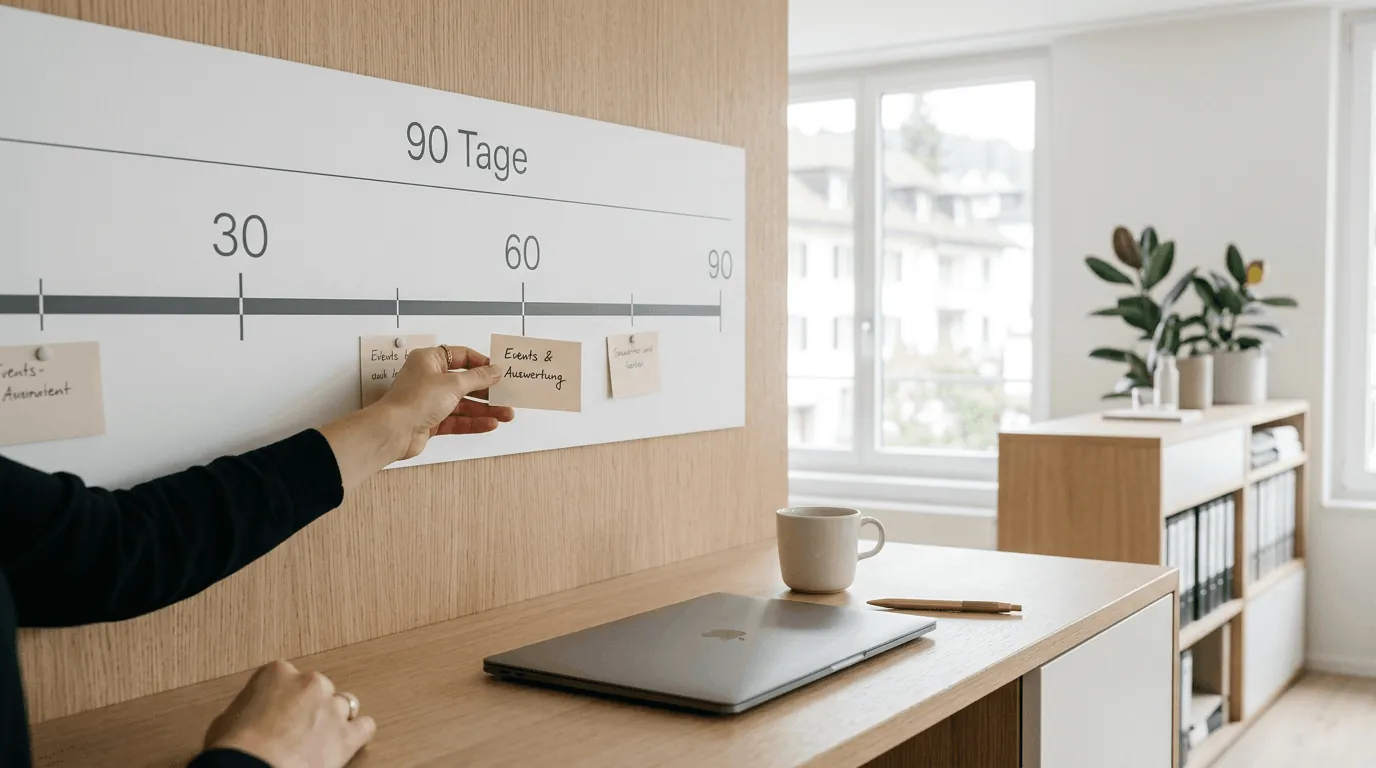
The 90-day roadmap at a glance
Days 1–30: building the foundations
Review website content and add clear facts (room size, amenities, directions). Fill out the Google Business Profile completely and add current photos. Review existing guest data and prepare it for a simple email programme.
Days 31–60: building visibility
Maintain the Google Business Profile weekly (new images, responses to reviews). Launch a first, clearly focused Google Ads or Meta Ads campaign with a small budget. Establish a regular but realistic rhythm for social media posts – two well thought-out posts per week are better than daily rush.
Days 61–90: deepening and measuring
Send a first email to regular guests, for example with a seasonal offer. Evaluate campaign results and adjust budget accordingly. Analyse booking sources from the last three months and use them to define the next 90-day cycle.
Practical example: a city hotel in Lucerne
Starting point: A city hotel with 45 rooms had neither a fixed schedule nor clear responsibility for online marketing. Measures were implemented irregularly, usually when occupancy was low and there was acute pressure to act.
Measure: Management introduced a 90-day roadmap with fixed weekly time slots for the Google Business Profile and social media. In the first four weeks, only the website was revised, followed by a first small Google Ads campaign for the low season. In the last four weeks, a simple email programme for existing guests was set up.
Result / expectation: After 90 days, the analysis of booking sources showed a clear increase in direct enquiries via Google. Weekly time spent remained manageable at around three hours, allowing the roadmap to continue into the next quarter instead of fizzling out after the first push.
(This example has been simplified slightly for illustrative purposes.)
Common mistakes
- Trying to implement too much at once. Anyone who tries to overhaul the website, social media and advertising campaigns all in the first week usually abandons the effort after a short time.
- Not scheduling fixed time. Without a fixed weekly appointment, marketing keeps getting pushed to «whenever there's time» – which in practice means never.
- Not evaluating after 90 days. Without an honest review, it's impossible to tell what actually worked – the next cycle then starts from zero again.
Conclusion
A small hotel without its own marketing department doesn't have to forgo professional online marketing – it just needs a more realistic rhythm than large chains. A 90-day roadmap with clear stages, fixed weekly time slots and an honest evaluation at the end turns isolated marketing actions into a continuous process. The most important step is not the biggest measure, but the first one: scheduling a fixed weekly appointment in the calendar and sticking to it.
Sources
- HOGAPAGE Nachrichten: Study on digitalisation in hotels (Betterspace study, 2026)
- HOGAPAGE Nachrichten: Study on digitalisation in hotels (Gastfreund GmbH, May 2026)
- htr.ch: Closing the digital gap in hospitality
- News-Bloggen: DACH Hospitality Benchmark 2026: Hotels recognise their revenue potential – but barely tap into it
More related articles:
- The most common online marketing mistakes of small Swiss hotels (starting point)
- The winners in hotel marketing build systems, not individual measures (target image of the roadmap)
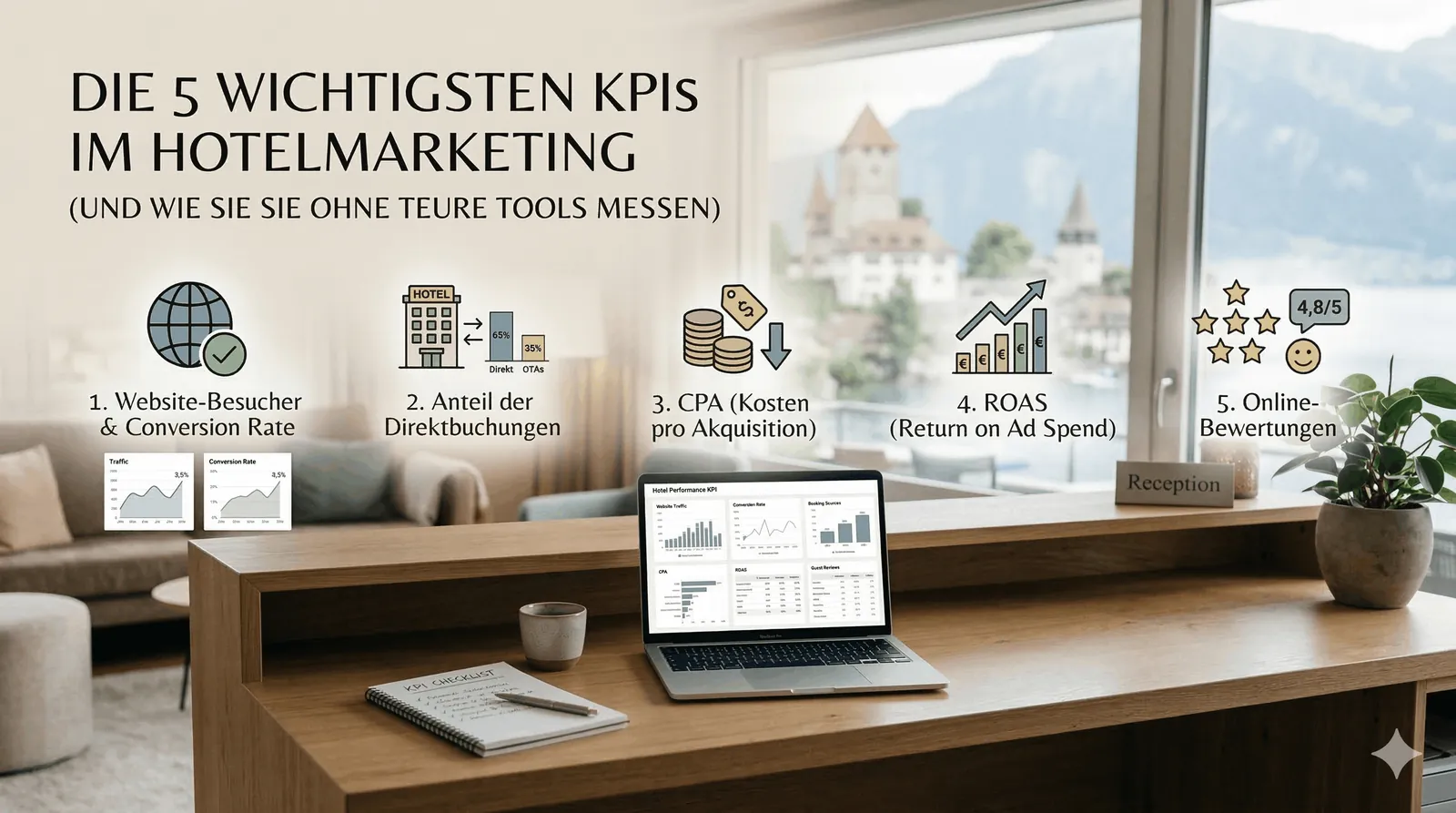
- The 5 most important KPIs in hotel marketing (measuring success after 90 days)
- Why does a hotel buy bread rolls from the baker (a contrasting perspective on outsourcing)