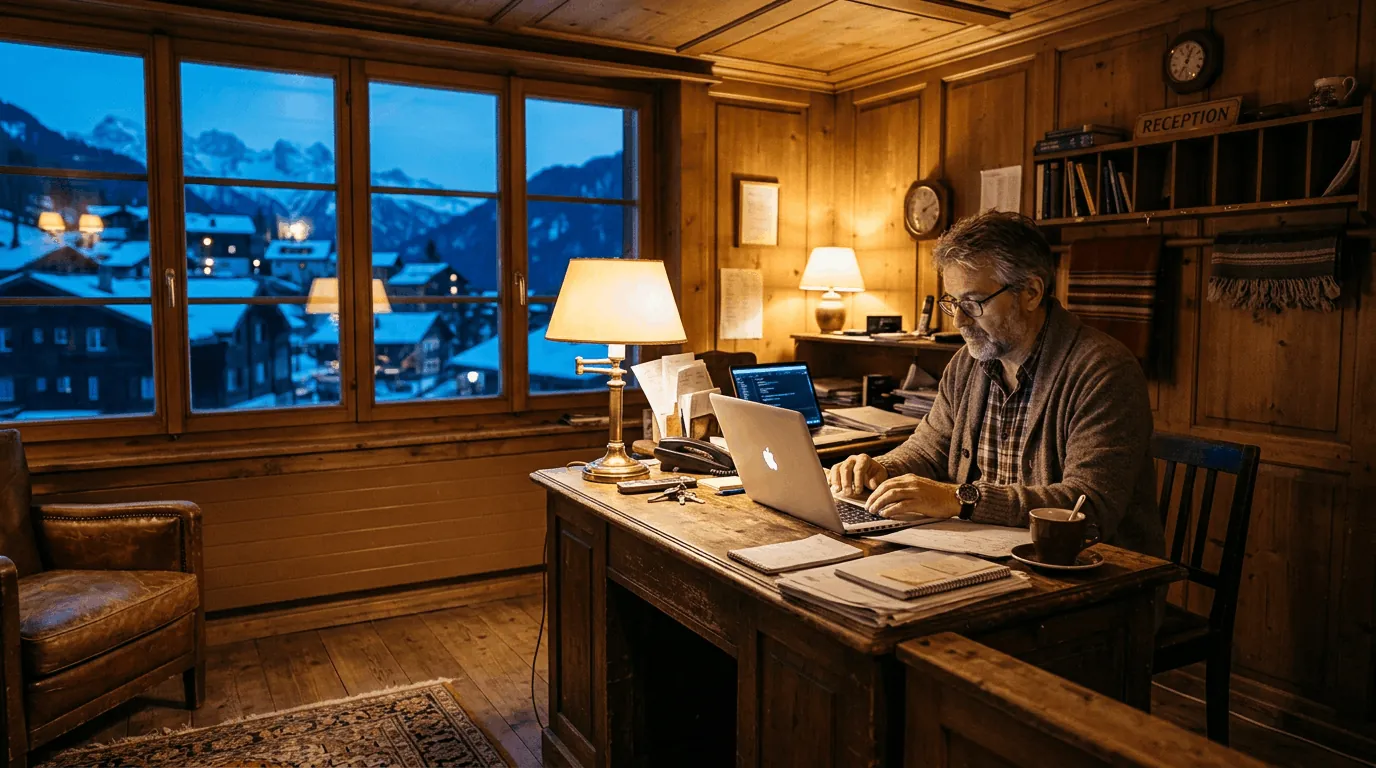
In 2026, small, owner-managed hotels face a pressure that large chains barely know: marketing happens on the side, usually without a dedicated specialist. This is not a criticism, but a reality — yet it is precisely this reality that gives rise to typical mistakes that could be avoided with little effort. Anyone who recognises them can correct them in a targeted way, without having to overhaul their entire marketing approach.
The problem in everyday hotel operations
In a property with 20 to 40 rooms, there is rarely a person dedicated full-time to online marketing. Management, sometimes supported by the front desk, maintains the website, posts on social media and occasionally runs ads — squeezed in between check-ins, complaints and supplier appointments. Current industry observations confirm this pattern: larger hotels work more systematically on digital processes, while smaller properties often operate more heterogeneously and have no dedicated IT or marketing staff (hogapage). This does not necessarily lead to less commitment, but it does lead to recurring, avoidable mistakes.
Current developments in the industry
- Digitalisation is no longer optional — it is an economic necessity. Rising costs and shrinking margins make operational efficiency — including in marketing — a survival factor for smaller properties (hogapage).
- Small and medium-sized hotels are particularly affected by structural change. Industry analyses estimate that several dozen smaller properties close each year in Switzerland — alongside succession problems, a lack of adaptation to digital requirements is one of the drivers (hotelinside).
- Digital transformation is an ongoing process, not a one-off project. Clear milestones instead of sweeping overhauls are considered a decisive success factor, especially for businesses with limited resources (htr).
- Digital presence alone is no longer enough. Those who want to succeed online must tell stories — emotional, visual and tailored to the platform, rather than merely being present (htr).
- Even small hotels can achieve above-average numbers of direct bookings with targeted digital measures. A Swiss boutique hotel example shows a direct booking share of over 30 percent — more than double the Swiss average — thanks to consistent, but simple digital measures (htr).
What does this mean for your hotel?
1. Limited resources does not mean limited impact
A small team cannot excel on every channel at once. What matters is focusing on two to three channels that demonstrably bring in guests, rather than spreading yourself thin across all of them at the same time.
2. Plan digitalisation in small steps
Rather than implementing an entire marketing strategy at once, a clear step-by-step plan helps: first the website fundamentals, then the Google Business Profile, then targeted advertising measures. This keeps the workload manageable in everyday operations.
3. Communicate stories, not just facts
A room list with prices is not enough. Guests choose experiences — your own story, the location, the team. Making this visible online sets you apart from pure booking platforms, where hotels tend to look interchangeable.
Case study: a mountain hotel in Valais
Starting point: A family-run mountain hotel with 24 rooms had barely maintained its website for years, posted irregularly on Instagram and had no budget planned for paid advertising. The direct booking rate was well below the industry average, and most rooms were sold through an OTA.
Measures taken: Instead of a major relaunch, three simple steps were implemented: The website received current, professional photos and clear information about the location, rooms and amenities. The Google Business Profile was fully completed and updated weekly with images. In addition, a small monthly budget was allocated for locally targeted Google Ads, focused on the main season.
Result / expectation: Within just a few months, inquiries through the hotel's own website rose noticeably, while dependence on the OTA declined slightly. The hotel plans to implement the next step — a simple email programme for regular guests — in the following quarter.
(This example has been slightly simplified for illustrative purposes.)
Common mistakes
- Trying to be active on too many channels at once. Anyone who wants to be active on Instagram, Facebook, Google Ads and newsletter at the same time ends up only doing each one halfway — with correspondingly half the impact.
- Neglecting the Google Business Profile. An incomplete or outdated profile costs visibility exactly where many guests search first.
- Treating marketing as a one-off project instead of an ongoing process. A website that is built once and then left untouched for years continuously loses relevance — both with guests and with search engines.
Conclusion
Small Swiss hotels do not need to compete with large chains on marketing budget — but they can avoid many of the most costly mistakes without hiring additional staff. The key lies in focusing on a few channels, maintaining them consistently, and understanding marketing as an ongoing process rather than a one-off project. Getting these fundamentals right often gets more out of an existing budget than any additional campaign ever could. It is worth taking an honest first look: which of these three mistakes is happening in your business right now?
Sources
- Gastfreund GmbH: industry report "Digitalisierung & KI in der Hotellerie", cited in HOGAPAGE Nachrichten
- HES-SO / htr.ch: Digitale Kluft in der Hotellerie schliessen
- HotellerieSuisse study, cited in Hotel Inside: Vom Gastgeberland zum Konsolidierungsmarkt
- Lenk Lodge case study, cited in htr.ch: Digital statt analog
Further related articles:
- Warum kauft ein Hotel die Brötchen beim Bäcker (overarching thesis)
- Online Marketing für Hotels ohne Marketingabteilung: 90-Tage-Fahrplan (solution approach)
- Die Gewinner im Hotelmarketing bauen Systeme, nicht Einzelmassnahmen (related structural topic)
- Tourismus Marketing Agentur gesucht? (alternative: professional support)