
Anyone searching for a "tourism marketing agency" today finds a wide range of options — from broadly positioned advertising agencies to studios specialised in tourism to individual consultants. This very diversity makes the decision difficult, because not every agency listing "tourism" in its portfolio truly knows the industry from the inside. For hotels and destinations with limited budgets, this choice is decisive, as it determines whether marketing funds have a targeted effect or seep away in generic campaign logic.
Problem in everyday hotel operations
Many hotels and tourism organisations have no marketing department of their own and sooner or later have to decide on external support. The choice is often made on gut feeling, recommendation or price — rarely with a clear view of whether the agency understands the particularities of the industry: seasonal demand, long booking lead times for holiday trips, the role of OTAs such as Booking.com, or the special importance of images and emotions in travel decisions. A generalist agency can work technically cleanly and still plan past the reality of the industry.
Current findings from studies / events
An analysis of current market observations on marketing outsourcing among Swiss SMEs and tourism businesses in 2026 shows several clear developments.
- Marketing outsourcing is becoming the norm, not the exception. More and more small and medium-sized tourism businesses are outsourcing marketing tasks in whole or in part, because internally there is neither the time nor the specialised knowledge available.
- The central question is no longer "agency or not", but "which agency". Businesses are increasingly looking specifically for partners with a clear industry focus rather than interchangeable full-service providers.
- A single point of contact is preferred over several individual agencies. Businesses without their own marketing department benefit from receiving strategy, implementation and channels from a single source, rather than having to coordinate several specialist agencies themselves.
- Transparent, predictable costs are gaining importance. Clear hourly packages or fixed prices instead of non-transparent billing are increasingly becoming a decision criterion when choosing an agency.
- Specialisation in tourism shows measurable effects in practice. Agencies that work exclusively or predominantly for hospitality and tourism understand seasonal booking patterns and guest behaviour from the outset — an advantage reflected in shorter onboarding times.
What does this mean for your hotel?
1. Check industry experience before portfolio size
Do not just ask how many clients an agency serves, but how many of them come from hospitality and tourism. An agency that mainly serves local trades or e-commerce shops brings a different understanding of campaign logic than one that works daily with seasonality, room inventory and booking lead times.
2. Collaboration from a single source instead of piecemeal channels
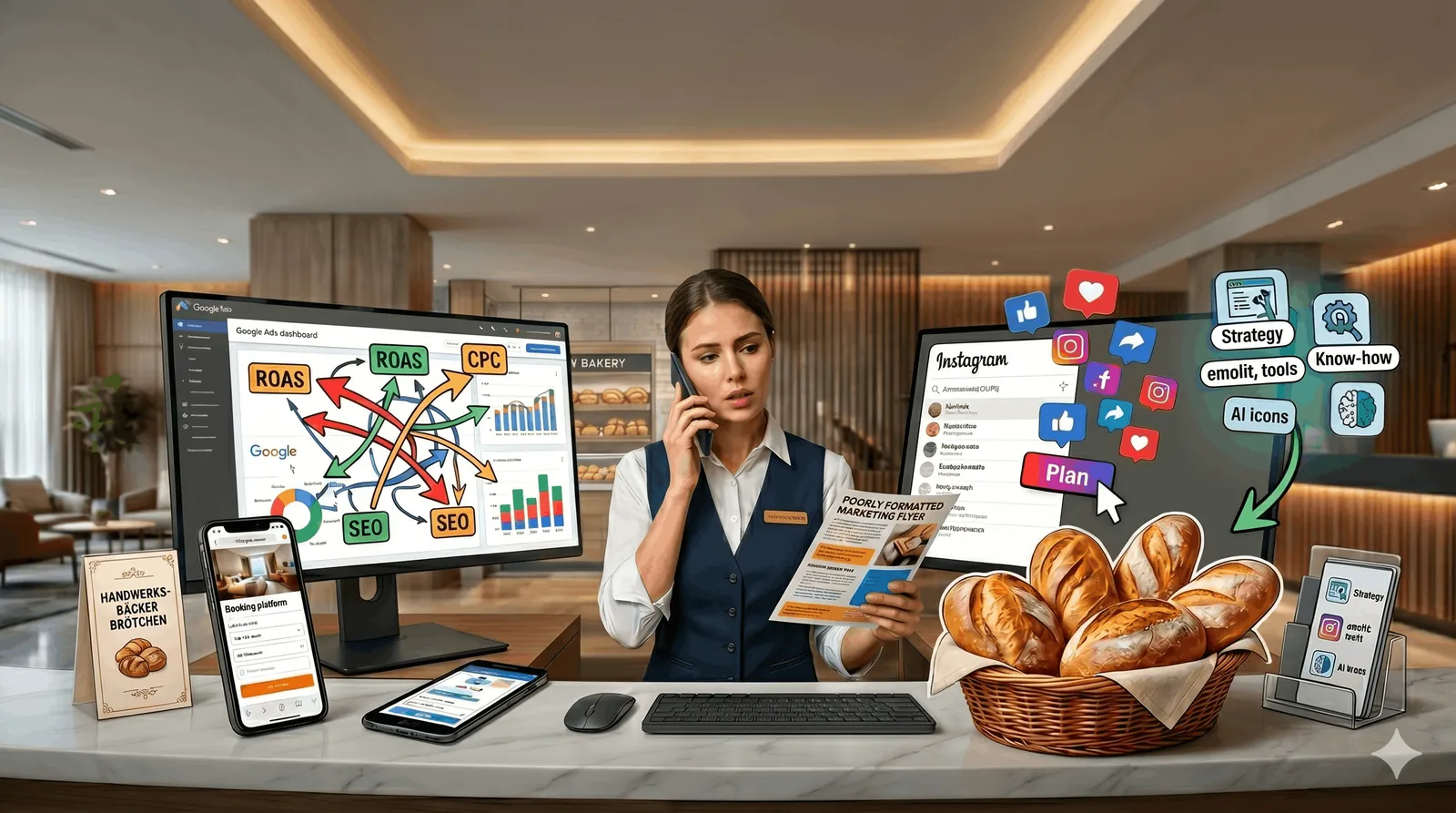
Check whether an agency thinks of strategy, Google Ads, SEO, social media and website optimisation as a coherent system or offers them as loose individual measures. Those who commission a different agency for each channel quickly lose sight of the bigger picture — and often pay twice for contradictory measures.
3. Demand transparency on costs and results
A good tourism marketing agency discloses what its budget is used for and how success is measured — for example by direct bookings rather than just reach or clicks. Insist on clear, comprehensible reporting instead of vague promises of success.
Concrete practical example
Starting point: A city hotel with 60 rooms in a medium-sized Swiss city had worked for years with a local advertising agency that also served restaurants, retailers and craft businesses. The website was appealingly designed, but direct bookings stagnated while commissions to online booking platforms kept rising.
Action taken: The hotel switched to an agency specialised in tourism. For the first time, this agency consistently aligned campaigns with seasonal booking windows, revised the Google Business Profile in an industry-specific way, and connected the website, Google Ads and email marketing into a joint system instead of isolated measures.
Result / expectation: Within six months, direct bookings rose noticeably, while the share of room nights mediated via OTAs declined. The hotel attributes this mainly to the industry-specific timing of the campaigns and the coordinated collaboration across all channels.
(This example is fictional for illustrative purposes but reflects a process typical in practice.)
Common mistakes
- Choosing an agency based on price rather than industry fit. The cheapest offer helps little if the agency does not understand the particularities of travel and booking behaviour.
- Commissioning too many separate agencies in parallel. Those who assign SEO, ads and social media separately risk contradictory messages and double costs for the same target audience.
- Measuring success only by reach rather than bookings. Likes and clicks say little about whether a campaign actually leads to more room nights.
Conclusion
Choosing a tourism marketing agency is not purely a matter of taste, but a strategic decision with a direct effect on direct bookings and independence from OTAs. An agency that understands the industry not only saves onboarding time but also factors in seasonal cycles and guest behaviour from the start. Anyone planning their next collaboration or reconsidering an existing one should ask less about the largest portfolio size and more about the deepest industry knowledge. In the end, what counts is not how creative a campaign looks, but whether it actually leads to more bookings.
Sources
- Witers: Marketing outsourcing for tourism & small businesses
- Witers: 7 marketing agencies for tourism & SMEs in Switzerland
- kaos.de: Marketing outsourcing for SMEs in practice
- magic-writing.de: External marketing department for SMEs — successful marketing outsourcing
- OBT: SME study 2026
More related articles:
- Why does a hotel buy its bread rolls from the baker — but do its own marketing? (same core message: outsourcing)
- The most common online marketing mistakes of small Swiss hotels (evidence for why specialist knowledge matters)
- The winners in hotel marketing build systems, not individual measures (related argument for professional support)