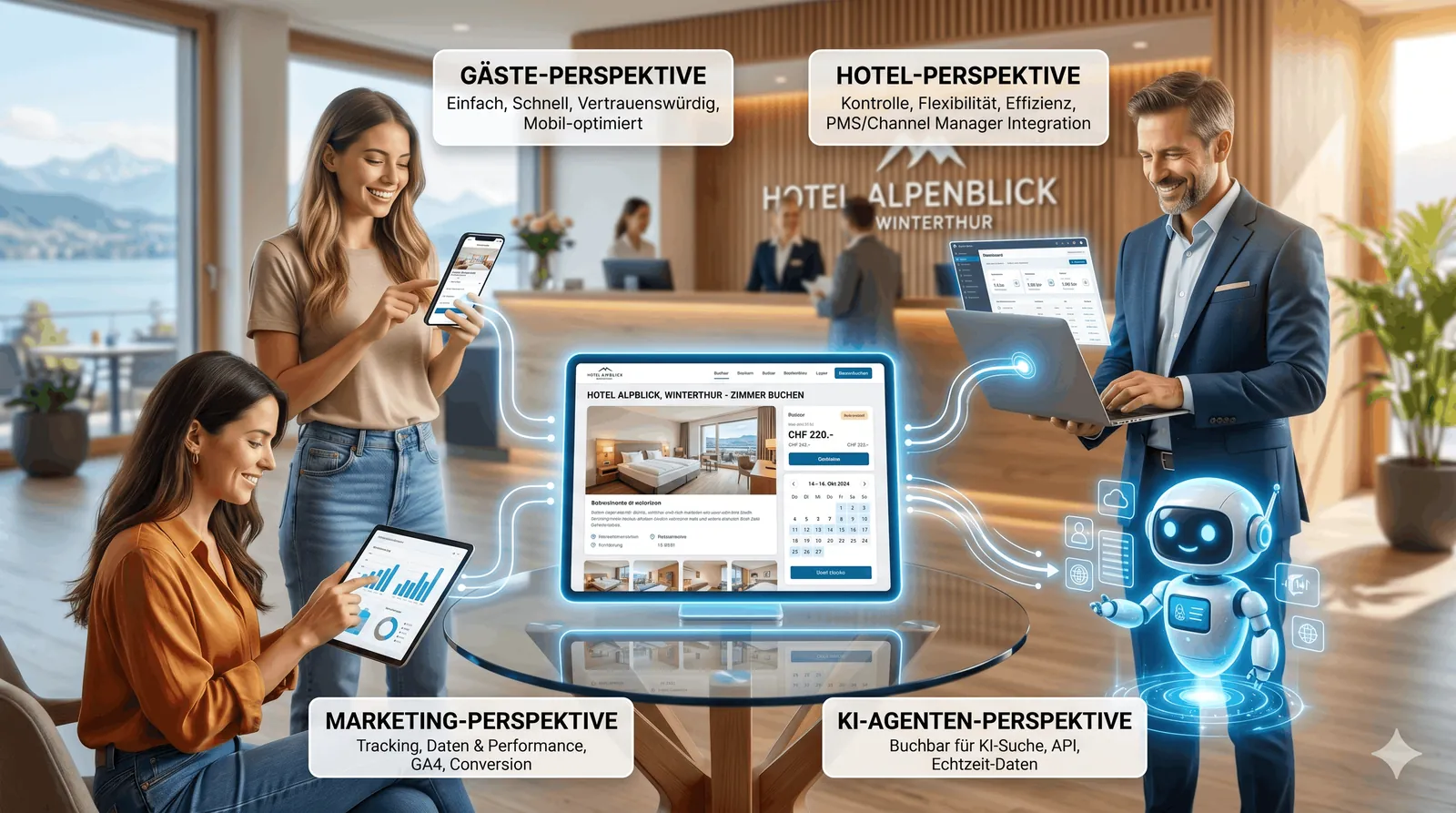
The booking engine is the heart of every hotel website. It is the moment when an interested visitor becomes a paying guest — or not. And yet the choice of the right system is often underestimated or reduced to a single aspect. In fact, four different stakeholder groups have very different — and equally legitimate — requirements: guests, the hotel, the marketing agency and — newly and increasingly decisively — AI agents. Only those who understand all four perspectives make the right decision.
1. The guest perspective: simple, fast, trustworthy
The guest arrives at the website, is interested — and now faces the booking mask. What happens next decides everything.
Mobile-optimised and fast-loading
Why does it matter? Over 60% of hotel website visits now take place on smartphones. If the booking engine is clunky, slow or confusing on mobile, the guest abandons — and books the next match on booking.com instead. A booking engine that does not work flawlessly on mobile costs direct bookings every day.
Clear display of availability and prices
Why does it matter? Guests want to see immediately what is available and what it costs — without guesswork. Unclear pricing structures, hidden extra costs or a confusing room selection create uncertainty. Uncertainty leads to abandonment. The booking engine must present prices transparently, comparably and understandably — including clear differences between rate plans (e.g. flexible vs. non-refundable).
Multilingual and multi-currency
Why does it matter? A hotel in Switzerland is visited by guests from Germany, France, the USA or Asia. If the booking mask is only available in German or only shows CHF, you lose international guests — who are often particularly attractive target groups. Multilingualism and local currency display significantly lower the barrier to booking.
Trust signals and secure payment
Why does it matter? Online payments are still a sensitive moment for many guests. A booking engine must be SSL-encrypted, offer common payment methods (credit card, TWINT, PayPal etc.) and visibly communicate security. If trust signals are missing, the guest has doubts — and prefers to book on the familiar platform booking.com, where they feel safe.
No media discontinuities
Why does it matter? If the guest clicks "Book now" and suddenly lands on a completely different-looking page — different design, different language, different feel — they lose trust. The booking engine should be seamlessly integrated into the hotel website, ideally with the same design, logo and colour scheme. This is also known as "white-label integration".
2. The hotel perspective: control, flexibility and efficiency
The hotel operates the booking engine. It must work with it every day — ideally without much effort.
Seamless integration with PMS and channel manager
Why does it matter? The Property Management System (PMS) is the hotel's control centre — all bookings come together there. The channel manager distributes availability to OTAs such as booking.com. If the booking engine does not communicate with both systems in real time, overbookings, manual rework and errors are likely. A clean interface (API integration) is therefore not optional, but essential.
Flexible rate plans and offers
Why does it matter? Hotels need to be able to react quickly to fluctuations in demand: early-bird discounts, last-minute offers, packages with breakfast or spa, exclusive direct-booking benefits. A good booking engine allows such rate plans to be created and activated easily, without IT knowledge. Those who need to rely on external help lose valuable time — and revenue.
Making direct-booking benefits visible
Why does it matter? The biggest lever for more direct bookings is the message: "Booking here pays off." Whether free cancellation, upgrades, breakfast included or the best price — the booking engine must be able to present such benefits prominently and convincingly. Without this differentiation, the guest has no reason not to simply book on booking.com.
Clear backend and easy operation
Why does it matter? Hoteliers are not software specialists. The booking engine's backend must be intuitive to use — for the receptionist just as much as for the director. Complicated interfaces lead to errors, frustration and, in the worst case, incorrectly set prices or availability.
Upselling and additional services
Why does it matter? The booking engine is not just a reservation tool — it is also a sales channel. Those who can offer additional services at checkout (parking, breakfast, spa voucher, shuttle) increase the average booking value without extra effort. Good booking engines integrate such upselling functions directly into the booking process.
Automated guest communication
Why does it matter? Booking confirmation, reminder email before the stay, thank-you email after check-out — all of this should run automatically. Manual emails cost time and, in everyday operations, often simply do not happen. Automated communication improves the guest experience while also offering further upselling opportunities.
3. The marketing agency perspective: tracking, data and performance
This point is most often forgotten when choosing a booking engine — and it is at the same time one of the most important. Because without clean tracking, no one knows whether the marketing is actually working.
Google Analytics 4 (GA4) integration
Why does it matter? GA4 is the standard for website analysis. The booking engine must be fully integrable into GA4 — including e-commerce tracking. Only then can the marketing agency measure which campaigns, channels and keywords actually lead to bookings. Without this data, online marketing is essentially flying blind.
Google Ads conversion tracking
Why does it matter? If a guest arrives at the website via a Google ad and books, this booking must be recorded as a conversion in Google Ads. Only then can the system learn which ads and target groups really convert — and optimise campaigns accordingly. Booking engines that do not support this tracking make precise Google Ads management simply impossible.
Meta Pixel and social media tracking
Why does it matter? The same principle applies to Facebook and Instagram campaigns: the Meta Pixel must be active in the booking engine to capture bookings as conversions. Only then can retargeting campaigns — that is, specifically addressing guests who abandoned the booking process — be used effectively.
Cookie consent and data protection
Why does it matter? Tracking is only permitted if the guest has given consent. The booking engine must be compatible with the website's cookie consent system. If this compatibility is missing, tracking data is either captured illegally — or not at all, because the consent banner blocks tracking. Both are a problem.
Clean URL structure and UTM parameters
Why does it matter? When a guest arrives at the website via a campaign, the source information is passed along in so-called UTM parameters in the URL. The booking engine must preserve these parameters throughout the entire booking process. If this information is lost, it is no longer possible to attribute bookings to campaigns — and the marketing budget cannot be managed sensibly.
Funnel analysis: Where do guests drop off?
Why does it matter? A good booking engine allows the booking process to be analysed step by step: How many guests start the booking? Where do they drop off? On which device? This data shows exactly where there is potential for optimisation — whether in the pricing model, the booking form or the payment process.
4. The AI agent perspective: bookable for the next generation of search
This fourth perspective was still a vision of the future until recently — it no longer is. As we described in our article "Google becomes a booking agent..., the way guests find and book hotels is changing fundamentally: it is no longer the human navigating through portals and filling out booking masks — an AI agent does this on the guest's behalf. Direct, automatic, in seconds.
This raises a new, decisive question: Is your booking engine even accessible and bookable for AI agents?
API openness: Can an AI agent even make a request?
Why does it matter? AI agents — whether from Google, OpenAI or other providers — do not communicate via a website interface, but directly via programming interfaces (APIs). A booking engine that does not offer an open, standardised API is simply invisible to these systems. It cannot be queried, compared or booked. Those without an API do not exist in the AI-driven booking world.
Structured data: Does the AI understand what the hotel offers?
Why does it matter? AI systems do not read glossy websites — they read structured data. Through so-called Schema.org markup, hotel information (room types, prices, amenities, location, reviews) can be prepared so that search engines and AI agents can interpret it precisely. Without this structured data, an AI agent cannot correctly classify the hotel — and simply does not recommend it.
Connection to AI booking platforms
Why does it matter? Google is already working with Booking.com, Expedia, Marriott and other partners on direct hotel booking via AI Mode. Those reachable via these partner platforms, with a booking engine connected compatibly, have a real chance of appearing in AI-generated booking recommendations. Those not connected are passed over — regardless of how good the hotel itself is.
Real-time availability: No outdated data
Why does it matter? AI agents work with live data. If the booking engine does not deliver availability and prices in real time, the results are wrong — and an AI agent that provides incorrect information loses its user's trust. Outdated or faulty availability data cause the hotel to fall out of AI-driven recommendations.
Multilingual and complete data maintenance
Why does it matter? AI agents respond in the guest's language and filter according to precise criteria. A hotel whose data is only maintained in German and incompletely will simply not be considered for English- or French-language queries. Complete, multilingual and regularly updated master data are the basic requirement for AI visibility.
Conclusion: the booking engine is a strategic decision
A booking engine is not a commodity product that you install once and forget. It is the hotel's most important sales channel — today for guests and campaigns, tomorrow also for AI agents.
Those who look only at the price end up paying more in the end: through lost direct bookings, uncontrollable campaign costs and missing AI visibility. Those who, on the other hand, include all four perspectives — guest, hotel, marketing, AI — in the evaluation make a well-founded decision with long-term impact.
Not sure which booking engine suits your hotel? We help with the evaluation and make sure that tracking and AI connectivity are set up correctly from the start.
Checklist: what a good booking engine should be able to do
For guests:
- ✅ Mobile-optimised and fast-loading
- ✅ Clear display of availability and prices
- ✅ Multilingual and multi-currency
- ✅ Secure payment and visible trust signals
- ✅ Seamless white-label integration into the hotel website
For the hotel:
- ✅ Real-time PMS and channel manager connection
- ✅ Create flexible rate plans and offers independently
- ✅ Present direct-booking benefits prominently
- ✅ Intuitive backend, operable without IT knowledge
- ✅ Upselling functions in the booking process
- ✅ Automated guest communication
- ✅ Complete and up-to-date master data maintenance
For the marketing agency:
- ✅ GA4 e-commerce tracking fully integrated
- ✅ Google Ads conversion tracking
- ✅ Meta Pixel for Facebook and Instagram campaigns
- ✅ Cookie consent compatible and data-protection compliant
- ✅ UTM parameters persistent throughout the entire booking process
- ✅ Funnel analysis: making drop-offs visible step by step
For AI agents:
- ✅ Open API interface for automated requests
- ✅ Structured data (Schema.org) fully implemented
- ✅ Connection to AI booking platforms (e.g. Google, Booking.com, Expedia)
- ✅ Real-time availability — no outdated data
- ✅ Multilingual and complete data maintenance
Do you have questions on this topic? Contact us for a free initial consultation: tourismusconsult.ch/kontakt
Further reading: Google becomes a booking agent...
Other related articles:
- Conversion Rate Optimisation for Hotel Websites (area of application)
- Agentic Commerce: Making Your Hotel Bookable for AI Assistants (future requirement for booking engines)
- Why Your Hotel Website Will Be Your Most Important Sales Tool in 2026 (broader context)