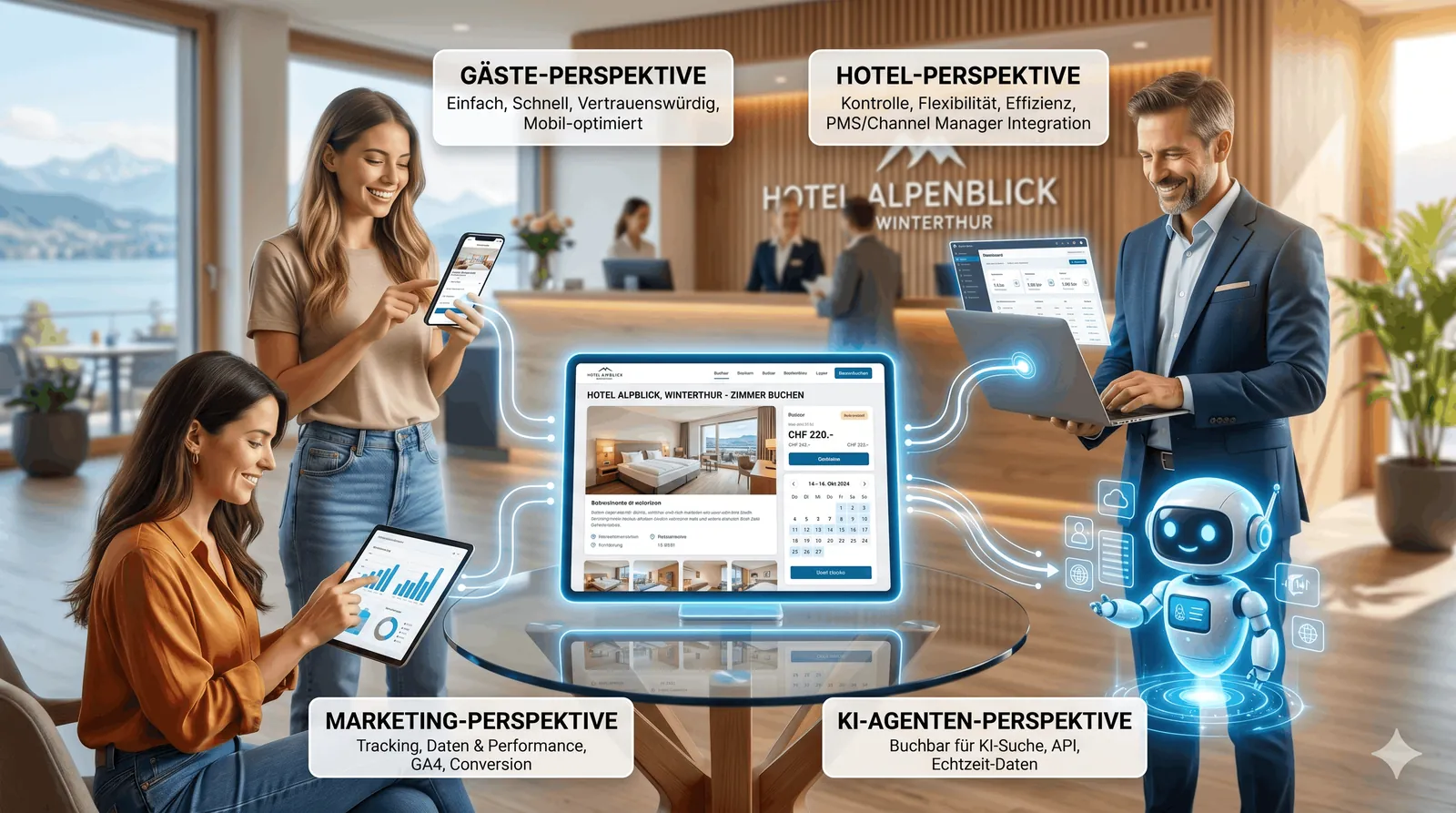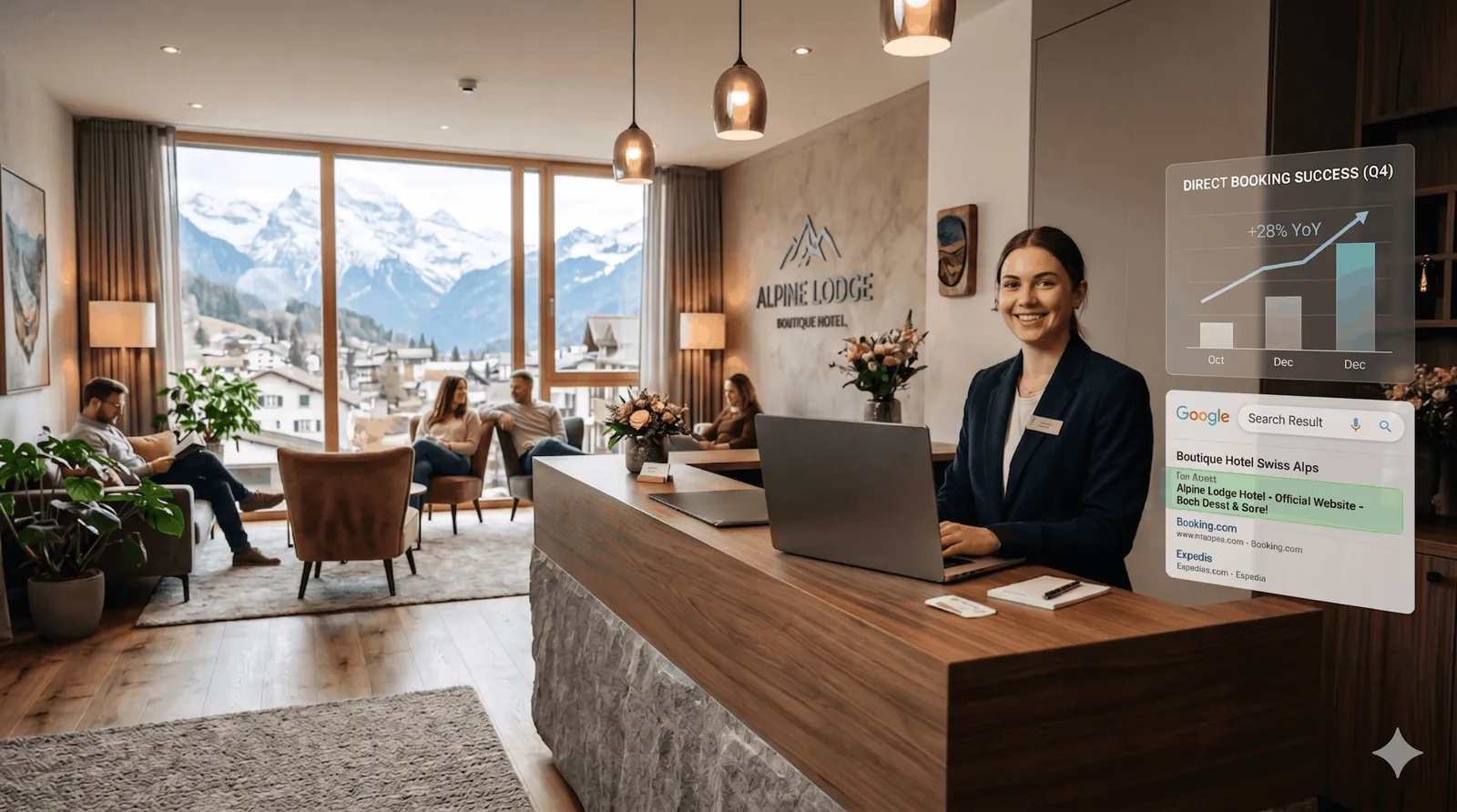
Imagine this: 100 potential guests visit your website today. 98 of them don't book. They leave the page — and end up at Booking.com or a competitor. This is exactly what happens every day on most hotel websites. The average conversion rate (the share of visitors who actually book) in 2026 stands at 1.5 to 2.5 percent. For comparison: Booking.com achieves rates of up to 15 percent among users ready to buy. The difference is no coincidence — it is the result of targeted optimisation.
The problem in everyday hotel life
Many hoteliers invest in Google Ads, SEO or social media — and this brings more visitors to their website. That makes sense. But if the website itself doesn't complete the booking, every franc of advertising budget goes to waste. Traffic without conversion is expensive. The underlying problem: most hotel websites are built for presentation, not for selling. Nice pictures, a pleasant text — but no clear path to booking, no convincing arguments for the direct channel, no answer to the questions a guest really has just before booking.
What the figures say
Current industry data from the Cloudbeds State of Independent Hotels Report 2026 (90 million bookings from over 180 countries) and benchmarks from Prostay and Roomstay paint a clear picture:
- 63.4 percent of all bookings at independent hotels run through OTAs — at costs of 18 to 30 percent per booking, once Genius discounts and visibility boosters are factored in.
- The average conversion rate of hotel websites is 1.5 to 2.5 percent. Well-optimised websites achieve 4 to 5 percent — double to triple that.
- Direct bookers are more valuable: according to Prostay, the average booking value via the direct channel is around CHF 417, compared to around CHF 259 via OTAs. Direct guests book higher-value rooms, stay longer and order more additional services.
- OTA cancellations are twice as frequent: 21.8 percent of OTA bookings are cancelled, compared to only 10.6 percent for direct bookings.
- 75 percent of travel bookings today take place on mobile devices — but most hotel websites are optimised for desktop.
One caveat applies to these figures: the conversion rate depends not only on the booking process but also on availability. If a hotel is fully booked on a given weekend, no booking path, however good, can turn a visitor into a guest — they want to book but cannot. Especially during peak periods or at small properties with few rooms, this pulls down the conversion rate without the website doing anything wrong. Anyone assessing their own rate should therefore differentiate it by occupancy — or at least keep in mind that a low figure during fully booked periods is not a warning sign.
What does this mean for your hotel?
1. The booking path must become shorter
Every additional click between arriving on the website and completing a booking costs bookings. Check: is the "Book now" button visible on every page — including on smartphones? Does a guest have to scroll to find it? Can date, room category and price be selected in just a few clicks? According to Gourmet Marketing, hotels that reduced their booking process to fewer than four steps report 10 to 22 percent more conversions within 90 days.
2. Build trust before the guest books
A guest visiting your website for the first time doesn't know you. They wonder: Is the hotel really as it appears? Can I cancel if my plans change? Am I really getting the best price here? Answers to these questions need to be visible — not hidden in the fine print. Reviews (with date and source), clear cancellation terms, and an explicit mention of the best-price advantage right next to the booking button are not extras. They are prerequisites.
3. Clearly communicate the direct booking advantage
Since the abolition of price parity in Switzerland, hotels are allowed to be cheaper on their own website than on Booking.com. Many don't do this — or don't communicate it. Yet this is the strongest lever of all. A concrete offer ("Book direct and get free breakfast") beats any abstract mention of "best prices". Make the advantage tangible — and place it where the guest sees it: on the homepage, on the room page, in the booking form.
Case study: Boutique-Hotel Seehof, Thun (fictional example)
Starting point: The Boutique-Hotel Seehof, with 28 rooms, had a well-designed website with professional photos. The conversion rate stood at 1.2 percent. 70 percent of bookings came through OTAs, and the direct share was stagnating.
Measures:
- The "Book now" button was displayed as a fixed element at the top of every page (sticky header), including on mobile devices.
- Right next to the button: a small banner reading "Direct booker advantage: breakfast included + free cancellation up to 48 hours".
- Genuine Google reviews (with star rating and date) were embedded on the room page.
- The booking process was reduced from seven to three steps — room selection, date entry, payment.
Result: Within three months, the conversion rate rose to 2.8 percent. The OTA share fell from 70 to 55 percent. Direct revenue rose by around 30 percent — without additional advertising budget.
Common mistakes
1. The booking button is not visible enough.
It's small, grey, or only reachable after scrolling. On smartphones, it disappears entirely. Anyone wanting to book has to search for it — and gives up.
2. The website is built for desktop, not for mobile devices.
75 percent of bookings today start on smartphones. If the booking process is cumbersome on mobile, the guest drops off — and ends up at Booking.com, which is optimised for mobile.
3. There is no clear reason to book direct.
"Book direct" is not an argument. "Book direct and get free breakfast, free cancellation and the guaranteed best price" is. If you don't name the advantage, you don't have one.
Conclusion
Conversion rate optimisation is not a technical niche topic. It's the question of whether your website functions as a sales tool or merely as a digital brochure. The good news: the biggest levers are not big projects. A visible booking button, a clear direct-booking advantage and a lean booking process — that's enough to noticeably improve the conversion rate. Anyone who implements this gets more out of the traffic they already have. And every direct booking that doesn't go through an OTA saves 18 to 30 percent in commission. That's not a marketing promise — that's mathematics.
Sources
- Cloudbeds: State of Independent Hotels Report 2026 — cloudbeds.com
- Prostay: Hotel Direct Booking Conversion 2026: The Website Playbook — prostay.com
- Roomstay: Hotel Conversion Rate Benchmarks & Boosting Tips for 2026 — roomstay.io
- Gourmet Marketing: Hotel Website Conversion Strategy: How Top Hotels Maximize Direct Bookings — gourmetmarketing.net
- Phocuswright: Global Travel Market Report 2026 — phocuswright.com
Further related articles:
- Why Your Hotel Website Will Be Your Most Important Sales Tool in 2026 (broader framework)
- Requirements for a Booking Engine on the Hotel Website (technical lever for CRO)
- SEO for Hotels: Why a Slow Website Costs You Bookings (related performance factor)
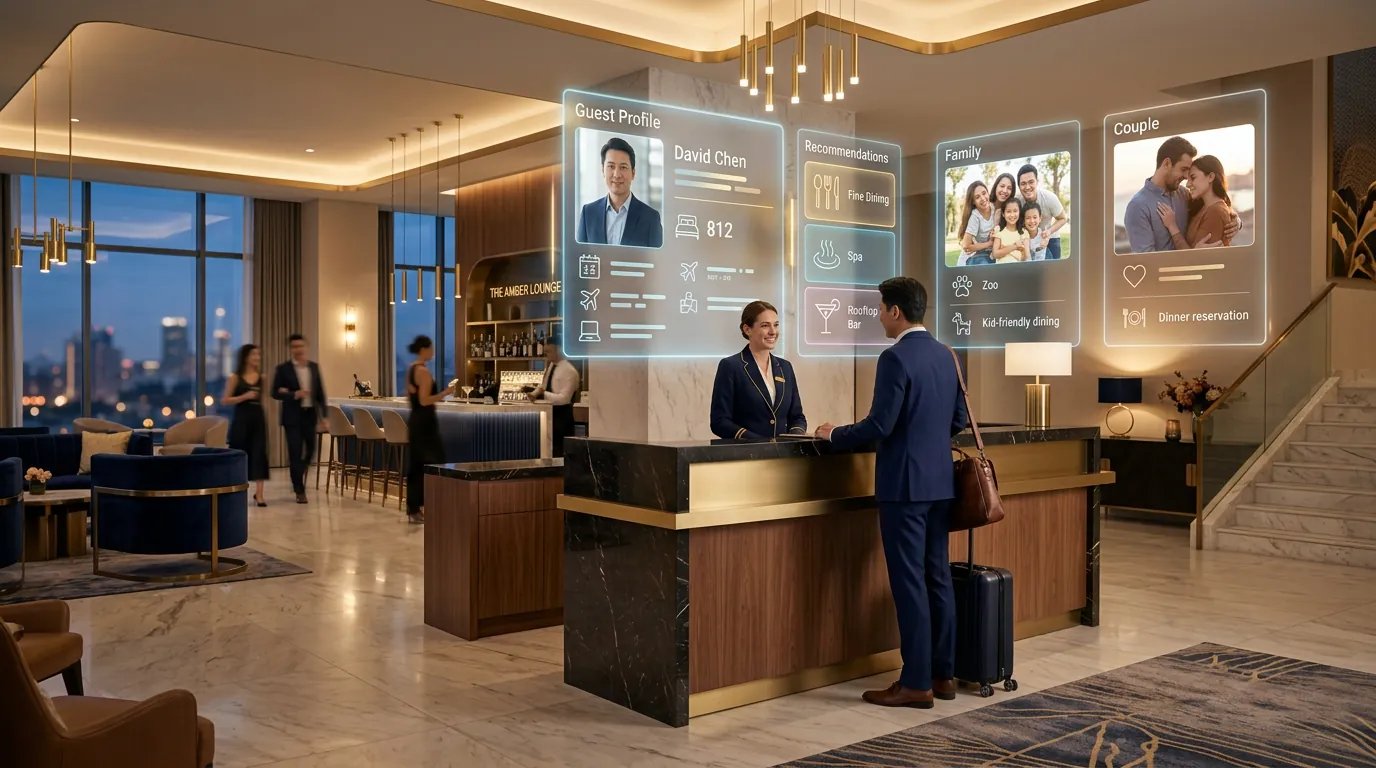
- Hyper-Personalisation 2.0 (another CRO lever)