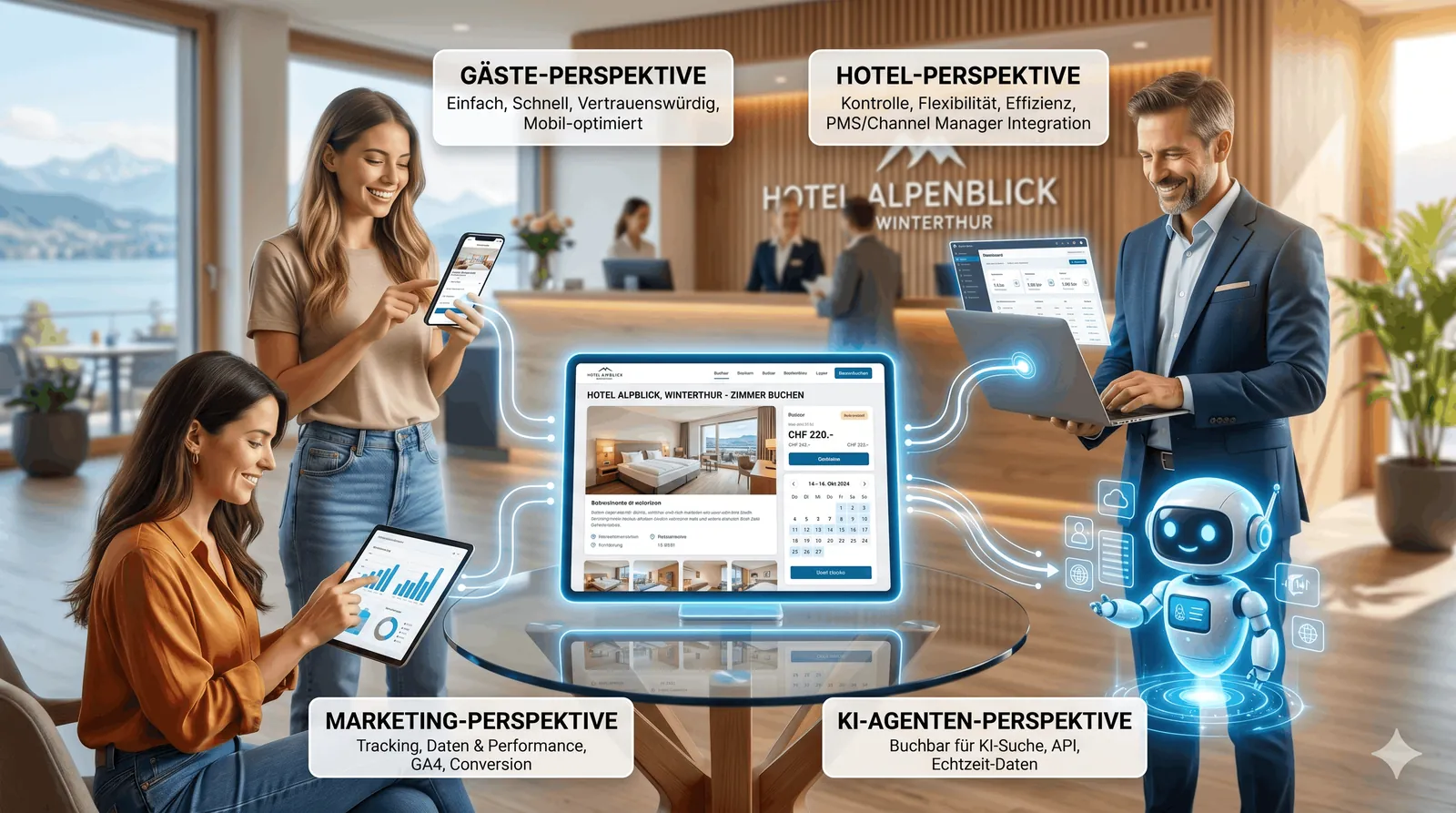
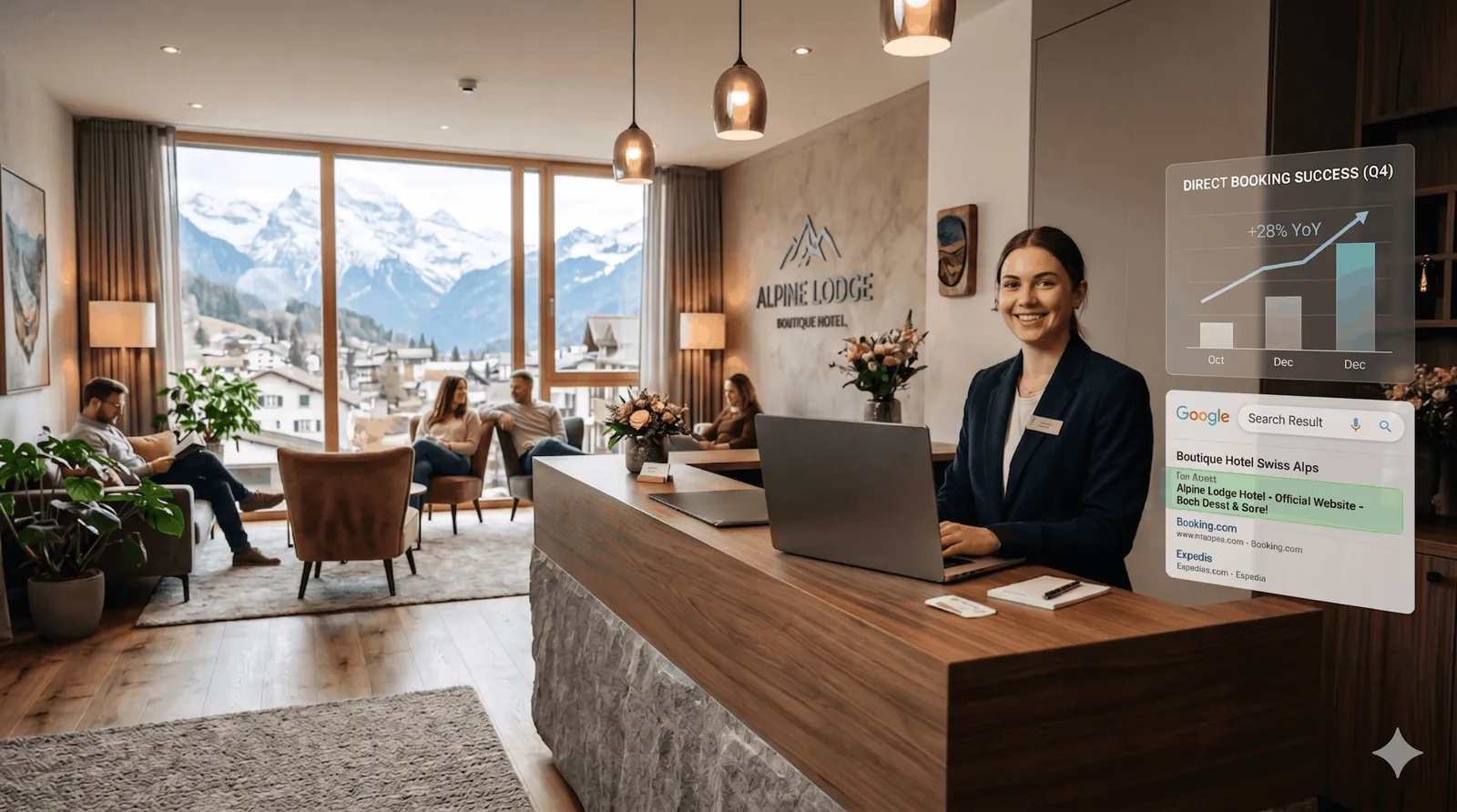
Anyone marketing their hotel through Booking.com or Expedia pays a high price for it – between 15 and 25 percent commission per booking. That sounds like a familiar complaint, but by 2026 the starting position has changed: guests search more smartly today, Google shows hotel prices directly in search results, and any property that isn't visible simply doesn't exist for potential guests. The good news: it has never been more accessible to increase direct bookings through your own website – if you know where to start.
The problem in everyday hotel operations
Many hoteliers have a website. But only a few have a website that truly sells. The site exists, looks reasonably tidy – and yet most bookings still end up with the big platforms. The reason: the hotel's own website doesn't even appear in Google search, the booking process is cumbersome on smartphones, or the guest lacks the confidence to book directly. The result: the OTA collects the commission, and the hotel loses not only money but also direct contact with the guest.
What current observations show
The developments in digital hotel marketing in 2026 are clear – and speak for themselves:
- More than 60 % of all hotel search queries come from smartphones. A booking form that doesn't work on mobile directly costs revenue.
- Google shows hotel prices directly in search – including a free direct-booking link for hotels that maintain their Google Business profile correctly. Anyone who ignores this gives away visible advertising space.
- OTA commissions between 15 and 25 % eat into margins that are already tight in the hotel industry. Every direct booking saves this amount completely.
- Guests who have booked through a platform once tend to stay loyal to the platform – not the hotel. Anyone who doesn't build their own guest relationships loses these guests permanently.
- A slow-loading website loses visitors before they even book. Google additionally penalises this with lower placements in search results.
- Best-price guarantees and small extras (e.g. free breakfast for direct bookings) cost the hotel less than an OTA commission – and still convince guests to book directly.
What does this mean for your hotel?
1. Your website must be visible in Google – not just look nice. Search engine optimisation (SEO) means: guests find you when they search for a hotel in your region. That's not magic, but it does require upkeep. Local content, a complete Google Business profile and a technically clean website are the starting point.
2. The booking process must work smoothly on mobile phones. Test it yourself: can you book your hotel on a smartphone in under two minutes? If not, you're losing bookings every day.
3. Give guests a reason to book directly. Communicate clearly: «Book direct and get the best price.» Or offer a small extra – a welcome drink, late check-out, free parking. This costs you less than any commission.
Case study: the boutique hotel "Zur alten Post"
Starting position: The family-run boutique hotel "Zur alten Post" with 22 rooms in a mid-sized Swiss city generated around 70 % of its bookings through Booking.com. Its own website was outdated, barely usable on mobile, and the Google Business profile hadn't been updated in years.
Measures: The property invested in a mobile-optimised website with a simple, fast booking form. The Google Business profile was updated with current photos, opening hours and a direct booking link. A clear message was placed on the website: «Book direct = best price + free breakfast.» In addition, short blog articles about local excursion tips were published – simple texts that appeared in Google search when guests searched for activities in the region.
Result: Within six months, the share of direct bookings rose from just under 30 % to over 50 %. The commissions saved fully financed the website investment within one year.
This example is a fictional but realistic scenario based on typical industry experience.
Common mistakes
1. "We have a website, that's enough." A website without SEO is like a brochure in the basement. Nobody sees it if it doesn't appear in search.
2. The Google Business profile is neglected. Outdated photos, missing opening hours, no booking link – this costs visibility every day. And maintaining it is free.
3. No clear message for direct bookers. If the guest sees no visible advantage in booking directly, they will book wherever they feel safe – usually with the platform.
Conclusion
Your hotel website isn't just a digital business card – it's your direct sales channel. Anyone who neglects this channel pays commissions year after year that they wouldn't have to. The entry barrier is smaller than many think: a well-maintained Google profile, a mobile-friendly booking process and a clear direct-booking advantage are enough as a first step. The platforms won't disappear – but your goal should be that your most loyal guests book directly with you. Because then the guest relationship belongs to you, not Booking.com.
Sources
- Gastgewerbe-Magazin (26 March 2026): Digitale Sichtbarkeit: Wie Hot...
- HiJiffy: Hotel Marketing 2026: Der ulti...
- SiteMinder: Effektiver Einsatz von Google ...
- RoomRaccoon: Hotel-Metasuchmaschinen: mehr ...
- MARA Solutions: Tipps für digitales Hotelmarke...
- MARA Solutions: Google Hotel Ads: Der ultimati...
- Shapefruit: Google Hotel Ads & Metasuchen ...
- Highfive Kommunikation: Die neuesten Strategien im Hot...
- 48concepts: Erfolgreich durch Hotelmarketi...
- Prostay: 25 Hotel-Marketing-Strategie-I...
- Bookassist: Digitales Marketing für Hotels...
- Hotel Tech Report: Die 10 besten Hotelmarketingag...
More related articles:
- Conversion Rate Optimization for Hotel Websites (practical deep dive)
- Requirements for a Booking Engine for the Hotel Website (a central element of the website)
- Price Parity in Switzerland (argument for direct booking through your own website)
- The Underrated Channel: Email Marketing (complementary direct-booking channel)