Why this topic matters now
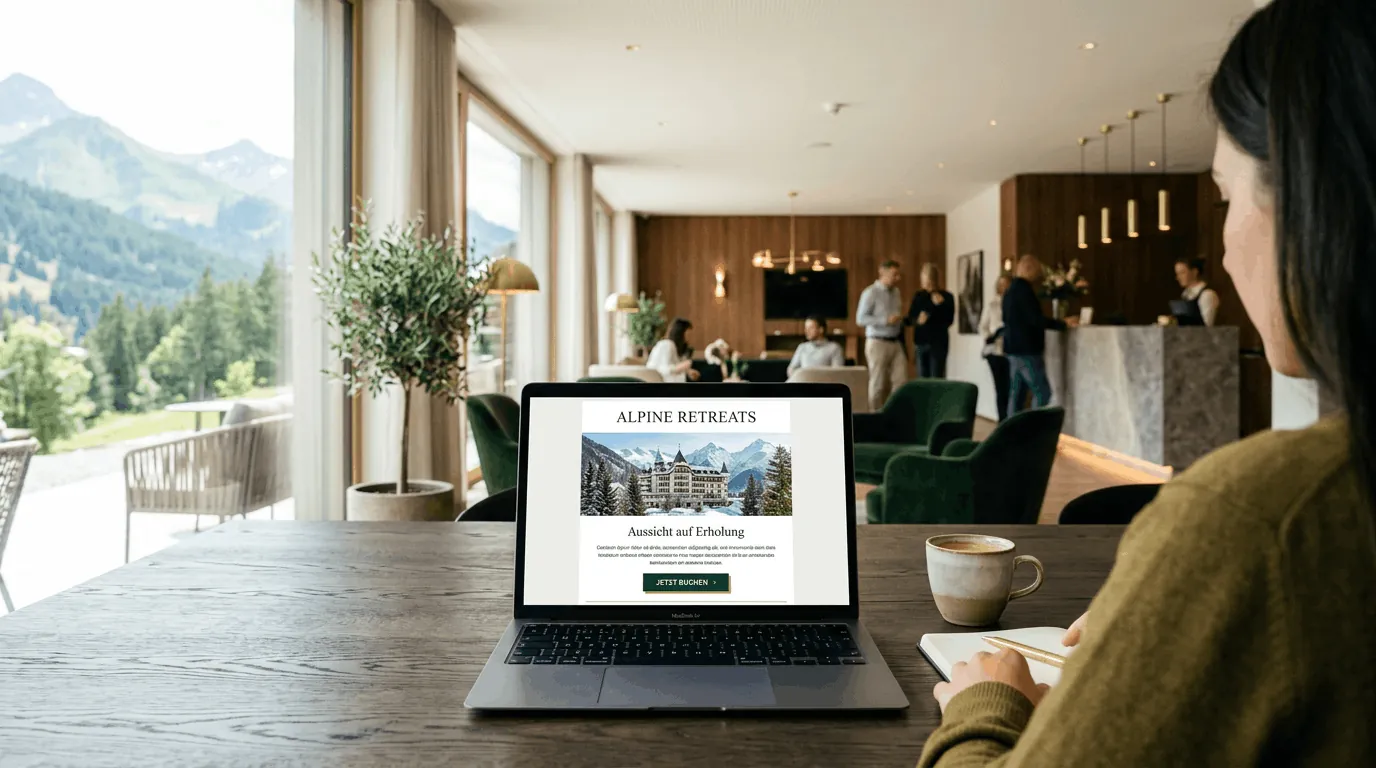
While many hotels are currently putting a lot of energy into social media, Google Ads and AI visibility, most properties have a channel lying dormant that has delivered the highest return of all digital marketing channels for years: email marketing. According to current industry analyses, email marketing achieves an average return on investment of over 35 francs per franc spent — with comparatively little effort. Anyone who does not yet run a structured newsletter channel is giving away real money.
The problem in everyday hotel operations
Most hotels do have a guest list — but they barely use it. The email addresses of previous guests sit somewhere in the property management system (PMS — the hotel's digital management system), but are rarely used actively. Instead, energy goes into new channels, while the most valuable target group — people who already know and like the hotel — remains untapped. On top of that: many hoteliers believe email marketing is complicated or expensive. Neither is true.
What current figures and observations show
The trends in digital hotel marketing for 2026 are clear:
1. Repeat guests prefer to book directly — if you reach out to them.
Guests who have already stayed at a hotel once show a significantly higher willingness to book directly. Addressing them personally by email activates exactly this potential.
2. Personalisation is the decisive difference.
Generic newsletters barely work anymore. Emails that reference the last stay, the travel period or the room type achieve significantly higher open and click rates. Modern email tools make this possible even for small properties.
3. The right timing beats the perfect text.
Emails sent shortly after the stay, before typical booking seasons or on personal occasions such as birthdays perform significantly better than mass emails without context.
4. Email beats social media for direct bookings.
While Instagram and TikTok mainly provide inspiration, email leads directly to action. A well-placed link to your own booking engine brings the guest back without a detour via an OTA (online travel platform such as Booking.com).
5. Data protection is not an obstacle — it is an opportunity.
Anyone who collects email addresses correctly and clearly asks guests for permission builds their own, independent database. It belongs to the hotel — not to Booking.com or Google.
What does this mean for your hotel?
Point 1: your guest list is worth its weight in gold — start using it.
Every guest who has ever stayed at the hotel and consented to receiving emails is a potential direct booker. Even a simple, well-written newsletter twice a month can noticeably increase the rebooking rate.
Point 2: automation makes the difference.
Modern email tools such as Mailchimp, Brevo or hotel-specific solutions make it possible to automatically send a thank-you email after the stay, place an offer for the next visit a few weeks later, and send a targeted reminder ahead of the main booking season. This runs in the background — without daily effort.
Point 3: less OTA dependency, more margin.
Every direct booking that comes through your own newsletter saves 15 to 25 percent commission. With 10 additional room nights per month at a room rate of 180 francs, that adds up to as much as 450 francs per month — without extra effort.
Practical example: Familienhotel Alpenblick in Graubünden
Starting point: The Familienhotel Alpenblick (fictional example, typical situation) had around 2'800 email addresses in its system — collected over years from bookings and enquiries. There was no newsletter. The rebooking rate was below 20 percent, and almost 70 percent of all bookings ran through OTAs.
Measures: The owner decided to set up a simple email tool and activate the existing guest list (with consent). From then on, three emails were sent per season: a personal invitation for early booking with a small direct-booking advantage, a seasonal newsletter with insider tips from the region, and a birthday email with a symbolic welcome gift.
Result: After two seasons, the direct booking rate rose by around 12 percentage points. The rebooking rate improved from below 20 to nearly 30 percent. OTA commission costs decreased noticeably — and the owner felt she was speaking directly with her guests again, instead of losing them to platforms.
Common mistakes
Mistake 1: writing too rarely or too irregularly.
Anyone who sends a newsletter only once a year will be forgotten. Regularity — even if it is only every four to six weeks — builds trust and recognition.
Mistake 2: trying to do too much at once.
A long newsletter with ten topics, five offers and three calls-to-action is overwhelming. Better: one clear message, one image, one link. That is enough.
Mistake 3: not obtaining consent.
Anyone who sends emails without clear consent from recipients violates the General Data Protection Regulation (GDPR) and risks warning letters. The good news: a short opt-in field at booking or check-in solves the problem.
Conclusion
Email marketing is not old-fashioned — it is one of the most reliable, cheapest and most direct ways to bring guests back and reduce OTA costs. Anyone who activates their existing guest data, communicates regularly and personally, and puts their own booking engine at the centre, builds a channel that works independently of Google algorithms and platform commissions.
The good part: you do not need to be a marketing professional to get started. A simple tool, an honest message and a clear link to your own website are enough for the first step. And that first step pays off — literally.
Sources
- HiJiffy: Hotel Marketing 2026 — Der ultimative Leitfaden (hijiffy.com)
- Hotel Tech Report: Die 5 besten E-Mail-Marketing-Softwares für Hotels im Jahr 2025 (hoteltechreport.com)
- Smart Host: Kostenloser Contentkalender 2026 für Hotel-E-Mail-Marketing (smart-host.com)
- Ada Cosmetics Expert Stories: Hotelmarketing — der Guide für 2026 (ada-cosmetics.com)
- Highfive Kommunikation: Die neuesten Strategien im Hotelmarketing für mehr Direktbuchungen (highfive-kommunikation.de)
More related articles:
- Why your hotel website will be your most important sales tool in 2026 (related direct booking channel)
- Do you really know your guests? Buyer personas (basis for targeted email campaigns)
- Conversion rate optimisation for hotel websites (related conversion topic)