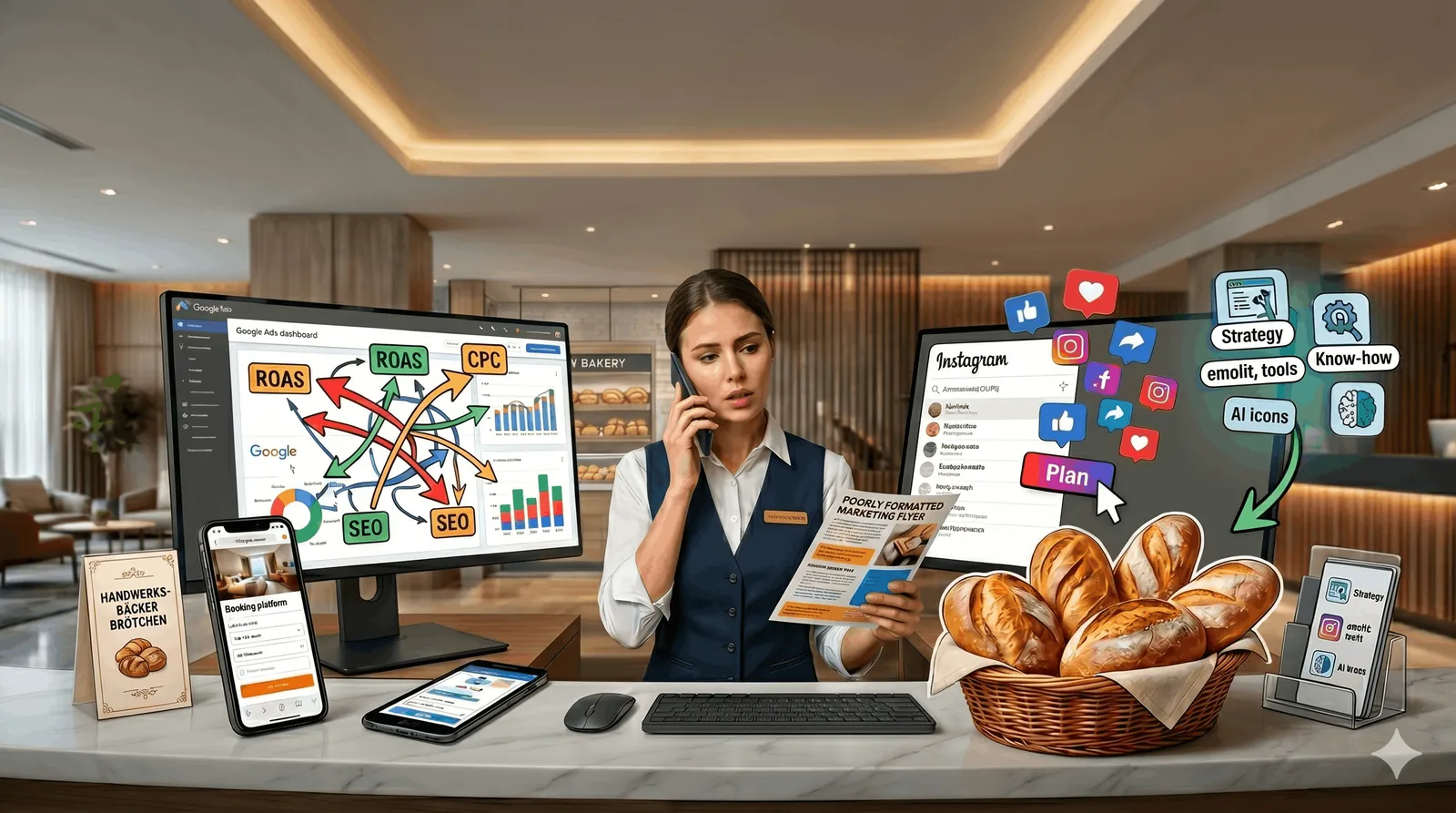
Many hoteliers have heard the same sentence for years: «You need to be more present online.» But that doesn't answer the actual question – what exactly should the budget be used for? While the number of channels keeps growing, the marketing budget stays the same in many places. Anyone who still allocates by gut feeling in 2026 loses on two fronts at once: with Google and with the AI search systems that increasingly decide visibility.
The problem in everyday hotel operations
Most small and medium-sized hotels have no dedicated marketing team. The management decides, alongside reception, staff planning and guest care, how much to spend on Google Ads, social media or the website – on the side. Decisions are often based on last year's budget or on what the agency currently recommends – not on which channel actually brings bookings for the specific business. The result: money flows into channels that used to work, while new paths to the guest – such as Google Maps, AI assistants or the hotel's own Google Business Profile – barely get any budget.
Current developments from the industry and practice
A look at current industry data and market observations shows where the weight is shifting:
- The website remains the foundation, not just one channel among many. Without a well-converting website, every advertising franc fizzles out – whether it goes into Google Ads, Meta Ads or newsletters.
- AI search is growing rapidly, but most hotels are invisible there. Studies on hotel search show that a large share of hotel websites are effectively not discoverable by AI systems such as ChatGPT, because content is too unstructured or too «flowery».
- The Google Business Profile is gaining weight relative to the hotel's own website. A large share of hotel clicks in the new Google AI Mode do not land on the hotel website, but directly on the Google Business Profile – a channel that is barely planned for in many budgets.
- OTAs are overtaking search engines as the starting point of trip planning. More and more travellers start their search directly on platforms like Booking.com rather than on Google – this changes where visibility budget should be invested.
- Automation is no longer optional for Meta Ads, it is the infrastructure. Anyone still working with small, manually maintained campaign structures burns budget, because the algorithm systematically disadvantages such setups.
- Direct booking advantages must be actively communicated. Guests who search on OTAs still book directly to a relevant extent – provided the hotel makes the advantages visible, for example through flexible conditions or an upgrade promise.
What does this mean for your hotel?
1. Allocate the budget according to visibility logic, not habit
Instead of repeating the same allocation every year, an annual check is worthwhile: where do guests actually come from – website, Google Business Profile, OTA, social media? The channel allocation should follow this reality, not the memory of what worked three years ago.
2. Stabilise your own website first, then run advertising
A website that is technically clean, delivers clear facts (room size, distance to the station, amenities) and loads quickly is the precondition for Google Ads, Meta Ads or email marketing to have any effect at all. Anyone who invests in advertising first and neglects the website pays twice.
3. Manage the Google Business Profile as its own channel – not as a mere formality
Many hotels only maintain their Google Business Profile sporadically. Since a significant share of clicks from AI search land there, it deserves dedicated, regular maintenance: current photos, responses to reviews, correct amenity details and opening hours.
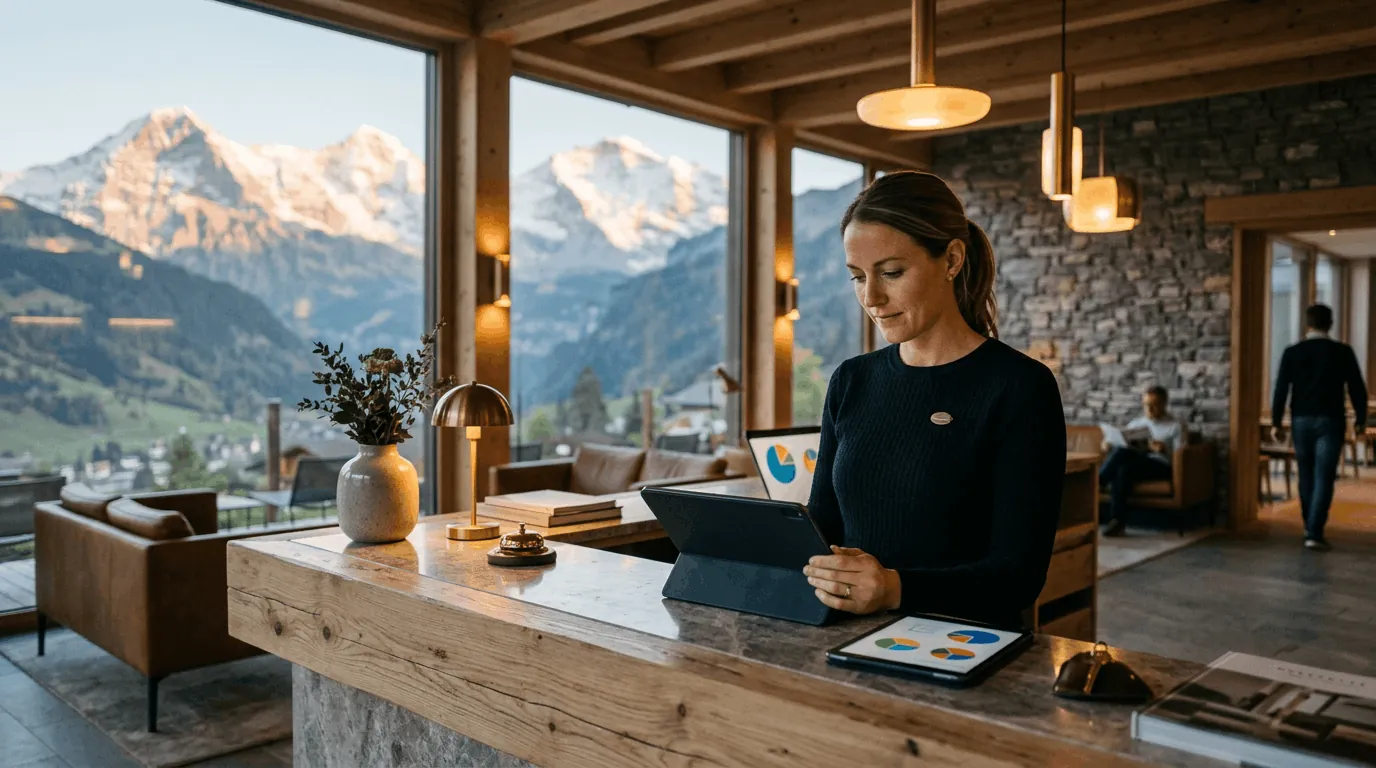
Practical example: a family hotel in the Bernese Oberland
Starting point: A family hotel with 38 rooms had spent around 70 percent of its entire online marketing budget on Meta Ads and 30 percent on Google Ads for years. The Google Business Profile was only updated as needed, and there was no structured content strategy for the website.
Action: After an analysis of booking origins, it turned out that a growing share of enquiries came via Google search and the Business Profile, not via social media. The hotel shifted around a third of its previous Meta Ads budget into maintaining the Google Business Profile, into structured page content (clear answers to typical guest questions such as amenities, arrival, family offers) and into a simple email programme for regular guests.
Result / expectation: Within one quarter, enquiries via the Google Business Profile rose noticeably, while the cost per booking on Meta Ads fell, because the campaigns ran more focused. The hotel plans to review its budget allocation every six months from now on, based on actual booking origins, rather than fixing it rigidly.
(This example has been slightly simplified for illustration purposes and is presented as a representative case.)
Common mistakes
- Budget is allocated by gut feeling rather than by data. Without looking at actual booking origins, channel selection remains pure guesswork.
- The Google Business Profile is treated as a side issue. Precisely because AI systems increasingly draw on it, neglecting it is costly.
- Advertising budget flows into channels before the website is ready. A weak, unstructured website makes every additional advertising franc less effective.
Conclusion
Online marketing for hotels in 2026 is no longer a choice between a «large» or «small» budget, but a question of the right allocation. The channels through which guests actually search and book today have shifted – away from pure click advertising, towards structured content, well-maintained Google profiles and a stable website of your own. Anyone who critically reviews their budget once a year based on their own booking data makes better decisions than any generic industry comparison. The first step is often not more money, but an honest stocktake: where do our guests really come from – and does our budget match that?
Sources
- Tourismusconsult: Hotel marketing 2026: why 94% of hotels are invisible in AI search
- Tourismusconsult: Google AI Overviews: the new showcase for your hotel
- Tourismusconsult: Meta Ads for hotels: what has fundamentally changed in 2026
- Tourismusconsult: Google Business Profile 2026: what hoteliers need to change so AI finds them
- SiteMinder: Changing Traveller Report 2026
- RevPARGenius: Is ChatGPT Replacing Google for Hotel Search?