In 2026, the Google Business Profile is an important data and visibility building block for hotels. It supplies Google with information on location, facilities, opening hours, reviews and other offerings. However, it is only one of several sources that can be relevant for local search results and AI-powered answers.
The importance of the Google Business Profile therefore cannot be meaningfully reduced to a single percentage figure. Google processes information from various sources and weights it depending on the search query and context. For hotels, what matters is that details on name, address, contact, facilities, opening hours, offers and reviews are as consistent as possible across the profile, the hotel's own website and relevant platforms.
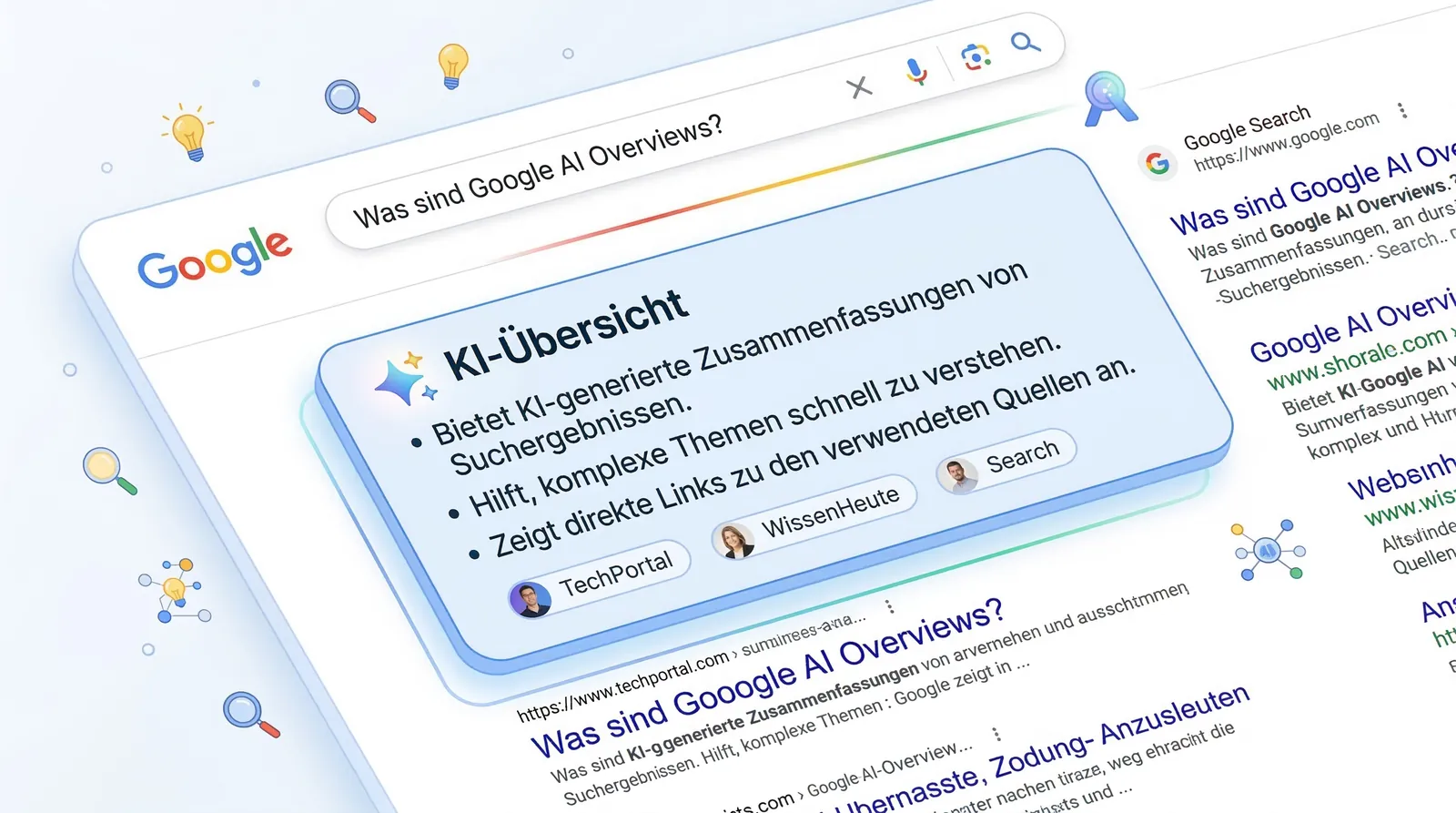
Within the AI Overview interface, the shift is even more extreme: 96.8% of hotel-name links point to the Google Business Profile. In the classic Local Pack, by contrast, 81% of links lead directly to the hotel website. Both worlds exist in parallel — but 81% of hotel mentions in Google AI Mode now come via the AI Overview interface, not the Local Pack.
Why classic SEO is no longer enough as a shield
Anyone who relies on the assumption that a good organic ranking also means AI visibility is mistaken. BrightEdge compared nine industries and found that travel has the lowest overlap between organic top-10 rankings and AI Overview citations, at 23.6%. In other words: even position 1 on Google guarantees not a single hit in the AI answer.
At the same time, the reach of AI search is growing rapidly. AI Overviews now appear in 25.11% of all Google searches — up from 13.14% in March 2025. Over 40% of travellers use AI tools for trip planning, and according to Operto data, 70% of hotel bookings are now influenced by AI-powered recommendations. Over 65% of all Google searches in 2025 end without a click to an external website (SparkToro). Anyone not directly present in the profile or in the AI answer in this zero-click world is not in the game.
Craig Webb (former GM, Bespoke Hotels, 17 years of industry experience) puts it succinctly: "For direct booking impact, the Google Business Profile wins every time. If your marketing resources are limited, one hour a week on GBP will deliver more commercial return for most independent hotels in 2026 than one hour on Instagram."
Verification and completeness: the non-negotiable foundation
Birdeye's "State of Google Business Profile 2026" (April 2026, based on 30+ industries worldwide) provides the key figures: fully optimised profiles appear 80% more often in search and generate up to 4× more website visits than incomplete ones. Verified profiles additionally bring double-digit increases in calls and direction requests. The verification rate rose to 76% in 2025 (2024: 71%) — anyone not yet verified belongs to the minority that AI models treat as less trustworthy.
What "complete" specifically means:
- Correct category (primary category as hotel type, plus matching secondary categories for wellness, restaurant, events)
- Full address, phone and website details, exactly identical to all other online sources (NAP consistency)
- Opening hours including public holidays and seasonal periods
- Description with concrete figures (number of rooms, year of opening or renovation, distance to the railway station, square metres of wellness space)
- Services section fully filled in
- Attributes activated (family-friendly, pets allowed, on-site wellness, free parking, etc.)
On the description, fuelonline.com formulates a finding that is especially relevant for hoteliers: "GBP descriptions with specific numbers (years in business, response times, service area) are cited more often by Google AI Overviews than descriptions with generic wording." A Princeton/KDD study (Aggarwal et al., 2024) confirms the pattern: content with named expert quotes increases the AI citation rate by 41%, dated statistics by 31%.
The underestimated fields: services, photos, posts
The services section is one of the most underestimated fields. It is read directly by Google's structured data parser and feeds into AI Overview answers. Concretely for a hotel: "Superior double room", "half board", "wellness day pass", "MICE rooms for up to 80 people", "EV charging stations" — each with a description and, where sensible, a price. Anyone who only has three generic entries here is giving away a main channel through which AI understands what the property offers.
Photos are not a beauty topic — they are a ranking signal. Google's own data (cited by fuelonline.com) shows: profiles with over 100 photos generate 520% more calls than those with fewer than ten photos. Profiles with photos receive 45% more direction requests and 31% more website clicks. Equally important: profiles that have not published a photo or a post for more than 30 days measurably lose impressions, according to AgencyJet. Profile activity is a direct ranking signal in 2026.
BrightLocal's 2025 Local Search Ranking Factors study has a concrete figure on this: profiles with high activity rank 1.4× more often in the top-3 Local Pack positions than dormant profiles, given identical star ratings. Google's 2026 local algorithm update has shifted weight from "prominence" (history, establishment) towards "popularity" — that is, click-through rate, dwell time, review engagement. A new property with an active profile can outperform a long-established but inactive one.
Reviews: 20% ranking weight — and the fuel for AI citations
BrightLocal's 2026 survey (November 2025) measured AI search visibility separately for the first time. The result: reviews have risen from 16% (2023) to 20% (2026) of Local Pack ranking weight — and reviews plus citations are the dominant factors specifically for AI visibility.
For hotels, this means more than "collecting stars". Google now uses NLP-based sentiment analysis to extract attribute-specific sub-scores from review texts — cleanliness, location, service, value. These scores appear prominently in the Knowledge Panel and directly influence the conversion rate. A guest who writes "the bathroom was spotlessly clean" lifts your cleanliness score — even if they only gave 4 stars overall.
AgencyJet formulates the practical rule as follows: "An average of 4.5 stars or more, combined with at least 20 recent reviews and active engagement, is sufficient. A 'perfect' 5.0 with no negative voice at all is often flagged as suspicious by AI filters."
Important for the multi-platform strategy: ChatGPT has no access to Google Reviews. Perplexity has sourced hotel recommendations from a TripAdvisor partnership since January 2025. Anyone who only collects reviews on Google is invisible in at least two of the three most important AI searches. A Stiplo.io analysis shows: businesses that publish content on three or more external platforms receive 325% more AI citations than those present only on their own website.
What has concretely changed in 2025/2026
Google has recently implemented several rule changes that affect every hotel:
- August 2025 spam update: profiles that insert keywords into the business name that are not on the commercial register entry or on the signage are suspended. Google's AI detects such violations in real time. "Hotel Bellevue – Wellness & Spa Ticino" as a profile name is risky if the official designation is simply "Hotel Bellevue".
- Instagram link removal: in 2025, Google removed external links to Instagram from hotel profiles. Only official websites and booking pages are now permitted. Photo galleries and booking funnels need to be moved to the hotel's own website.
- "Ask Maps" instead of manual Q&A: Google is gradually replacing the manual Q&A section with a Gemini-powered feature that automatically generates answers from profile content, website and reviews — without waiting for a response from the owner. This means that anyone maintaining contradictory or outdated information on their website will be cited by the AI with incorrect answers.
- Schema markup as a requirement: for hotels, three schema types are considered the basis for AI visibility: LodgingBusiness (or Hotel), FAQPage on guest-facing pages, and Speakable schema to mark passages that AI and voice assistants are meant to extract.
The important caveat: GBP is mandatory, but not enough
Dylan Allen-Arnegård, CEO of Cheers, summarises Google's position: "Google explicitly tells businesses to keep their Business Profile information up to date for AI features in search. Google also says that AI Overviews and AI Mode build on the same search foundations: indexed pages, crawlable content, internal links, visible text, page experience and structured data that matches the page."
In other words: GBP is the single most important lever — but it replaces neither a technically clean website nor a broad presence on external platforms. Beyond Booking has a stark observation on this: "A hotel can dominate Gemini and be invisible on ChatGPT. The cross-platform divergence is severe." Independent research found differences in citation rates of up to 615× between AI platforms.
And a ChatOptic analysis (1,000 queries across five sectors, including hotel booking, GPT-5, 2026) shows: only 62% of brands that rank on page 1 of Google appear in ChatGPT answers at all. Nearly 38% of the most successful Google brands are invisible in ChatGPT.
What you honestly cannot know
Despite all the data, there are areas where no one can seriously offer guarantees. Google has not published official threshold values for a minimum number of reviews or a minimum star rating for AI Overview citations. Which GBP fields Gemini internally weights most heavily is not openly documented. Exactly how the attribute-based sub-scores (cleanliness, location, service, value) are calculated has likewise not been disclosed by Google. And there is no published study that isolates the effect of hotel-specific attributes such as "pet-friendly" or "spa on-site" on the probability of AI Overview citation.
In other words: anyone who promises you a "guaranteed ranking in ChatGPT" is overstating things. What works is the clean completion of all known signals — and continuous maintenance, because the mechanics shift several times a year.
The seven-point checklist for the next 30 days
1. Check verification status. If not verified: apply immediately.
2. Profile completeness to 100%. Fill in every field Google offers — including attributes and seasonal periods.
3. Expand the services section with all room types, packages, wellness and MICE offerings, each with a description.
4. Rewrite the description: with concrete figures, years, distance details — no marketing phrases.
5. Upload at least 30 current photos, at least 4 new ones per month. Long-term target: over 100.
6. Weekly GBP posts: offers, events, seasonal packages. Avoid 30-day inactivity.
7. Roll out a review strategy across three platforms — Google, TripAdvisor and at least one other (Facebook, Yelp, industry-specific). Respond to all reviews.
Anyone who consistently implements these seven steps builds the data foundation from which Google AI Mode, Gemini, ChatGPT and Perplexity generate hotel recommendations. It is not a one-off project, but an ongoing process.
Further articles on this topic
- Why ChatGPT recommends your hotel – FAQ page (companion article, same series)
- Google, the most important review platform for hotels (directly related topic: Google profile/reviews)
- 68% of Google searches end without a click (zero-click context)
- Local SEO for tourism regions (related visibility measure)