Do you remember the days when the TripAdvisor sticker on the hotel door was the ultimate seal of quality? That era is now definitively over. A historic power shift has taken place in the digital hotel review landscape — with massive implications for your visibility and your direct bookings.
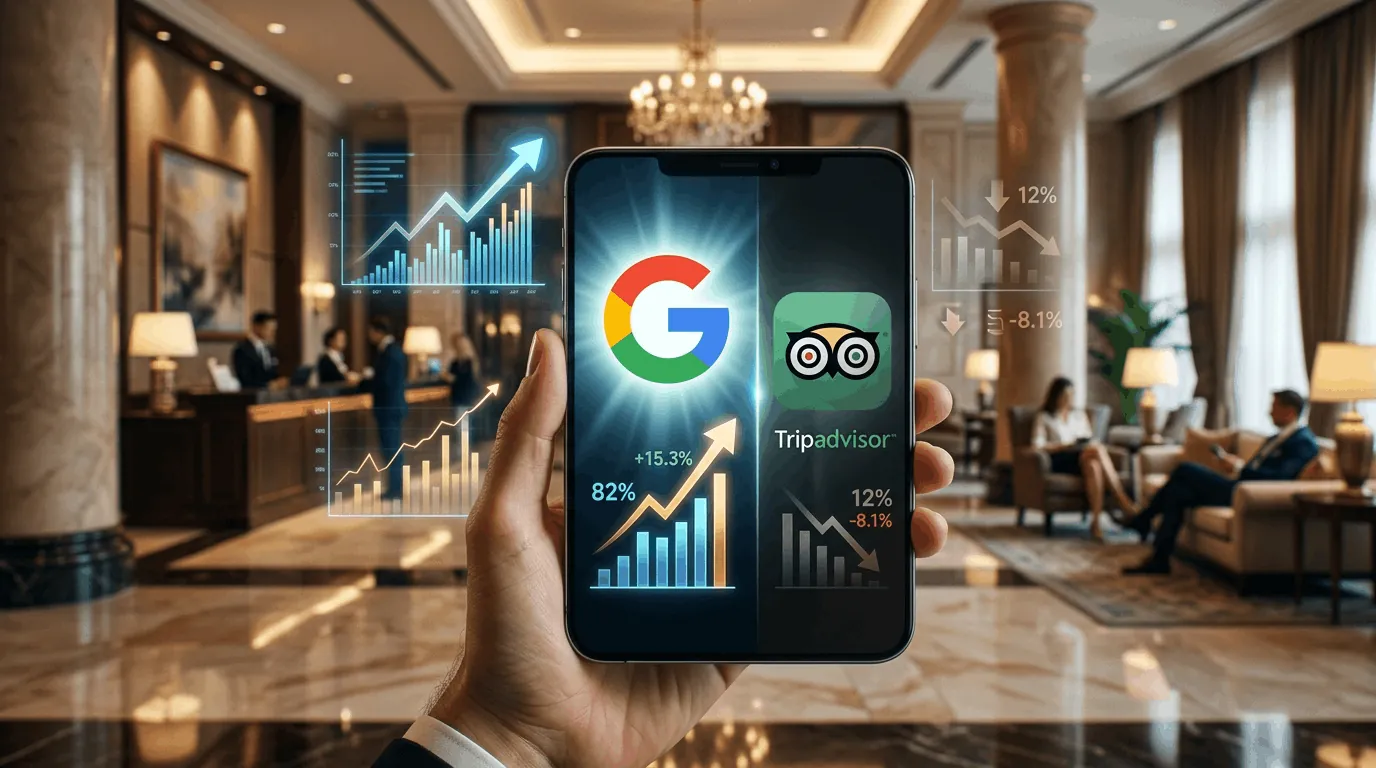
The new "Guest Experience Benchmark 2026" from Shiji, which analysed more than 40 million hotel reviews from 12'000 hotels worldwide, provides the proof: for the first time since the pandemic, Google has overtaken TripAdvisor as the largest review platform for hotels.
For Swiss hoteliers, this means the rules of the game for online reputation management have fundamentally changed. Those who fail to act now risk losing the most important digital touchpoint to their future guests.
The numbers behind the power shift
The study's data speaks a clear language and shows a remarkable shift in market share. While global review volume grew by 2.1 percent overall in 2025, the major platforms developed in strikingly different directions:
- The rise of Google: In 2023, TripAdvisor was still ahead of Google with 11.6 million global reviews (versus 9.1 million). By 2025, the picture had completely reversed: Google recorded 12.4 million mentions, while TripAdvisor slipped to 10.3 million.
- Dominance in research: A recent study by Sojern (2025) confirms the relevance of this shift for the booking process: 71 percent of travellers look at Google reviews during their research. TripAdvisor (44 percent) and Booking.com (38 percent) follow at a considerable distance.
- Growth of OTAs: In Europe, Booking.com remains dominant with a 60 percent share of the total review market, but Google recorded rapid growth of 14 percent.
This development is so significant because Google reviews are directly integrated into search results and Google Maps. They often form the very first impression, long before a potential guest visits your website or the profile of an Online Travel Agency (OTA).
The dark side of AI: the flood of fake reviews
While Google expands its dominant position, the entire industry is grappling with a new, invisible threat: AI-generated fake reviews.
According to a 2025 study published in the Journal of Marketing Research, 15 to 20 percent of all hotel reviews on the major platforms are now AI-generated. In 2022, this figure was still estimated at 4 to 6 percent.
The biggest problem here is the quality of these fakes. The study shows that human readers can now correctly identify AI-generated reviews in only 38 percent of cases — a figure barely better than pure guessing. This development is leading to a noticeable erosion of trust: 52 percent of travellers today doubt the authenticity of online reviews, compared with 31 percent in 2023.
Google is responding with massive countermeasures, using AI itself for detection. In 2025, the search engine giant removed 170 million suspicious reviews — an increase of 45 percent over the previous year. Nevertheless, experts estimate that 10 to 12 percent of visible hotel reviews on Google are still artificially generated.
AI as a helper: the authenticity paradox
Yet artificial intelligence is not only the problem, but also part of the solution. Around 35 percent of hotel responses on the major platforms are now already written with AI support.
However, this creates a paradox: if you use AI to respond faster, your response rate increases — which has a demonstrably positive effect on revenue. But if guests recognise that a response comes from a machine, trust declines. Surveys show that 62 percent of travellers rate a hotel more negatively when they identify an AI-generated management response.
The solution lies in hybrid use: let AI create the draft, but always adapt it manually. Add personal details of the stay and align the tone with your brand. This reduces the time spent per response from 10 to 2 minutes while preserving human authenticity.
3 strategies for your reputation management in 2026
How can Swiss hotels respond to these tectonic shifts? Here are three concrete recommendations for action:
1. Focus on the Google Business Profile
Stop treating your Google Business Profile as merely a digital business listing — treat it as your most important reputation and distribution platform. In 2025, Google introduced topic-based sentiment analysis. This means: an overall rating of 4.1 stars with excellent sub-scores for "cleanliness" (4.6) and "service" (4.5) is often ranked better in search results than an undifferentiated 4.3-star rating. A practical example: a 4-star city hotel in Zurich increased its visibility in Google Hotel Ads by 22 percent by specifically asking guests at check-out to mention specific aspects such as breakfast or the central location in their Google review.
2. Prioritising verified reviews
The trend is clearly moving towards verified reviews. TripAdvisor has already introduced a "Verified Stay" badge, and Google is testing similar features based on booking confirmations in Gmail. Verified reviews receive up to 40 percent more "helpful" votes from readers. Adjust your automation processes: for guests who booked directly, preferably ask for a review on platforms that can verify the stay.
3. Active monitoring of the competition
In an environment where AI-generated fake reviews are on the rise, it is no longer enough to monitor only your own profile. Also keep an eye on the review profiles of your most important competitors. If a competitor suddenly shows an unnatural surge in generic 5-star reviews, this can be an indication of a manipulated campaign.
Conclusion: quality beats quantity
The change at the top of the review platforms — from TripAdvisor to Google — marks a turning point in hotel marketing. Reviews are now an integral part of the search and booking process. At the same time, the AI-driven crisis of trust forces us to rethink our approach. The most successful hotels of 2026 no longer blindly chase every 5-star review. They focus on detailed, authentic and verified feedback on the platforms that are truly relevant for guest research.
References
Shiji (2026). 2025 Guest Experience: How Hotels Are Winning Satisfaction in a Year of Record Demand. https://www.hospitalitynet.org/opinion/4130626/2025-guest-experience-how-hotels-are-winning-satisfaction-in-a-year-of-record-demand
BookingWhizz (2026). Online Reputation in 2026: AI Reviews, Google Changes, and What Hotels Must Do. https://web.bookingwhizz.com/uk/blog/online-reputation-trends-2026
Hospitality.today (2026). Google reviews reshape hotel visibility and guest decision-making. https://www.hospitality.today/article/google-reviews-reshape-hotel-visibility-and-guest-decision-making
Further related articles:
- Google Business Profile 2026 (directly related topic: Google as the central platform)
- PR as a GEO lever (reputation building as a visibility factor for AI)
- How visible is your hotel really (overarching framework for AI/Google visibility)