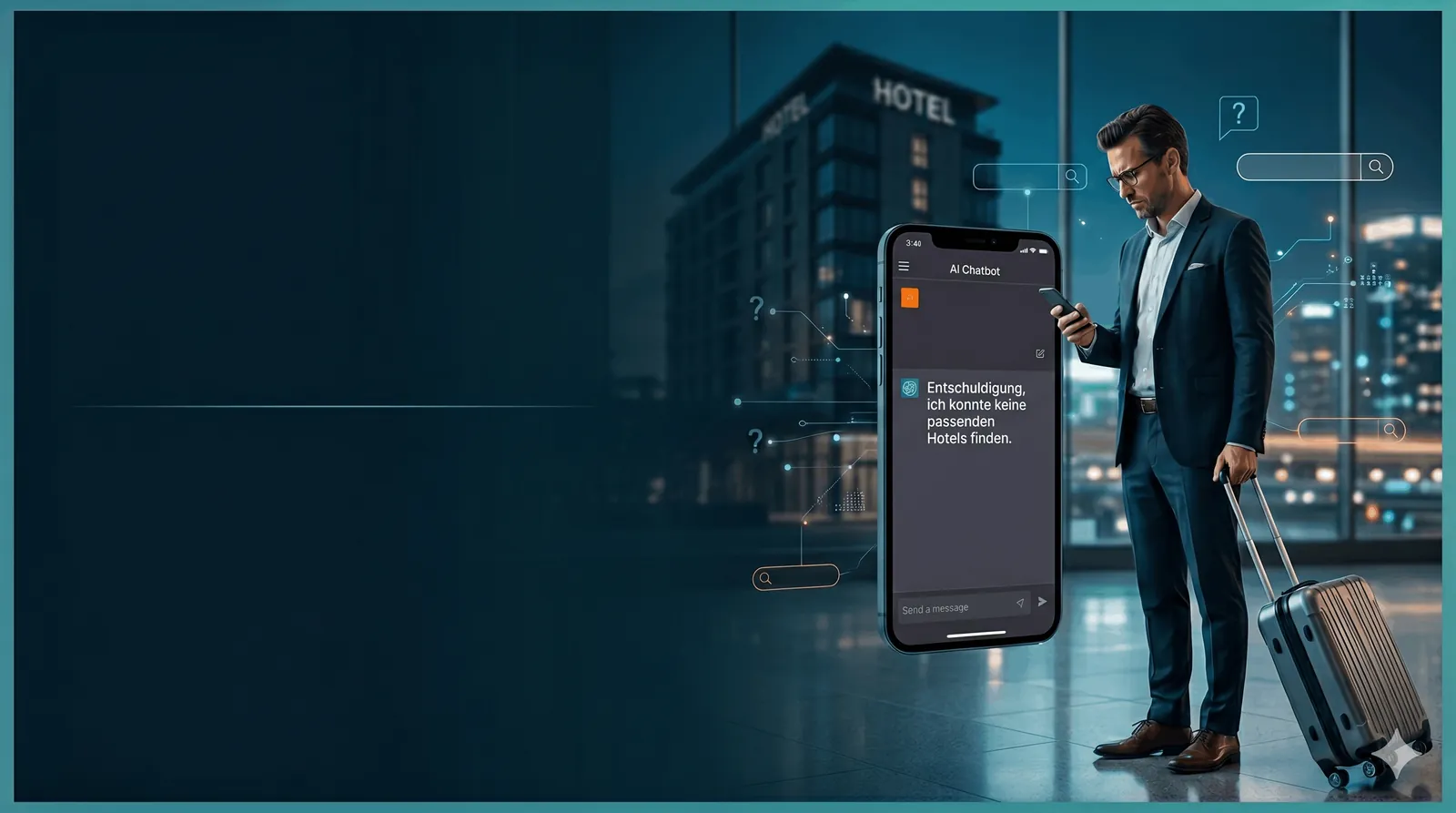
Imagine a guest asking ChatGPT: «Which boutique hotel in Lucerne is particularly recommendable?» The AI names three hotels. None of them is yours – even though you have had good reviews for years and rank well on Google. What's missing? Media mentions. Because AI systems such as ChatGPT, Gemini and Perplexity don't recommend what is best optimised. They recommend what the internet is talking about.
The problem in everyday hotel life
Most hoteliers know SEO. They know that a good website, reviews and Google rankings matter. What many don't know: different rules apply in the world of AI search. Here, what counts is not primarily what is on your own website – but what others write about you. Travel magazines, industry portals, local media, travel blogs. Anyone who doesn't appear there simply doesn't exist for many AI systems.
This is not a theoretical problem. According to a study by RevPARGenius, 94.3 percent of hotel websites are effectively invisible to AI systems. And the gap between «good on Google» and «visible on ChatGPT» is widening.
What current studies show
Several independent analyses from 2025 and 2026 paint a clear picture:
- ChatGPT favours third-party sources. According to a Yext study (2025) analysing 6.8 million citations, around 48.7 percent of ChatGPT's sources come from directories, review platforms and media – not from the companies' own websites.
- Backlinks alone are no longer enough. An Ahrefs study (December 2025) covering 75,000 brands shows: YouTube mentions and brand mentions across the web are the strongest predictors of whether AI platforms cite a brand. Classic backlinks showed almost no correlation.
- 80 percent of pages cited by ChatGPT don't even rank in Google's top 100. This means AI visibility and Google ranking are two different games.
- Earned media is a direct GEO lever. Research shows that AI systems weight content from third-party sites – press coverage, travel magazines, industry publications – significantly more heavily than self-published content.
- AI referral traffic converts 5x better. Visitors who reach a website via an AI recommendation book with a probability of 14.2 percent – compared with 2.8 percent for organic Google traffic.
- 40 percent of travellers use AI for trip planning (Operto, 2026). And 70 percent of hotel bookings already involve AI-supported recommendations.
What this means for your hotel
1. Media mentions are no longer optional – they are essential
In the past, an article in a travel magazine was nice for your image. Today, it's a technical factor for your visibility in AI systems. When a travel blog, an industry portal or a local newspaper mentions and describes your hotel by name, the AI learns: this hotel exists, it has a reputation, it is recommended by others. That is the difference between «present» and «recommendable» from a language model's perspective.
2. Not every mention counts equally
AI systems weight sources differently. A mention in an established travel magazine or on a high-authority industry portal counts more than an entry in an unknown directory. In concrete terms: if a journalist mentions your hotel in an article about «the best family hotels in the Bernese Oberland», that is more valuable to ChatGPT than ten self-written blog posts on your own website.
3. PR and GEO are the same goal
Anyone doing press work today – sending press releases, inviting journalists, placing guest contributions in trade magazines – is doing GEO at the same time. This is not double work. It is the same work with double the benefit: reach today, AI visibility tomorrow.
Practical example: Berghotel Alpenruh, Graubünden (fictional, realistic)
Starting point: Berghotel Alpenruh (48 rooms, family-run, 4 stars) had a solid Google presence and good reviews on Booking.com. It did not appear in ChatGPT for queries such as «family-friendly mountain hotel Graubünden» – even though that's exactly what it is.
Measures: The hotelier family specifically invited two travel journalists – one from a German family travel magazine, one from a Swiss outdoor blog with 80,000 monthly readers. Both published articles mentioning the hotel by name, with concrete descriptions (room types, activities, location) and a link to the hotel website. In addition, the hotel was mentioned in an article by the Swiss tourism association on «sustainable mountain hotels».
Result: Three months after publication, the hotel appeared in ChatGPT answers to relevant search queries. Direct bookings via the hotel's own website rose by 18 percent in the following quarter. The effort: two invitations, two nights' accommodation, no advertising costs.
Common mistakes
1. Relying only on your own website. Many hotels invest heavily in their website copy while neglecting what others write about them. For AI systems, this is a problem: they trust third-party sources more than self-presentation.
2. Treating media work as a one-off action. One article brings short-term visibility. Anyone who wants to appear permanently in AI recommendations needs regular mentions – not one big campaign every two years.
3. Ignoring the quality of the source. Not every mention helps equally. A feature in an established travel magazine or on a high-authority platform carries significantly more weight than an entry in a directory nobody knows.
Conclusion
The rules of the game have changed. Anyone who wants to appear as a recommendation in ChatGPT, Gemini or Perplexity needs more than a good website. They need a digital network of mentions, reports and references – on platforms that AI systems trust. This is not a new discipline. It is classic press work, rethought. Hoteliers who invest in media relations today are simultaneously building their visibility in tomorrow's AI search. Those who wait leave the field to those who started earlier.
Sources
- Yext (2025): Analysis of 6.8 million AI citations from ChatGPT, Gemini and Perplexity
- Ahrefs (December 2025): Study on AI visibility and brand signals, 75,000 brands
- RevPARGenius (2025/2026): Study on AI visibility of hotel websites
- Operto (2026): GEO Consultant data on AI use in trip planning
- Search Engine Land (2026): «Mastering Generative Engine Optimization in 2026»
- TravelBoom Leisure Travel Study (2026): AI use in trip planning
- Pixelmojo (2026): AI Citation Tracking Guide
- Hotel Dive (2026): «The tool giving hotels visibility into gen AI search»
Still have questions about media work and GEO strategy for your hotel? Contact us for a no-obligation initial consultation: tourismusconsult.ch/kontakt
Further articles on this topic
- Content clusters instead of single articles (complementary GEO strategy)
- How visible is your hotel really (putting GEO into overall context)
- Google, the most important review platform for hotels (mentions/reputation as a ranking factor)