Google has changed the rules of the game — and many hoteliers haven't even noticed yet. Since February 2025, the convenient commission model for Google Hotel Ads no longer exists. Those who used to simply pay a commission per booking now have to bid actively and manage their own budget. That sounds technical — and it is. But it has a direct impact on your direct bookings and your costs.
The problem in daily hotel operations
Many small and medium-sized properties have barely managed Google Hotel Ads actively until now. You were listed, paid a commission when a booking came in — and that was it. That model is now history. Those who do nothing lose visibility in metasearch and leave the field to the big OTAs like Booking.com or Expedia. They continue to run campaigns — and with considerable budget.
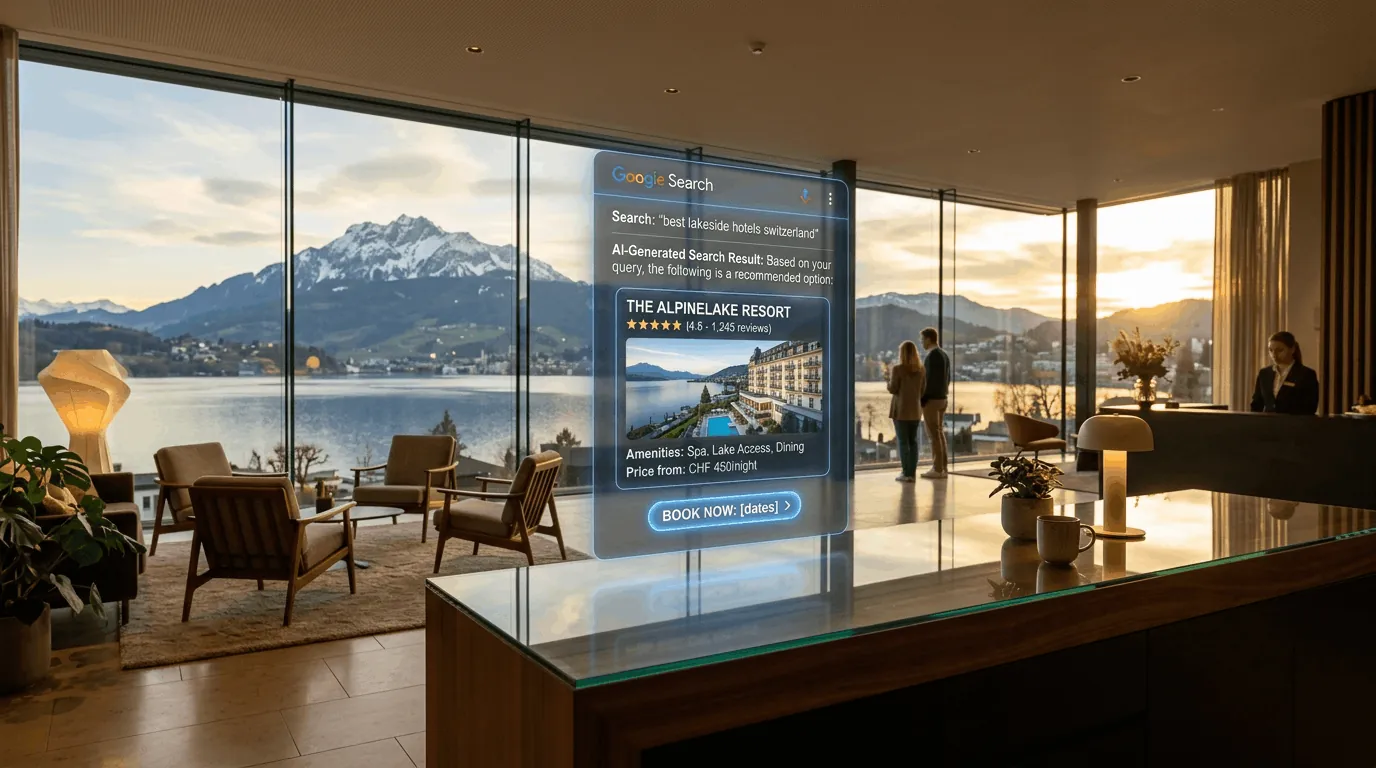
Metasearch means: platforms like Google Hotels display prices from different providers side by side. The guest sees at a glance what Booking.com charges — and what your own website costs. Those who don't appear there simply don't exist for many travellers.
What has specifically changed — and what it means
1. The commission model is gone — and it's not coming back.
Google permanently discontinued the "commission per booking" and "commission per stay" bidding strategies as of February 2025. Those still running on this model had to switch. Those who missed it have simply not been visible since.
2. Now the rule is: CPC or Smart Bidding.
The new standard model is called CPC — Cost per Click. This means: you pay per click on your ad, regardless of whether a booking results. Alternatively, there is "Smart Bidding" with target ROAS (Return on Ad Spend) — Google automatically optimises the bid. But be careful: this only works if your website accurately tracks which clicks lead to bookings.
3. OTAs dominate — but direct bookings are cheaper.
Booking.com and others pay up to 15–25 % commission to Google to appear at the top. If you are present yourself and offer a competitive price, you can win guests directly — and save exactly this commission.
4. Price parity is decisive.
If your website is more expensive than Booking.com, no one books directly. Google shows the prices side by side — the guest decides in seconds. Those who are cheaper or equally priced have a real chance.
5. Even small properties can compete — but only with the right setup.
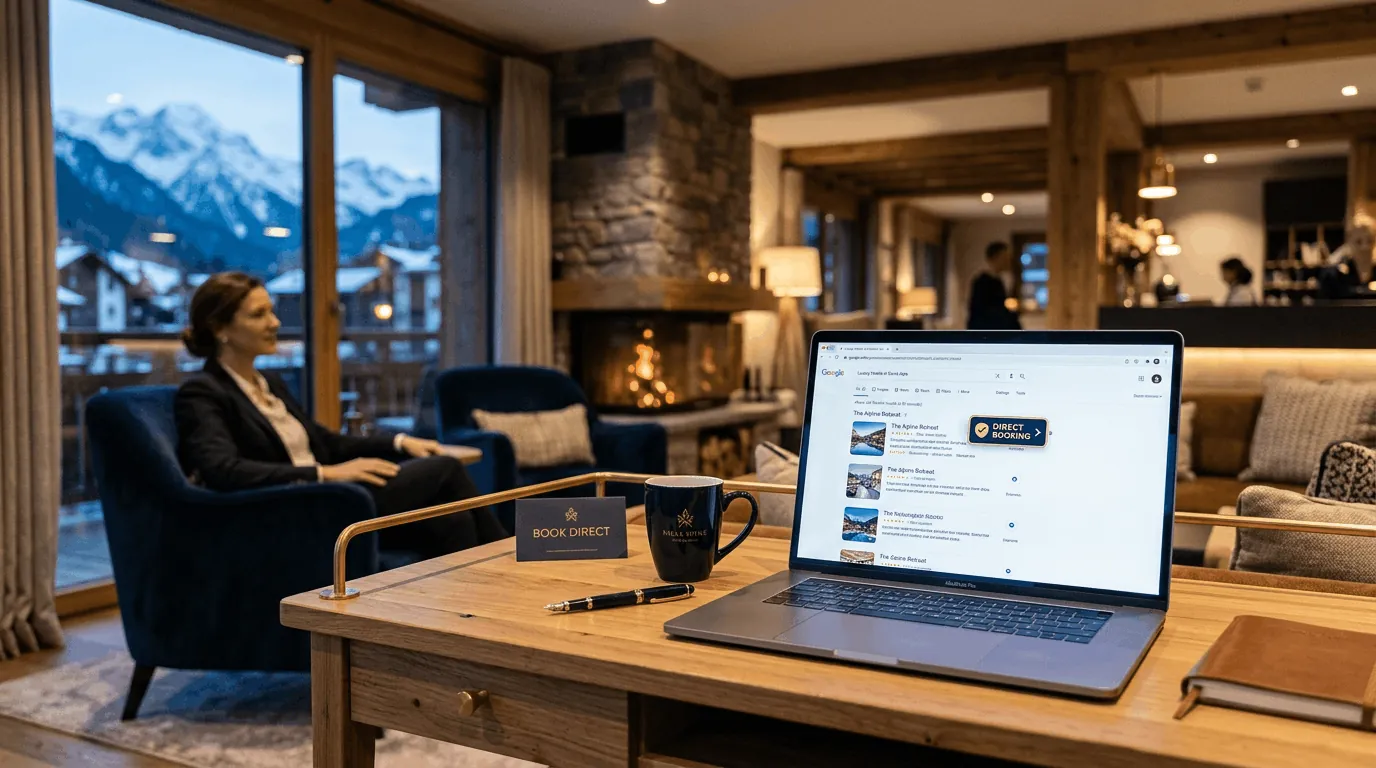
Google Hotel Ads is not an exclusive tool for hotel chains. Even a boutique hotel with 20 rooms can benefit — provided the technical foundations are right: a verified Google profile, a booking engine (IBE) that can be connected correctly, and functioning conversion tracking.
What does this mean for your hotel?
Point 1: check whether you are still visible at all.
Search for your hotel on Google and see whether your own website appears in the price overview — alongside Booking.com and Expedia. If not, you are invisible in metasearch. That's the first step.
Point 2: no meaningful bidding without tracking.
Smart Bidding sounds tempting because Google optimises "automatically". But without conversion tracking — that is, without knowing which clicks lead to bookings — it's like driving with your eyes closed. Make sure your booking engine is measured correctly.
Point 3: your direct price must be competitive.
If you are present in metasearch but Booking.com is cheaper, you still lose out. Regularly check whether your direct prices are at least as high as on the OTAs — ideally somewhat cheaper, combined with a small added value (e.g. free cancellation, breakfast included).
Case study: Berghotel Sonnalp
Starting point: Berghotel Sonnalp*, a family-run property with 35 rooms in the Swiss Alps, had previously been listed via the commission model on Google Hotel Ads. When the model was discontinued — nothing happened. The owner only noticed months later that direct bookings via the website had dropped significantly. Booking.com dominated metasearch, while the hotel itself was no longer visible.
Measures taken: With the support of a marketing agency, the Google profile was set up again, the booking engine was connected correctly, and a simple CPC campaign setup was implemented. At the same time, it was ensured that the direct price on the website matched the Booking.com price — supplemented by the note "Best price guarantee & free cancellation".
Result: Within three months, the share of direct bookings rose back to its previous level. The cost per booking was significantly lower than the OTA commission — and the owner regained control over her own visibility.
Common mistakes
Mistake 1: doing nothing and hoping it will sort itself out.
The commission model is gone. Those who haven't actively switched are simply no longer present in metasearch. It won't sort itself out.
Mistake 2: activating Smart Bidding without tracking.
Many turn on Smart Bidding because it sounds "automatic" — without checking whether conversion tracking is actually working. The result: Google optimises into thin air, and the budget is wasted.
Mistake 3: being more expensive on the website than on Booking.com.
If the direct price is higher than on the OTAs, no guest books directly — no matter how good the ad is. Price parity is not optional, it's mandatory.
Conclusion
Google Hotel Ads is no longer a given — but it's not rocket science either. The abolition of the commission model has caught many properties off guard. Those who act now can gain a real advantage: more direct bookings, less OTA dependency, better margins.
The decisive question is not whether Google Hotel Ads is worth it. The question is whether you can afford not to be present there — while Booking.com markets your hotel for you and collects 15–25 % commission for doing so. Take ten minutes and check whether your hotel is still visible in Google metasearch at all. What you discover might surprise you.
Sources:
- Google Ads Help Center: Changes to bidding strategies for hotel campaigns (support.google.com, 2024/2025)
- Sojern: "The Future of Metasearch: What Google's Commission Bidding Removal Means" (sojern.com, 2025)
- Chekin: "Metasearch engine for hotels: a strategic guide" (chekin.com, 2025)
- Mews: "Google Hotel Ads: your ultimate guide" (mews.com, 2025)
- HSMA Deutschland: "Changes in the world of Google Hotel Ads" (hsma.de, 2024)
* Name changed
Further related articles:
- Google now tracks hotel prices (related Google development in price comparison)
- Booking.com overtakes Google (market context OTAs/metasearch)
- Price parity in Switzerland (connection between price display/metasearch)