
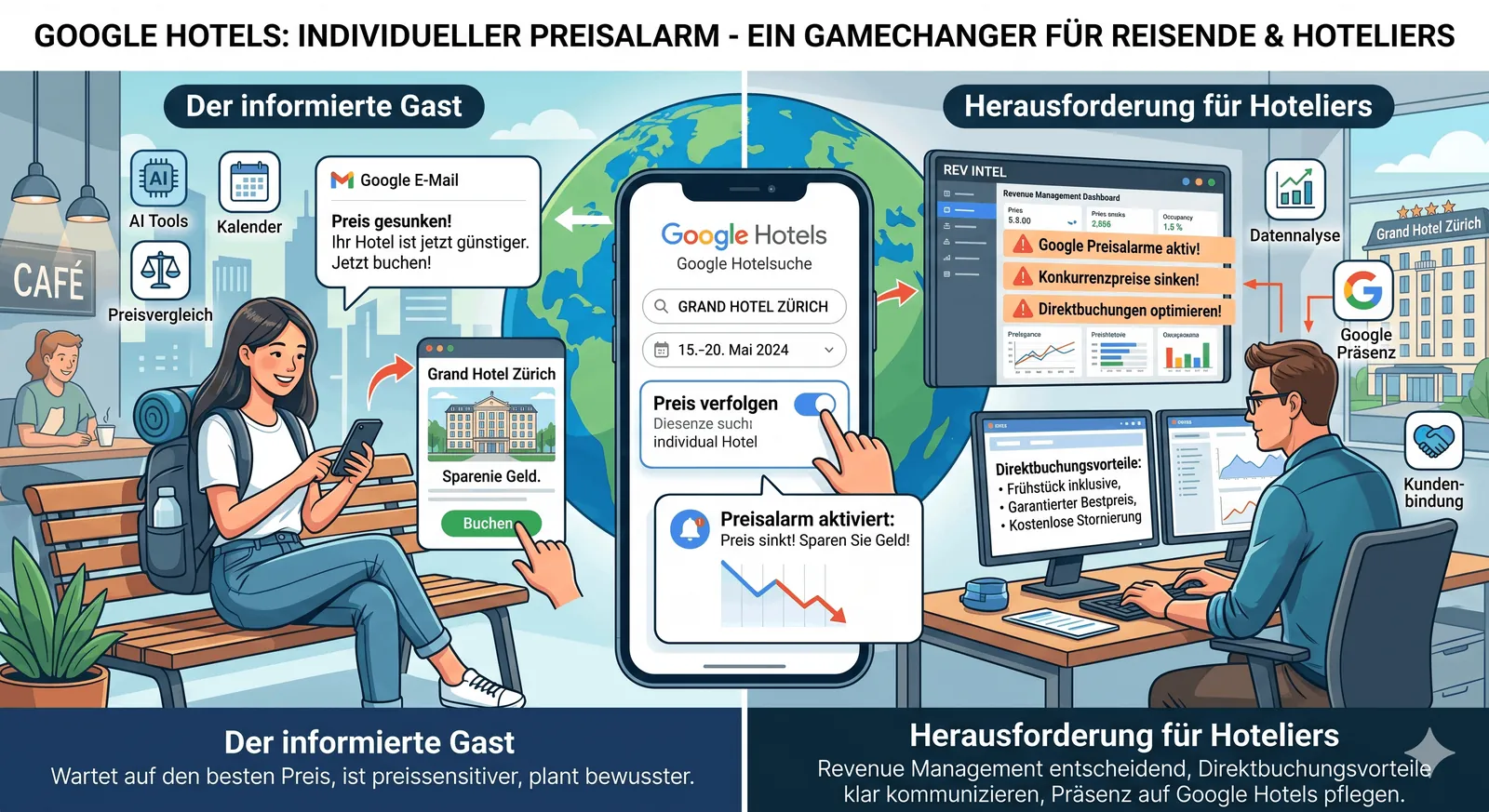
Google has quietly taken its price-tracking feature to a new level: from now on, travellers can not only monitor prices at city level but also keep a close eye on individual hotels — and receive an automatic email as soon as the price for their chosen travel dates changes significantly.
What looks at first glance like a handy travel feature is in reality a fundamental shift in booking behaviour — with direct consequences for every hotel business.
What Google has actually introduced
Via Google Search or google.com/hotels, signed-in users can now activate a price alert for a specific hotel. The system then continuously monitors the price development for the selected travel dates and notifies the guest by email as soon as a significant price change occurs. The feature is available worldwide — in English and Spanish.
Until now, this kind of tracking was only possible at city level — for example "hotels in Zurich" — and worked similarly to Google Flights. Now it is precisely tailored to the individual property.
Guest demand: a clear trend
This feature is no coincidence. It is the answer to a clearly measurable shift in search behaviour:
- Searches related to AI-supported trip planning and booking tools have risen sharply over the past twelve months
- Travellers are planning more deliberately, comparing for longer, and deliberately waiting for favourable price windows
- The trend towards solo travel and longer stays reinforces the desire for individual, precise price monitoring — no longer at city level, but for the specific desired hotel
In short: today's guest is more patient, better informed and more price-sensitive than ever before. And Google is now giving them the tool that reinforces this behaviour even further.
What this specifically means for hoteliers
The guest waits — and Google reminds them to
Anyone who previously had their eye on a hotel had to check regularly themselves to see whether the price had dropped. Google now takes over this effort. This means: guests no longer decide the booking moment spontaneously — they set a price alert and wait. The booking still comes, but only once the price is right.
For hotels with an inconsistent or unclear pricing strategy, this behaviour becomes a problem: whoever is expensive today and cheap tomorrow trains the guest to wait.
Google embeds itself even deeper in the booking process
With this feature, Google once again positions itself between the guest and the booking — this time even earlier and more precisely. As we already described in our article «Google becomes a booking agent..., this is no coincidence but strategy: Google wants to become the central hub for trip planning, price comparison and booking.
Price transparency is now mandatory — not optional
When Google makes a hotel's price development publicly visible and actively notifies guests of price drops, price transparency is no longer a voluntary choice. Every price change — whether tactical, seasonal or born of uncertainty — is recorded, compared and communicated. This places new demands on the revenue management of every property.
What hoteliers should do now
Pursue revenue management consistently
A clear, comprehensible pricing strategy is more important than ever. Anyone who lowers prices arbitrarily loses credibility and trains guests to wait. Dynamic pricing must be based on real demand data — not on gut feeling.
Clearly communicate the benefits of direct booking
If the guest is tracking the price via Google, the direct booking path must show clear added value: free cancellation, breakfast included, best price guarantee. Anyone who fails to communicate a direct booking benefit loses the guest to booking.com — even when the price is identical.
Actively maintain your presence on Google Hotels
For the price alert feature to be available for a hotel at all, the property must be correctly and fully integrated into Google Hotels — including current prices, availability and photos. Anyone with gaps here will not be shown at the decisive moment.
Keep an eye on price history
Google shows guests price trends. This means that the history of a price is also relevant. Hotels should know their own price development and understand how it appears from the guest's perspective.
Conclusion: the informed guest is the new reality
With the individual price alert for hotels, Google has further shifted the information balance in favour of travellers. Today's guest knows more, waits longer and books more deliberately. This is not a threat — it is an invitation to finally put your own pricing strategy, direct booking path and Google presence on a professional footing.
Those who do this will benefit from this feature. Those who ignore it will be caught off guard by Google price alerts — namely when their own price reduction prompts the guest to book, but on booking.com instead of their own website.
Further reading: Google becomes a booking agent...
Do you have questions about your Google presence or direct booking strategy? Contact us for a free initial consultation: tourismusconsult.ch/kontakt
Sources
More related articles:
- Price parity in Switzerland (thematically related: price transparency/control)
- Google Marketing Live 2026 (another current Google feature)
- Metasearch 2026: Is Google Hotel Ads still worth it? (related price comparison topic)