
The budget phase for 2027 has begun — and in many hotels it follows the same pattern as every year: last year's budget gets increased by a flat percentage, without questioning the actual impact of individual channels. Current industry analyses warn precisely against this: anyone who simply carries their 2027 budget forward from 2026 is planning on a foundation that will no longer exist in that form.
The problem in day-to-day hotel operations
Budget planning in most hotels takes place under time pressure — usually in late summer or autumn, alongside ongoing operations. Not surprisingly, the allocation then often follows the previous year: what was spent on Google Ads, Meta Ads or the website is slightly adjusted and carried over to the new year. This approach looks efficient, but ignores the fact that search behaviour, advertising platforms and AI-driven booking paths can change noticeably within a single year. A budget that is merely carried forward rather than rethought plans according to yesterday's rules.
Current developments in 2027 budget planning
- Anyone who simply derives their 2027 budget from 2026 is working from a distorted basis. A current industry analysis warns against spreading growth rates evenly across the whole year when individual months were disproportionately strong due to special events — the result are plans that fail to work out, particularly in individual seasonal months.
- Budget planning has become more complex than pure channel allocation. AI-driven search, changing privacy requirements, rising acquisition costs and shifting travel behaviour increasingly shape how hotels compete for visibility and direct bookings, according to current planning guides.
- The 2027 budget should not look like the 2026 budget. Current planning guides explicitly recommend resetting investment priorities rather than simply backing existing priorities with more budget.
- An honest review of 2026 is worthwhile before 2027 planning begins. Before setting new targets, hotel managers should first evaluate what actually worked during the current year — only then can meaningful assumptions be derived for the coming year.
- The most common budgeting mistakes remain the same year after year. Individual actions instead of a systematic approach, overemphasis on classic advertising without impact tracking, and a lack of performance measurement continue to be among the biggest weaknesses in hotel marketing planning.
What does this mean for your hotel?
1. Evaluate first, then budget
Before setting figures for 2027, it is worth taking a sober look at 2026: which channels actually generated bookings, and which only delivered reach? This evaluation should be the basis for the new planning — not last year's budget.
2. Factor out one-off effects from your planning
If individual months in 2026 were shaped by extraordinary events, major events or one-off demand spikes, the 2027 budget should not simply carry these effects forward. More realistic planning distinguishes between recurring demand and one-off spikes.
3. Plan budget for new visibility channels from the start, rather than reallocating later
AI-driven search systems and changing booking paths continue to gain importance. Rather than reallocating existing budgets over the course of the year, it is worth deliberately setting aside a share from the outset for new visibility channels such as the Google Business Profile or structured, AI-readable content.
4. Plan a larger reserve for adjustments during the year
Developments in search systems, advertising platforms and AI-driven booking paths are currently moving faster than the classic annual planning cycle. Anyone who allocates their entire budget to individual channels as early as autumn has no room to manoeuvre during the year — for example, if new requirements for visibility in AI search systems emerge, or if a previously reliable measure suddenly deteriorates. A deliberately larger reserve that is not fully committed — depending on business size and risk appetite, in the low double-digit percentage range of the total budget — creates the flexibility needed to respond in 2027 to new measures that cannot yet be foreseen today.
Common mistakes
- Simply carrying the previous year's budget forward. Without analysing what actually worked, the same allocation repeats itself — regardless of whether it still makes sense.
- Budgeting for individual actions instead of a well-thought-out annual plan. Isolated campaigns without a system make it harder to compare success over the year and learn from it.
- Planning performance measurement only at year-end instead of continuously. Anyone who only checks in December whether the budget was used correctly loses valuable time to make adjustments during the year.
Conclusion
The 2027 budget phase is an opportunity not simply to carry things forward, but to reprioritise. Anyone who first honestly evaluates what actually worked in 2026, factors out one-off effects, plans budget for new visibility channels from the start, and keeps a noticeable reserve open for adjustments during the year, enters the new year on a significantly more realistic footing. The most important step is not a higher total sum, but the willingness to fundamentally question your own budget logic once a year and leave room for the unforeseen. Which assumption in your current budget would actually not withstand such scrutiny?
Sources
- Gourmet Marketing: Your 2027 Hotel Marketing Budget Is Built on a Year That Had the World Cup in It
- Cendyn / Hotel News Resource: Downloadable Guide: Your 2027 Budget Shouldn't Look Like Your 2026 Budget
- Actabl: Hotel Budget Season: How to Prepare for 2027
- Das KI-Magazin: Marketing budget hotel marketing — lower costs, more effectiveness
Further related articles
- Online marketing for hotels: which channels really pay off in 2026 – and what they should cost
- The winners in hotel marketing build systems, not isolated measures
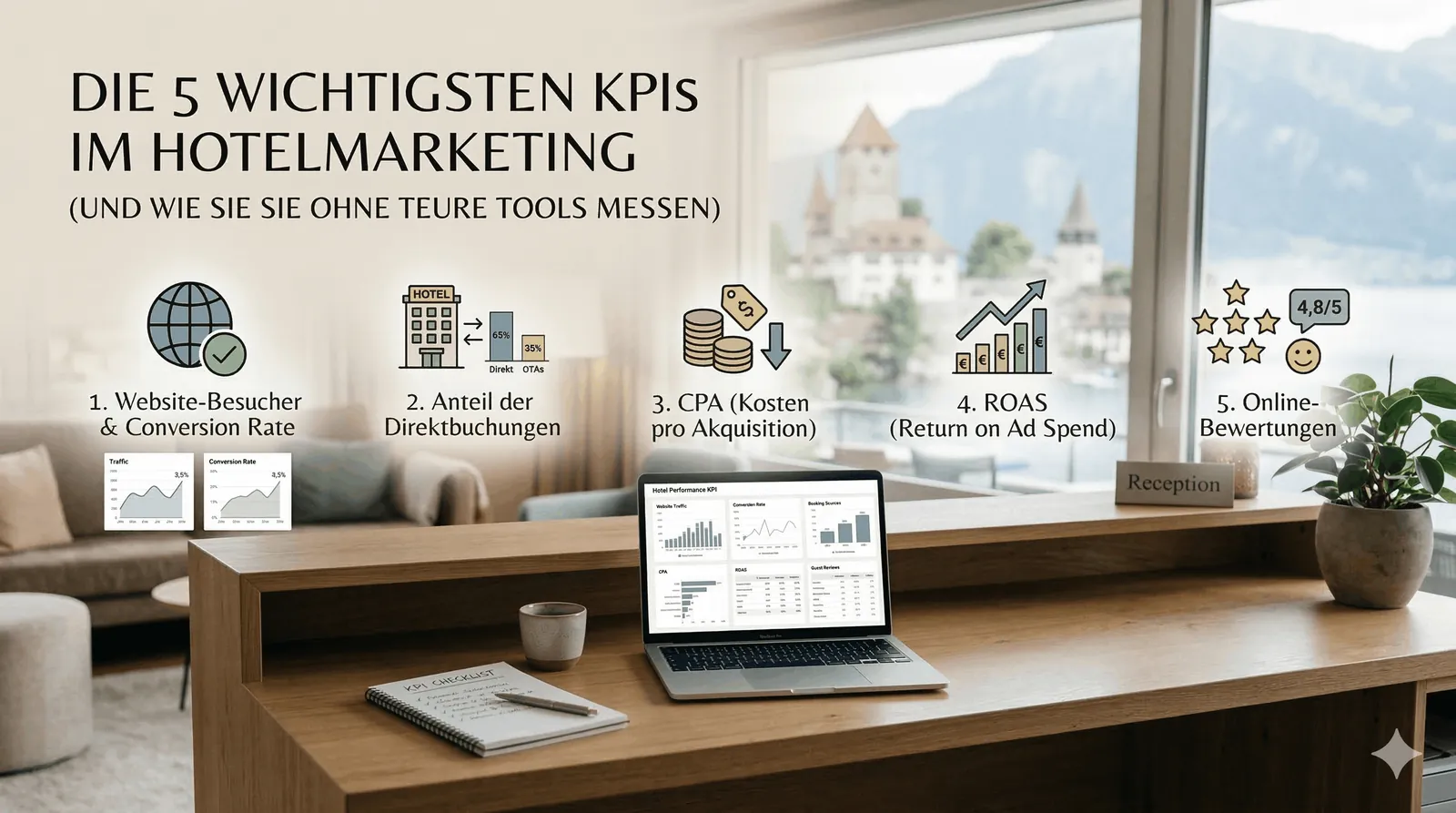
- The 5 most important KPIs in hotel marketing (and how to measure them without expensive tools)
- Why don't hotels have their own AI budget – and what does that really cost?