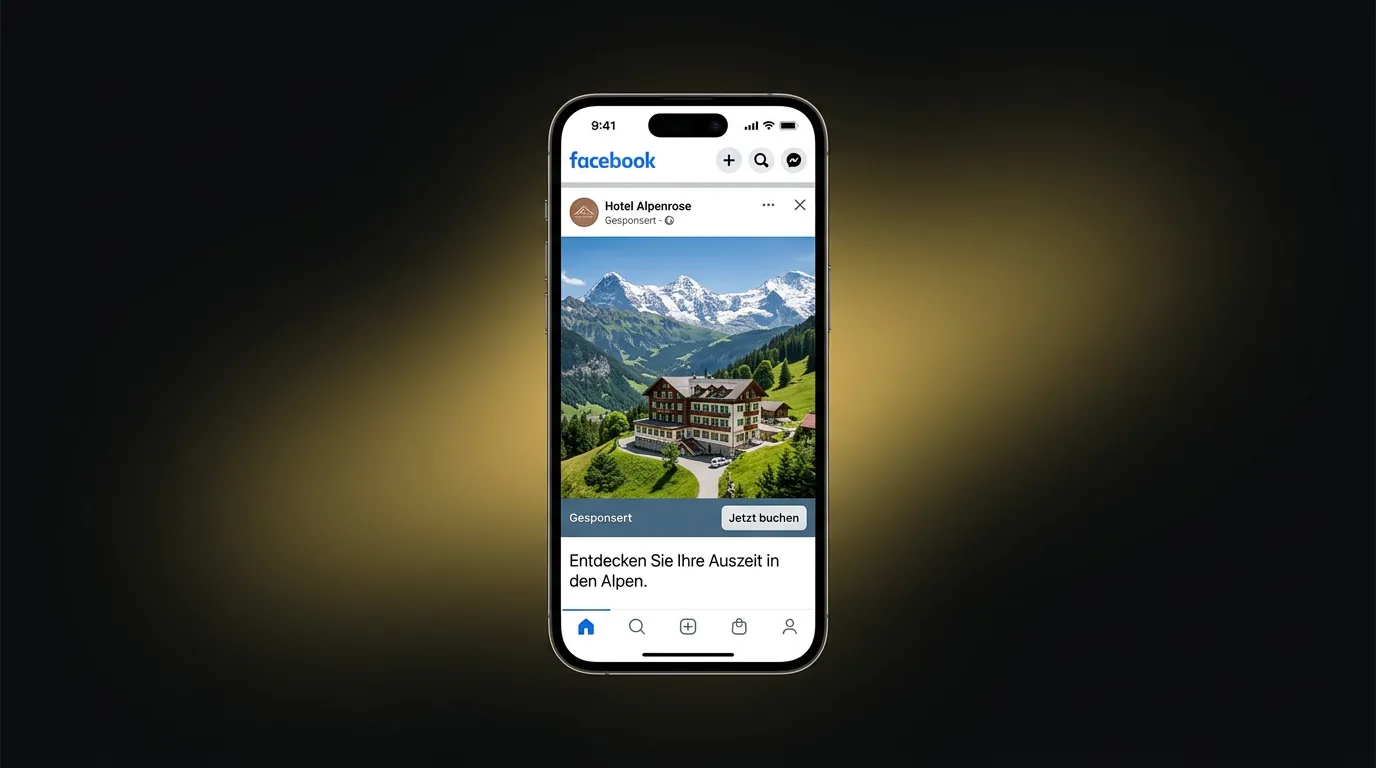
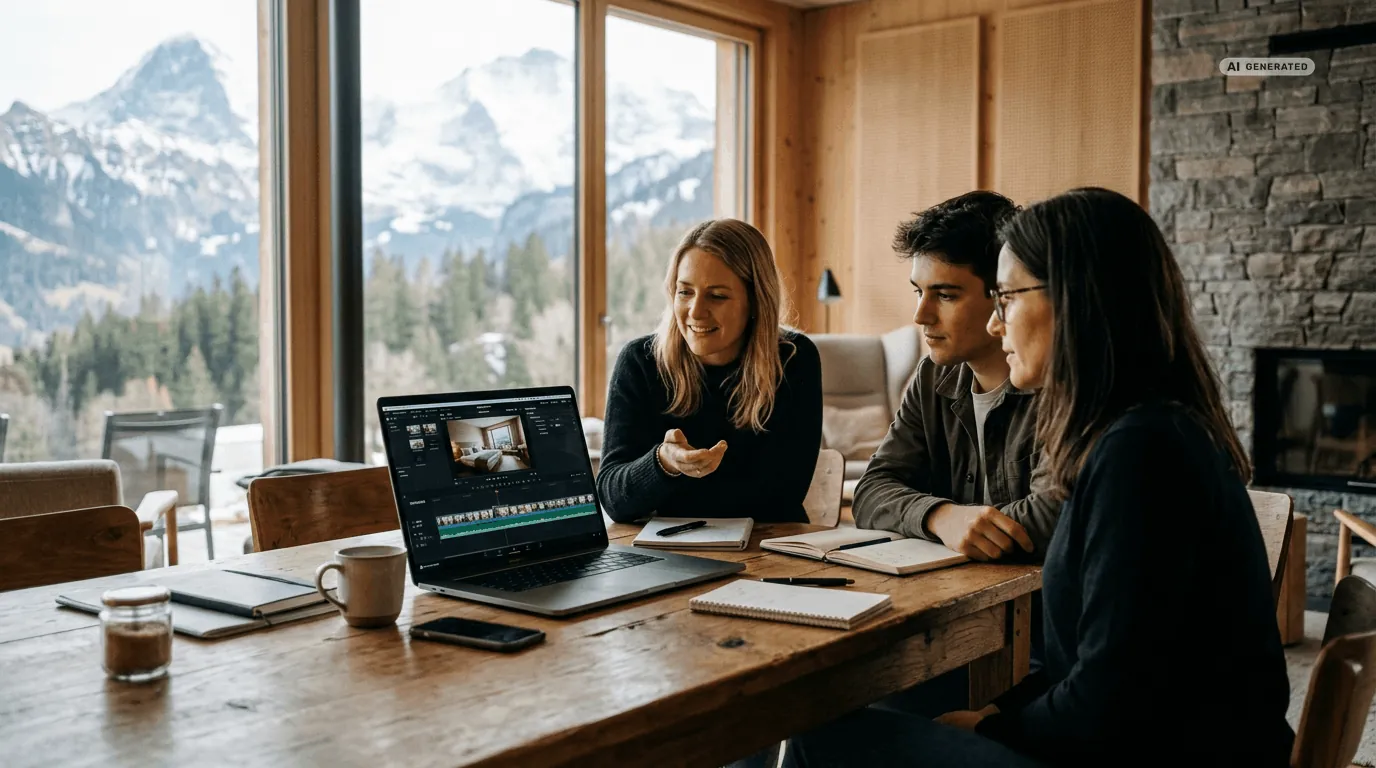
An ad clip showing guests at breakfast on the sun terrace — generated from a few existing photos, without any new shoot. What sounded like science fiction two years ago is now a few clicks in an AI video tool. Video ads have long been considered the most effective ad format for hotels — but production used to be expensive and slow. That is now changing fundamentally, and the first major studies on AI-generated ad videos are now available. Time to decide based on figures rather than gut feeling.
The everyday problem for hotels
Most Swiss hotels have no dedicated video team and no budget for regular productions. A professional ad video quickly costs several thousand Swiss francs and takes weeks — from planning through filming to editing. The result: many properties have been running the same two or three video clips for years, while platforms have long rewarded fresh, frequently changing creative. Those who do not deliver new image and video material regularly lose visibility and end up paying more per booking.
Latest findings from the study and industry event
A large-scale study by the Technical University of Munich, Columbia University, Harvard University and Carnegie Mellon University, conducted together with the performance advertising platform Taboola (now "Realize"), analysed over 500 million ad impressions and around 300,000 ad creatives. The key findings:
- AI ads perform on par on average. After statistical adjustment, the click-through rate of AI-generated ads was at the same level as human-produced ad creatives — so scaling does not automatically come at the expense of quality.
- What matters is that the ad does not look like AI. Videos that users did not recognise as machine-made achieved the highest engagement — even ahead of classic ads.
- Human faces build trust. A clearly recognisable, naturally looking face in the video was the single most important factor for trust and interaction.
- Quality beats origin. Our own campaign practice shows the same effect: high-quality AI-produced videos regularly outperform quickly and carelessly assembled generic clips — regardless of whether a human or an AI is behind the production. What matters is care in selection, refinement and context, not the tool alone.
- Labelling requirements already apply. Since August 2026, AI-generated or AI-edited ad videos and images must be labelled in the EU. Major platforms such as Google Ads, TikTok and Meta have introduced corresponding features. Since Swiss hotels mostly advertise on these European platforms, the requirement affects them directly as well.
What does this mean for your hotel?
1. Use AI for speed, not as a replacement for care
AI video tools are excellent for quickly generating several variants from existing photos and texts for A/B testing. But this does not replace quality control: every clip should be checked before going live — tailored to hotel marketing, this mainly means: do the facade, room furnishings and surroundings match reality?
2. Rely on real faces and real places
The studies are clear: a video with a real employee, a genuine guest testimonial or a recognisable reception desk appears more trustworthy than a purely generic AI scene. Use AI rather to animate or supplement existing material than to create entirely new, impersonal scenes.
3. Label AI content correctly and on time
The labelling requirement for AI-generated ad creatives also applies to Swiss hotels advertising on European platforms. Those who integrate this cleanly into their processes now save themselves adjustment stress later on and show guests transparency — a trust factor that stood out explicitly and positively in the study.
Concrete practical example (fictional example)
The following example is entirely fictional and serves only to illustrate how the study results described above could play out in practice. It does not describe a real hotel.
Starting point: A fictional 24-room boutique hotel in the Bernese Oberland would have only two video clips available for its Meta campaigns from its last professional shoot three years ago. The click-through rate of its ads would have been declining for months, and the ad budget would be delivering fewer and fewer bookings per franc invested.
Action: From existing photo material and short mobile-phone footage of the receptionist, an AI video tool could be used to create six new 15-second variants — for example, one video with the real employee showing the view from the breakfast terrace, plus two room loops generated purely from photos. All six variants would be run simultaneously as part of an A/B test, with AI-generated portions labelled according to the applicable platform rules.
Expectation: The variant with the real employee would, as expected, achieve the highest click-through rate and the lowest cost per booking enquiry. The purely synthetic room loops would perform solidly but noticeably weaker. The hotel could conclude from this that it should test two to three new AI-supported variants per month, combined with at least one real face per campaign.
Common mistakes
- Fully synthetic scenes with no human connection at all. Such videos often feel empty and fail to build trust — especially for an emotional product such as a holiday booking.
- Missing or incorrect labelling. Those who fail to correctly mark AI-generated ad creatives risk platform blocks and lose credibility as soon as guests notice anyway.
- Running a single video for months. The greatest advantage of AI video is fast, low-cost variant creation — those who do not use this advantage for ongoing testing give away the actual potential.
Conclusion
AI-generated videos are no substitute for good communication for hotels, but they are an effective tool for producing more variants for paid ads faster and more cheaply. The studies show: those who use AI wisely — with real faces, real places and clean labelling — can keep pace with human-produced material or even surpass it. Those who instead rely on purely generic, impersonal clips risk ads that look polished but simply perform weaker, without this being immediately obvious. The difference rarely lies in the tool, but in how consciously it is used. A good occasion to take a critical look at your own stock of ad videos.
Sources
- Taboola/Realize, Columbia Business School, TU München, Harvard University, Carnegie Mellon University: "AI Ads That Work: How AI Creative Stacks Up Against Humans" (2026), cited in: MEEDIA, "Eine neue Studie zeigt: KI-Werbemittel funktionieren" (29 January 2026), https://meedia.de/news/beitrag/21013-eine-neue-studie-zeigt-ki-werbemittel-funktionieren.html
- Google Ads: announcement of new labelling options for AI-generated or AI-edited images and videos in Google Ads, DV360, Campaign Manager 360, Merchant Center and Ads Editor, rollout from July 2026, https://ads.google.com/
- Practical experience from Tourismusconsult's own paid ads campaigns (2026)