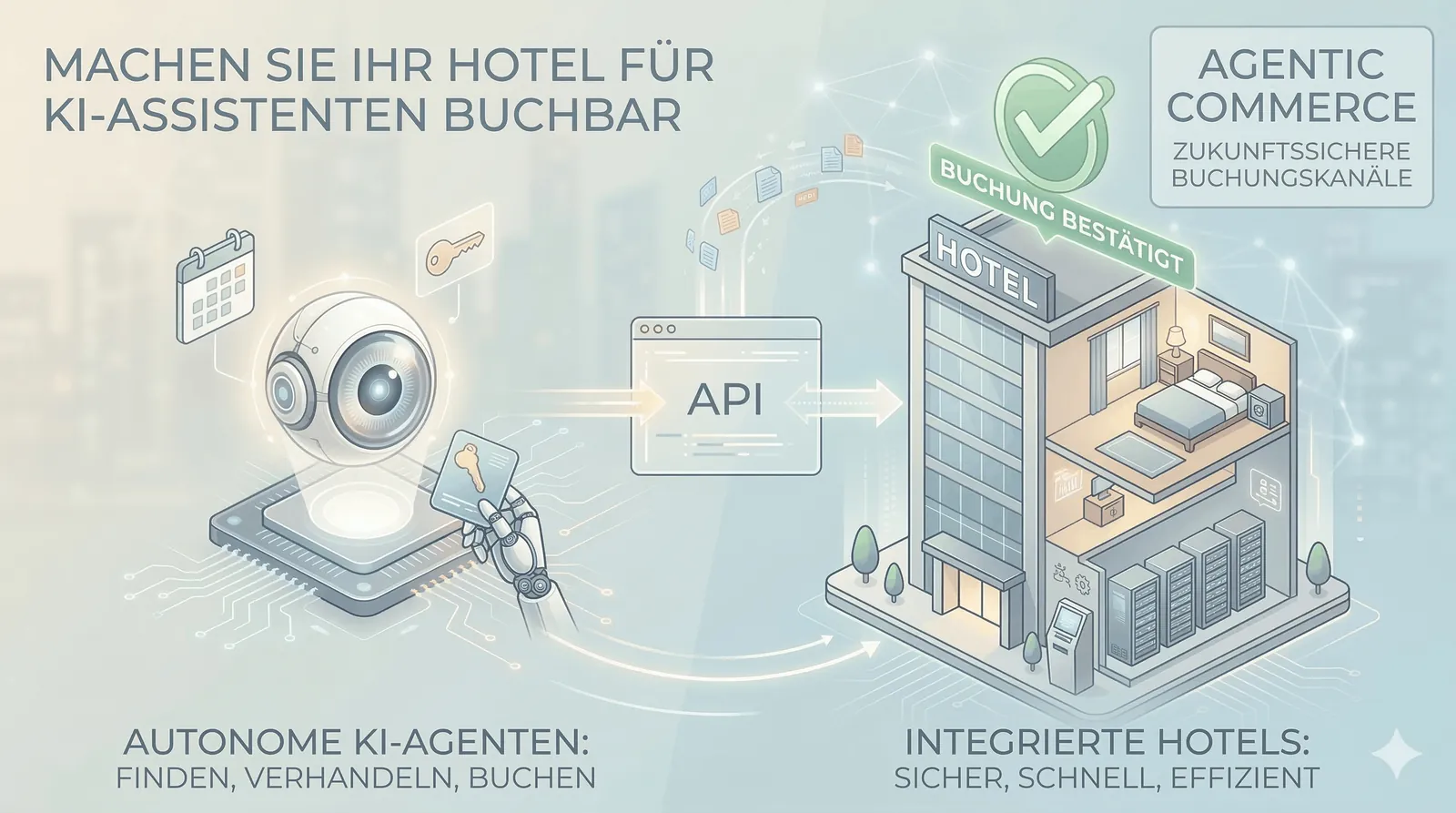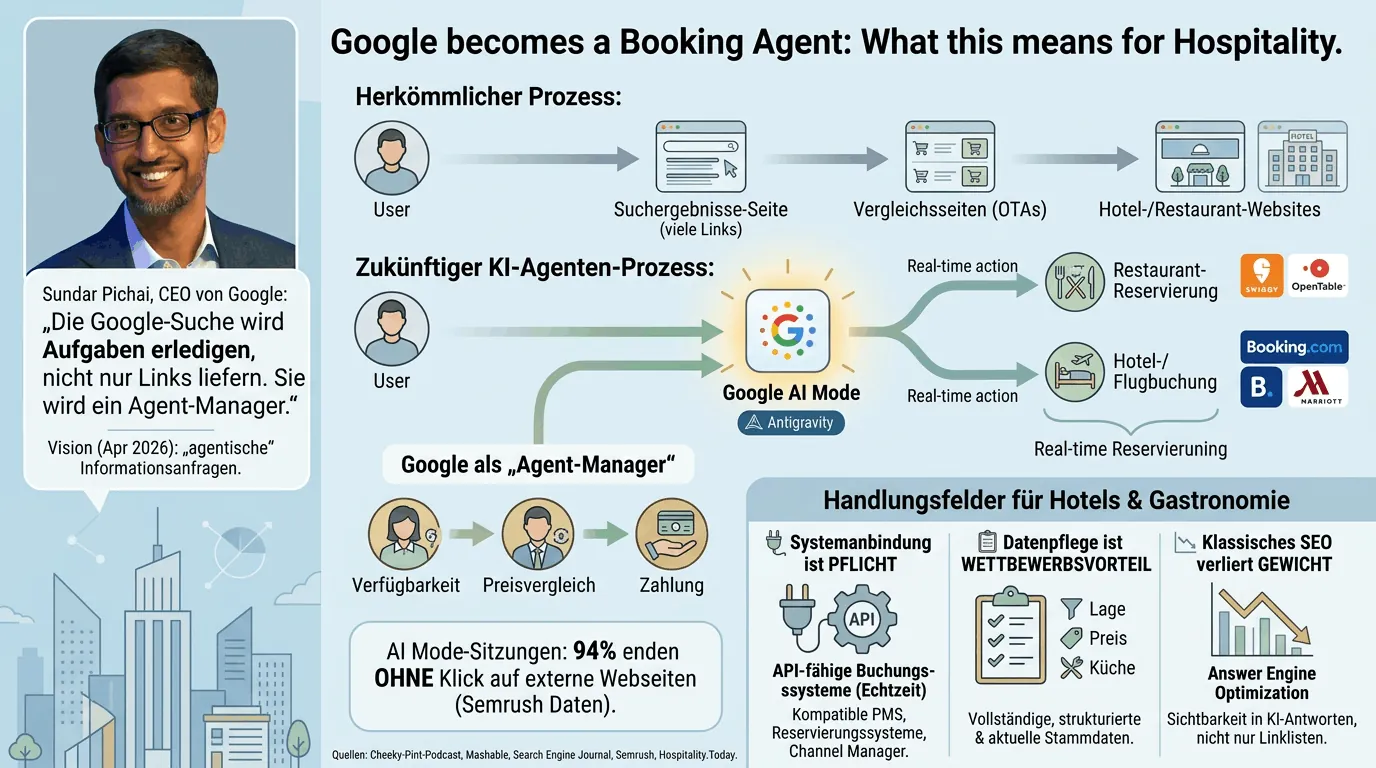
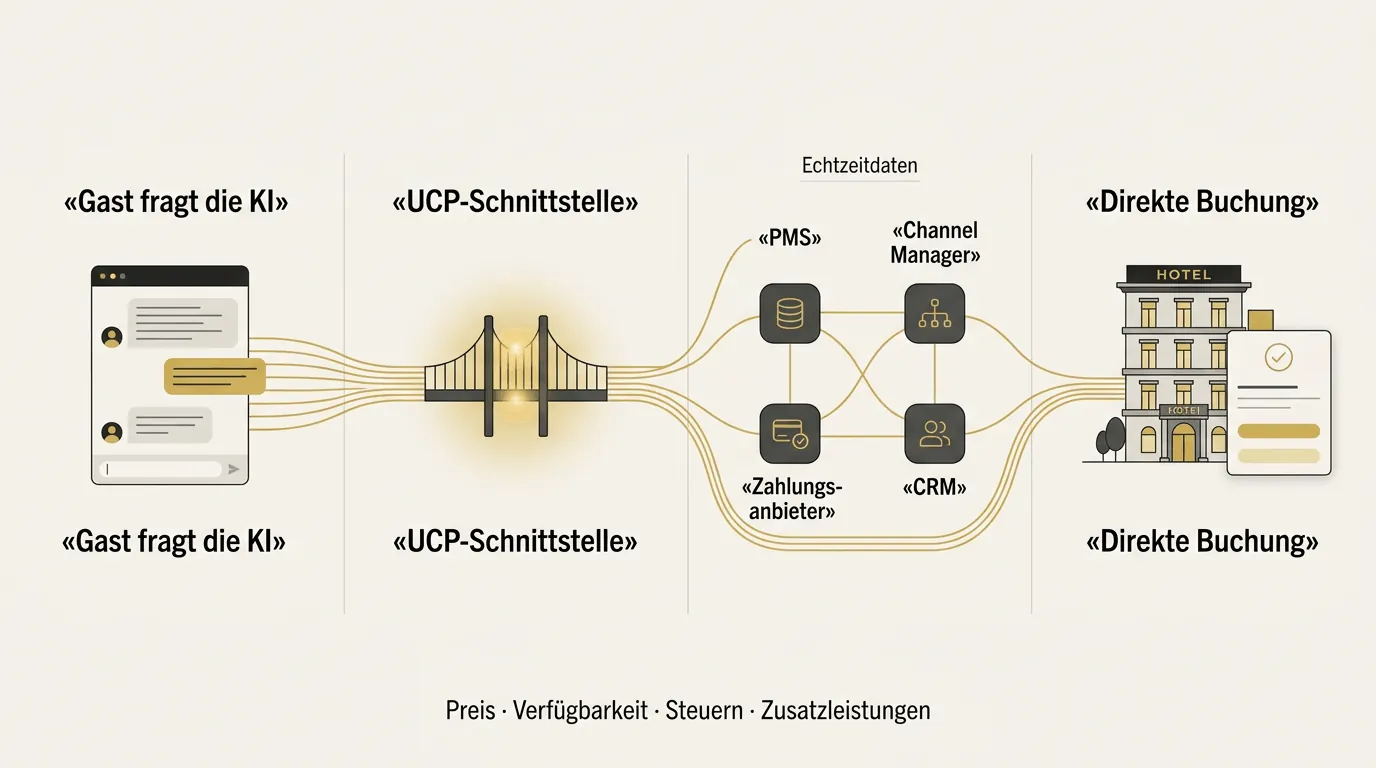
Google has introduced the «Universal Commerce Protocol» (UCP), an open standard now being extended specifically to the hotel industry. The goal: users should soon be able to book a room directly from within an AI conversation — without the detour via a website or booking portal. For hotels that have so far focused on «visibility in Google search», this creates a new, technically more demanding layer: visibility as a bookable unit within an AI conversation. Those who understand the principle early can position themselves in good time, instead of playing catch-up later under time pressure.
Problem in everyday hotel operations
Many hotel businesses have put a lot of energy into their own website and booking engine in recent years — rightly so. But the new AI booking channels work differently from a classic website: they require structured, machine-readable interfaces through which availability, prices and booking processes can be queried in real time. A normal booking form on the website is not enough for this. Most small and medium-sized hotels have neither their own IT department nor a direct interface to their property management system (PMS) that would be ready for such requests. The risk: while large chains and platforms take part in pilot projects early on, owner-operated businesses are left out — not because their offering is worse, but because the technical connection is missing.
Latest from the announcement
Google has made the protocol and the corresponding FAQ publicly accessible. The key points for hotel businesses:
- UCP is an open standard originally developed for digital commerce and now being extended specifically to the hotel industry («Lodging»). The goal is to enable an immediate, direct room booking from within an AI conversation.
- The booking is meant to take place directly within Google surfaces, in particular in the «AI Mode» of Google Search. There, a user could describe a room, compare offers and book without switching websites.
- The hotel remains «Merchant of Record»: Google explicitly emphasises that customer data, the customer relationship and control over the transaction remain with the hotel — not with Google.
- UCP is compatible with existing standards such as AP2 (Agent Payments Protocol), A2A (Agent-to-Agent) and MCP (Model Context Protocol). No separate Google Pay integration is required for payment processing, though your own payment provider must be able to process the payment tokens used.
- A real-time comparison of price and availability takes place directly with the hotel's interface before every final booking. An outdated or static price list is therefore not sufficient for UCP.
- The integration is not meant to affect ranking: Google explicitly states that participation in UCP has no influence on how a hotel is displayed in search results or price comparisons.
UCP for Lodging is currently still in the preparation phase: interested businesses and technology partners can register for access via a waitlist, with detailed technical specifications to follow.
What does this mean for your hotel?
1. Your booking data must be machine-readable and up to date
UCP only works if availability, prices, taxes and fees can be retrieved in real time via an interface. A hotel whose PMS or channel manager does not offer an open, up-to-date API cannot take part in this system for the time being — regardless of how good the offering otherwise is. It is worth clarifying early on with your own PMS provider or channel manager whether and when a UCP-compatible interface is planned.
2. Control over the customer relationship remains — but only if you are technically prepared
Google makes clear that the hotel continues to be «Merchant of Record» and owns the customer data itself. This is an important difference from classic booking portals. However, for this advantage to become real, a system is needed that cleanly transfers guest data from a UCP booking into your own CRM or guest records — otherwise the advantage goes unused.
3. Check payment processing early
Even though no Google Pay integration is needed on your own website: your own payment provider must be able to process the payment tokens used by Google. A conversation with your current payment provider (or the booking engine handling payment processing) will clarify early on whether any retrofitting is needed.
Common mistakes
- Waiting instead of checking your own data foundation. Those who only react once UCP is widely rolled out lose valuable lead time for technical preparation.
- Confusing UCP with a pure marketing measure. This is a technical booking interface, not an SEO or advertising campaign — implementation lies primarily with the PMS and IT, not with the marketing department alone.
- Underestimating payment issues. Those who don't clarify early on whether their own payment provider can process the necessary tokens risk a technical bottleneck later during rollout.
Conclusion
UCP for Lodging is not yet a finished product but an announced standard with a waitlist — yet the direction is clearly recognisable: bookings are meant to take place directly within AI interactions in future, without the detour via a website or portal. For Swiss hotels, this means above all one thing: the technical foundation — clean, up-to-date and machine-readable data on prices and availability — becomes the decisive competitive factor, even before the first guest actually books via an AI assistant. It is worth starting the conversation with your own PMS and payment provider now, rather than reacting only once the standard is already widely available. Those who put their data foundation in order today will be ready to act faster tomorrow — regardless of which AI system ultimately prevails.
Sources
- Google Developers: Universal Commerce Protocol (UCP) for Lodging
- Google Developers: UCP for Lodging – Frequently Asked Questions